
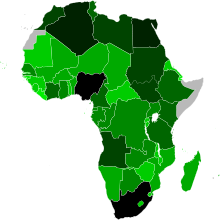
The above map shows the GDP distribution in Africa in 2012. The darker the colour, the richer the country relatively. Africa is still the poorest continent by some distance so even the darker shaded countries are not exactly doing well on a global scale.
The UK's decision to end aid to South Africa looks sensible on this view. South Africa is clearly a wealthy country by African Standards and despite many claims to the contrary, the economy has not collapsed since the end of apartheid and instead has shown modest growth; the major downside is unemployment at 23% which is both high and hard to bring down. South Africa is hardly alone in the world though at struggling to provide jobs when the population growth is 1% a year.
South Africa has reacted saying that it wants aid, this is a bad sign of a kleptocracy however that sees all foreign money as adding to the purse into which hands can be dipped. Compare and contrast the South African response today:
This is such a major decision with far reaching implications on the projects that are currently running and it is tantamount to redefining our relationship.
Ordinarily, the UK government should have informed the government of South Africa through official diplomatic channels of their intentions and allowed for proper consultations to take place, and the modalities of the announcement agreed on.
with responses printed in the Guardian to the withdrawal of aid from India:
Indian experts from across the political spectrum welcomed the aid move. Surjit S Bhalla, a Delhi-based consultant and former World Bank economist, said the British decision was "enlightened". "I don't think it makes a huge amount of difference. The whole concept of aid is very old and not necessarily relevant for modern times. These programmes were constructed when India and emerging nations were very poor," he said.
Instead, Bhalla said, investment should be largely focused on technical assistance in key areas such as sanitation or solar power in villages currently without electricity. The Indian government already ran a range of vast and often very wasteful welfare programmes. Compared with government expenditure on subsidised gas, for example, the British contribution of £280m annually was minimal, Bhalla said.
Dunu Roy, of the respected Hazards Centre, which supplies research to Indian NGOs, said his reaction to the news was "good riddance". "All aid was tied up with conditionalities so hopefully now Indians will have a better chance of doing what they want," he told the Guardian.
Jayati Ghosh, a professor of economics at Jawaharlal Nehru university, New Delhi, said she did not think too many people would notice the end of British aid. "It is not that there are no minor successes, but in general the nature of the spending has not been such that it will really be missed. It had a tendency to follow the latest development fashion. So it was privatisation, then microcredit and now conditional cash transfers. It made little positive difference."
Grown up countries do not even want aid. This is before even mentioning a great article on the BBC this morning which discusses the rise of orphanages in Cambodia to meet the demands of 'volunteer' tourists.
It is such a difficult moral subject Aid, that I do wonder why it is such a lodestar of the current government. There is much to be said for a more realpolitik approach to aid, at least we can see some of that now with the big recipients being Afghanistan and Pakistan.

