Wednesday, 28 March 2018

Lightening the Tone

It's all been a bit heavy of late, n'est-ce pas?  So let's lighten up.

Several years have elapsed since I last moaned (and you all jumped in) about the illiteracy of public discourse - not least in the writings of supposedly, err, educated Grauniad writers.  My bugbears on that occasion were the copiously misused terms elide, kudos and failsafe.

I have another.

It's hapless.
Don’t mock the ‘hapless’ Brexiters – they are still pulling all the strings
In America, Trump voters see any criticism of their hapless president as an attack on themselves
... holding signs aloft that decried endemic American gun violence, hapless politicians and the extremist gun rights movement
All from the Graun over the last few days.  Manifestly, most people think it means something like an erudite combination of hopeless and useless.  And it doesn't.

Your favourite bĂȘtes noires

ND

Tuesday, 27 March 2018

Jeremy's Judgement Revisited - Facebook, too

... and if we thought he'd screwed it up on Russia ...

But this latest one, well - stand back and light the red touch-paper.  Tough shit, Jezza, but you definitely had it coming.

Still, check the BTL comments on the CiF link; they are pretty much 50:50.  The Jeremy-right-or-wrong horde is still out there.  Does anything dent their ardour, does anything ever stick?  

GE 2017 notwithstanding, I think it does: four years is still a very long time.  Long enough for detailed memories to fade, for sure; but also long enough for residual dirt and doubt to hard-bake, as Kinnock found out.  And Corbyn will be generating dirt and doubt for as long as he is in the public gaze: he is a dubious and politically dirty old man.  One of the CiF-ers describes him as "the acceptable face of McDonnell", but I'm not sure John-boy will find him quite as useful an idiot as heretofore.  Cult leaders are sometimes worshipped, sometimes torn down and trampled.

Anyhow, a couple of other significant points, both of which have almost been lost in the noise (except on the Beeb and in the Graun, ironically, because they'd really rather talk about something else).  Firstly, May's triumph of diplomacy on the Russian front continues to snowball.  The Beeb reported yesterday that the Russians have described other nations expelling diplomats as "puppets of British policy", which must bring a smile to her face.  Of course, we know the euro-wallahs will be busily trying to parlay this into - See, it's best if you don't leave after all - but they are incorrigible and we may diskard them uterly.

But here's one you may not have seen.  It's a fairly thoughtful worry-piece from Labour List (not a typical link-destination of ours) bemoaning the fact that Labour's extremely successful GE 2017 media strategy had Facebook-optimisation squarely as its centre of gravity (I happen to know that one of Momentum's first actions was to set up a highly tech-savvy social media team) - so what on earth are they going to do now?  

What indeed!  Well moan away, chaps, because for once, asymmetric political warfare is going to work against you.   For I can exclusively reveal that the Wicked Tories had no such FB-based strategy ...

The weather may be rubbish this month but just now the political climate, after a long cold lonely winter, is positively balmy.  Here comes the sun?

ND  

Friday, 23 March 2018

Weekend Read: Defining "Solidarity" in Law


How do you define a fuzzy, abstract concept into law?

Some while ago I wrote about the European "Energy Union", a classic piece of acquis-grabbing-by-stealth from the EC.  There were follow-ups here, here and here.  For what it is worth, the Energy Union was one of the straws that broke this particular camel's back as regards Brexit.

Anyhow, while it may be of diminishing future significance for the UK, something moderately interesting has come of all this.  Because it is now compulsory for EU nations to render "solidarity" to each other in times of dire shortage of natural gas - I think we know where this finger is pointing ... yes, you over there in the East! - and because actually it's just a warm word (for all the euro-wallahs bandy it around like a comfort blanket), the EC is trying to define what "solidarity" might mean in law.

And very necessary, too! - if you insist on this type of prescriptive Civil-Code stuff.   Although these rules aren't yet in force (so the UK made no call on solidarity back at the cold end of February, relying instead on the market) we recall that gas didn't flow our way as one would ordinarily expect when quite exceptional prices were on offer.  Yes, those Good Europeans are - of course - self-interested bastards who need to be dragged by lawyers and regulators to carry through on their hallowed *principles*.

I realise this EC doument's earnest word-smithery may be of limited interest to many readers but personally, though not a lawyer, I enjoy such sub-philosophical endeavours.  It's all in the small print.  And below are some of the things we find amongst this new euro-babble:
  • You'll have to pay "fairly and promptly" for any "solidarity" (i.e. gas!) received;
  • The "fair" price is assumed to be "not lower than market price (+ costs)", for fear of "perverse incentives" (see, they have been listening to 20 years of the UK telling them what can go wrong with interventionist energy policies);
  • All market mechanisms need to have been deployed first (ditto); 
  • Solidarity doesn't give one state any authority over another; 
  • All subject to Fundamental Rights (which I take to be a get-out clause).
What might this remind you of - if you were German?
I have a feeling certain eastern euro-nations might have been hoping for something a bit less mercenary than this.  And, needless to say, if the market mechanisms are working properly, none of it should really be required at all.

Unless, that is, Russia cuts up really rough.  In which case, (a) frankly, all bets are off.

But ...  (b) those of us *ahem* old enough to remember the 1973-74 oil crisis will recall OPEC cutting up really rough.  On that occasion a rather effective ad hoc intervention swung into place.  The forerunner of the IEA was told by the OECD to sort it out and, adroitly commandeering a powerful linear programming tool sitting in Exxon's HQ in New Jersey, this team allocated the whole Free World's available stock of crude oil based on whatever principles it deemed appropriate.  Oil was tight, but it all sort-of worked.   

See, even avowed free-marketeers can allow for state / super-state interventions when the chips are down ... preferably by people who are competent - which, as well as technical capabilities, includes having market instincts that are strong!  

By now you'll have decided whether the EC document is of interest to you ...  A pleasant weekend to all, whatever you're reading.

ND

Thursday, 22 March 2018

Still a long road to normality: Update

The US raised interest rates yesterday, as did China following suit. It is a very long road back to financial normality after a financial crash of the like that we had in 2008 (on average 19 years historically, so we are only just over half-way!).


However, in the UK we have a particularly dovish Bank of England Governor at the moment in Mark Carney. This week has seen wage growth pick up and the economy continue to modestly improve alongside record employment. Few commentators or even economists seem to notice that with near full-employment the days of rapid economic growth are gone - all improvements have to come from either improving productivity or investment, neither of which is easy to do in the UK economy. The days of just hiring more migrants on shit wages and declaring economic nirvana as nominal GDP rises are over - THANK BREXIT FOR THAT!


Still, the Bank of England is left with a choice today, does it raise interest rates again? The Bank will likely decide to wait another month or two to see what is happening in the economy and take a view that the awfulness of Brexit means that it should stay with very low rates.


Which is a shame because we won't get investment levels from companies up and from individuals whilst the saving rate remains so low. All we see now is the continuation of the nightmare economy where the already rich borrow very cheaply and make easy returns; whilst the small companies and business are starved of capital holding back productivity gains.


Of course, too high rates can stall the economy; food retailers and general retailers are already struggling in an easy money environment so won't cope. But the wider economy will not recover its vigour until we move back to a more 'normal' economy - its a difficult balance to achieve but the Bank of England really needs to get its Hawkish skates on to fix the economy.


UPDATE: BOE holds rates, murmurs about doing something next time, circumstances allowing etc etc.

Tuesday, 20 March 2018

Do we care if it is Brexit surrender?

With a Remain Prime Minister, Chancellor and Home Secretary, the days of worrying/hoping for a hard Brexit have long since passed.


The EU are good at negotiating too (short-term, long-term their game is terrible, hence Brexit in the first place).


But Remoaners are going to complain what is the point if we end up with worse terms than we had, so they will never be happy.


Arch-leavers will be unhappy with all the concessions, but they always would be. Hard Brexit was the worst option in many ways and with such a close referendum would have caused as much split in the Country as a pure remain vote.


Personally, I voted mainly to gain some control over immigration, despite all the concessions, when the transition period is over this will be the case. We will be able to hold our own politicians to account for border control once more.


If we had to make plenty of concessions elsewhere, then that in the round is a good negotiation strategy. I am sure plenty of the Government's red lines were never intended to be such a thing, just as the EU's were not.


In the round then, things seem to still be going as well as can be expected. I can't see how they could be going better in the circumstances, once you filter for all the media noise.

Monday, 19 March 2018

Jeremy's Judgement

We've had two solid threads on the rights and wrongs of the nerve-gas business; and the actions and reactions; the knowns and unknowns, etc etc.  Our old friend Raedwald stirred up an even longer one  last week (- and it seems to have changed his mind on the matter).  My interest here lies in how May and Corbyn have reacted to it all, in base political terms.  I'll start by chipping in with three related points on the path to this realpolitik.

1.  Nations do indeed behave in extreme and spiteful ways, displaying crass bad judgement and, often, to the detriment of their own interests.  Let us merely recall the sordid epsiode of the Rainbow Warrior, perpetrated by none other than our good democratic neighbours the French.  This cuts both ways.  It means that to claim Putin would never have done anything like that is daft; but at the same time, you can take it as the basis of any false-flag hypothesis you wish to dream up.

2.   As Misha Glenny said in an interview before the recent screening of McMafia, when you meet an educated Russian in a suit, he might be: a businessman; an FSB agent; or a gangster - or all three.  For many purposes, "the Russians" is a term lacking today in precise definition, but nonetheless means something for the purposes of geopolitics.  It is clear Putin's government is thus able (at a superficial level of plausibility), and willing, to disavow literally anything - including a corps-scale attack on a neighbouring country.  In such circumstances, taking measures such as May has done against "the Russians" seems rather more appropriate than is being asserted in some pedantic quarters.

3.   On the subject of legalistic pedantry, it's always easy to find fault with any type of reaction or retaliation if one adopts the standards of a court of law and requires the matter to be beyond all reasonable doubt.  This, I fear, is the tone of a good many comments, here and at Raedwald's and elsewhere.   OK, we've all read David Hume; we can all summon up a 'doubt', or hatch an alternative explanation for anything (see 1. above) if we put ourselves to the challenge.  But it's not a court of law, it's the court of public opinion.  And given the present situation in Russia (see 2. above), to indulge in lawyer-like hair-splitting on judgements about Russian actions is to misapply a concept - a waste of breath.

Mrs May's Response

We all know what she's done; and given her utterly dismal showing against Hollande over the Hinkley contract when she first came into office, I suggest it's been a whole lot better than one might have feared - not only in its speed and tone of delivery, but in the way she has enlisted Macron, Merkel and Trump.

Note, in passing, the Macron / Merkel aspect to this.  They are keen (very keen - trust me on this one) that future security cooperation with the UK isn't to become some sort of Brexit issue.  So it behoves them to stand up and be counted, right now.  As they have done.  And - be it further noted - both France and Germany have been known to shuffle to the back of the room on security matters in the past.  Credit where it's due: to them, and to May - for once. 

(And for what it's worth, the public seems to agree in the ratio 5:1.  How this translates into votes is anyone's guess.  An Iron Lady moment?  Let's not get ahead of ourselves.) 

Mr *spits* Corbyn's Response

Sorry about that, I was just clearing my throat.    Well yes, we all know his instincts.  UK Bad, Everybody Else Good.  Corbyn Always Right.  Corbyn Never Backs Away.  So off he goes, to be disowned immediately and publicly by his parliamentary colleagues in large numbers.  As I've read it described, this actually discomfited him acutely and visibly.  But still, no backing down, no disowning the reptilian Milne.

So (presumably with a weary sigh) his office is obliged to make the best of it.  More; they are required to give him a line that can be written down in black and white, released to the outside (and rather hostile) world.  More still; it must come across as Jeremy Undaunted, Corbyn Courageous.  Never backing down; always right.

Well, they followed their brief.  The neat line in truculent sophistry they came up with is this:  I vehemently and resolutely insist that either Russia did this dastardly deed, OR some of those nasty chemicals (that seemed once to be in their possession, can't think how that happened) did it without their knowledge.  And this stern and unequivocal accusation by me must be followed up with resolute and proportionate action.  See how firm and fair I am.  Did I mention how firm I am?  And unbending.  And always right.  You can tell, can't you, from my righteous demeanour.

The trick is transparent (and, by the way, demonstrates he is in fact afraid of being labelled a Putin apologist: because this isn't even remotely an unequivocal statement - either of what he really believes, or 'what he ought to say'.  He actually wants to be able both to pretend still to be an upright Englishman, and to be thought not to have changed his mind or agreed with the warmonger May.) 

But presumably it passes the immediate test of: does it allow Jeremy to blow hard and fearlessly in public?  In the sure knowledge that a veritable army of sock-puppets is just waiting in the wings to love him for it (whatever they think 'it' is), and swamp CiF with upvotes.  And everyone can point to the thousands of swooning acolytes gathering on the densely-laid astroturf and say to themselves: see, it does actually work, seeming to be sticking to your guns like that.  Brazening it out.  They love him for it!  Some people actually think it's clever strategy!   There you go, Jezza-boy: you can carry on with the foreign-policy posturing.

We may allow them their heady moment of relief.   On the quiet, earlier in the week there had been a string of red-on-red incidents, most notably the General Secretary row but also others documented by Guido:  Jezza vs Abrahams; 'Corbyn & McDonnell Spilt Three Times in One Week'; 'McDonnell Orders Labour MPs to Stop Going on RT'; 'Corbyn Slaps Down McDonnell Over Anti-Semitic FB Group' ... 

Yes, we must allow for Guido being in Murdoch's pay these days; but those tensions are there to be watched as they simmer.  (At the weekend, McDonnell made sure his way of mouthing the carefully-crafted Party Line came across as outright condemnation of Russia.)  Yes, there is a hard core of Jeremy-lovers for whom, quite literally, he can do no wrong.  Yes, it's hard for observers on the other side of the political spectrum to fathom what goes on in these people's heads, and easy to underestimate their numbers and their enthusiasms.

But a couple of hard facts stand out.  McDonnell is no idle 'politics-of-protest' dilletante; and four years is a very long time.

ND

Friday, 16 March 2018

The Mafia are branching out.

On the recent Salisbury poisoning, Colonel Korbyn, Assistant First Directorate, UK district,  suggested the attempted murder might have been by criminal Russian elements.

Image result for russian mafia
These guys look like highly trained nerve agent assassins.

Can anyone think of any Mafia organisation that has a weapons grade, bio-chemical research facility. Of a kind of which there are less than ten in the world?
That they have a scientific staff.With some of the best brains in their field. And assistants. Guards. Power supplies. Hazchem environments..The whole criminal in a volcano villain thing.


Really? Is it remotely likely?

No. some say, that would be absurd. And instead say the Mafia purchased this exotic, extremely rare, extremely well guarded, highly monitored, highly controlled, highly secure substance from someone in the base. Maybe like Newman did in Jurassic Park.
 Image result for jurassic park newman

I suppose so.
It MIGHT have been Mossad.
The CIA.
ALIENS.
Or Joey from Friends.

Why not? 

 If you aren't going to offer any motive or any method, then you could, conceivably, blame anyone.
 It MIGHT have been me.
 My Nan went to Leningrad in 1986. Who knows what she brought back inside the 'supposed' gifts of Russian Dolls and the Sputnik paperweight?

Image result for sputnik toy

So, assuming the Russian {or, Korbyn really suspects, The Israeli} mafia, could buy, steal or make chemical nerve agents so secret we only recently found out they exist at all, why would they want to?
All the high risk, high cost expense to procure weapons grade toxins, so that when
'Miki the Frog, Koromski' absconds with half a million Roubles, he can get whacked in a way which doesn't identify the mafia?

My Mafia knowledge isn't great. But I'm fairly sure Al Capone wasn't overly troubled about gunning down his rivals in a garage, in daylight, using Thompson .45 Police sub machine guns.

Why?
Because
1} He wanted everyone to know he'd done it.
2}he already owned the police chiefs and judges to ensure he wouldn't be caught. And if accidentally caught, wouldn't be convicted.

And there are dozens and dozens more stories just the same.

So the theory, which is absurd, has to move to, well the Mafia want to frame Putin for some reason that we cannot guess why. But its up to YOU to prove they didn't! We are just making suggestions...

Someone I knew personally. Who did a property deal with a former business partner of mine. And with his proceeds, he went to Moscow. Got involved with the Russian mob. Found dead on the floor, in his Moscow apartment, with holes in his head. My partner identified the body and sorted out his stuff.
No Polonium. No cesium 137 radiating the building. Just shot in the face, for some reason, that no one knew, except him and the mob. And they didn't even take the cash from his wallet.

{Which, I was told, is so everyone knows it was a hit. Not a botched burglary. And, the money in the wallet at death, would have been far more than when discovered. Just to ensure the homicide squad did a really half assed job on the case.}

That is how the criminal world operate.

They don't concern themselves with managing to procure highly secret, highly toxic, highly dangerous nerve agents from military lockdown, in order to bump off a former GRU colonel who was swapped to the west many years ago.

Its childish to even imagine they would.

*****


On a separate point, but relevant.

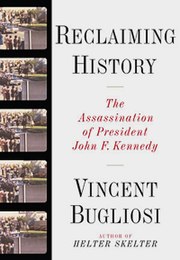
I recently got around to listening to Vincent Bugliosi's audiobook,  Reclaiming History: The Assassination of President John F. Kennedy
I've put it off for a number of years because it's 32 hours long. Even on my 4 hour car journeys, that's a stretch.

Bugliosi was a lawyer, who died only recently. He wrote this forensic examination of the Kennedy Assassination, and all of the conspiracy theories floated he could find. And he demolished every one. One by one. Some just to the point of looking very unlikely. But most to the point of  utter destruction.

Reclaiming History Bugliosi 1st-ed-2007 WWNorton.jpg

My prior Kennedy knowledge came from the Martin Sheen Kennedy film. Oliver Stone's epic JFK. And another documentary I must have seen. And the TV dramatisation 'trial of Lee Harvey Oswald.' 
I would say I thought, before the book, that there was maybe a 40% chance someone, somewhere, was also involved in the assassination. Because of ..like..how Oswald was conveniently killed. And the rifle had a bent scope and was a piece of crap. And Oswald was a spy for Russia. And how did Ruby just happen to be in the basement when Oswald came out for transfer. And the magic bullet. And 'back..and to the left..back and to the left"..and all that.

Thirty minutes into this audio book, I'm 100% convinced it was Oswald. Alone. And he was killed by Ruby, alone. And NO-ONE else was involved. He decided, maybe three days before, he was going to shoot the president. And that's why the shooting is not the most skillfully executed of plans.

Why? 
Because all the evidence is there. Evidence that I had never heard about before. Events and situations that have been willfully ignored, or altered, to make a conspiracy.

Evidence like, for instance, on the morning of the shooting Oswald, for the first time ever, removed his wedding ring and put into a cup on his wife's dresser. The notoriously short of cash Lee-Harvey also left all of his worldly cash and a note in the cup saying 'Take care of the children. Buy them whatever they want.'
Six or seven people saw the gunman in the window of the book depository before the shooting. One witness even pointed him out to his wife saying 'Look at that secret service guy up there."
And there are hundreds more bits of info just like this. And the links to the people who gave this info and testified to Warren Commission. Statements from police etc. etc.

So, thirty minutes in, I'm convinced. When the police arrived at the friend's house his wife was staying at and they asked' Does Lee have a rifle?' She said 'Yes. He keeps it in the garage.'
She knew he had a rifle. He'd asked her if he could keep it there. 
Oswald was arrested with two different I.D.documents in diferent names. One of them, in the name of the person who purchased the mail order rifle.
 And a revolver. A revolver that was later found to have killed officer Tippit. A murder that was witnessed by twelve people. Who mostly picked him out of three police lineups over then next two days.
And the first thing Oswald was charged with. 

So, why listen to another 31.5 hours if I'm convinced it was Oswald?
 Because it was compelling. And, mightily embarrassing to hear my own theories taken to pieces so skillfully.

Just two for-instances. 

If, as some have claimed, Oswald was a Mafia Hitman, why was he applying for jobs in the weeks before he was due to kill the President? Jobs that would move him from his strategic sniper hole in the Book Depository building, to a different location in Dallas where no presidential motorcade would pass by?

And when he got the job at the Texas School Book Depository it was for a general warehouse person. And the TSBD co had TWO building in which they sorted the books. 

In addition to its building at Elm and Houston, the Texas School Book Depository Company maintained a second warehouse at 1917 Houston. Several blocks north of the main building, the short four-story structure was well removed from the parade route, half-hidden on an unpaved section of Houston. 
Oswald's supervisor, Roy Truly, told the Warren Commission that he had had the option to assign Oswald to either building on his first day at work. 

"I might have sent Oswald to work [there]... Oswald and another fellow reported for work on the same day [October 15] and I needed one of them for the depository building. I picked Oswald."

That entry is from Wikipedia. Its in the Warren Commission files, and the files of the Dallas Police of course. But also on Wikipedia. Not that you'd ever know to look for it, unless you had a reason to do so.

Our readers here do love a conspiracy. But I was genuinely embarrassed to think how utterly foolish I had been to even briefly consider that the CIA. The FBI. The Dallas Police. The Press. The Secret Service. The Warren Commission. The Doctors at Dallas. The autopsy doctors at Bethesda Naval Hospital. Robert Kennedy. Lyndon Johnson. The IRS. J. Edgar Hoover. The Mafia. The KGB. Castro. The Free Cubans. The US military. Had somehow, or some part of them, all conspired to shoot the nation's youngest president.

 How would you even hold that meeting? How would you arrange those people to meet to discuss their plans. And not just their plans but the cover up afterwards. For fifty years. In the age before the internet. Before computers. And who is in charge? Who funds. Where does the money come from. Where does it go? 
And why do it at all?

{The autopsy doctors are key in conspiracy theories. They have to be part of the plot as they disguise the front head wound from the grassy knoll. They disguise or conceal the other bullet wounds from other gunmen.}

In actual fact Jackie Kennedy was asked by a secret service man which hospital did she want the autopsy performed at. She said she didn't know. And the Secret Service man said it would be best a military hospital. And Jackie chose the Navy hospital. Because the President served in the navy in WW2. But his other family members were army. Jackie could have said 'the nearest.' 
It was partial chance she chose the navy hospital. She might have said anything. Might have said Vermont. Her husband's brains were still across her face and dress. As can be seen in the swearing in photo with Lyndon Johnson and when she leaves the plane in Washington.
 She refused to get changed until at the White House.


It was also chance which doctors were called. Not total chance,of course. But if you've just killed the president, you wouldn't have asked the First Lady at all. You'd have taken the body to your waiting men, at your destination,  to do their work. Without her involvement at all.
She was in shock. She wouldn't know as next of kin it was her decision alone to make.


Thursday, 15 March 2018

All-Time Record Sock-Puppet Operation in Guardian

This really is hilarious - and potentially of even greater significance than just setting records for sock-puppetry.

Clearly stung by the tsunami of opprobrium coming his way, J.Corbyn's machine has lumbered into action on the Jezza-McMafia crisis with a lame apologia in the Grauniad.  More on his performances this week in another post.

But (- they just couldn't help themselves -) they then whipped in a posse of grovelling BTL comments.  And thousands of 'likes'.  That's where it gets really silly - as many as 538** likes for one particularly sycophantic comment.  By way of context, generally speaking 20 likes is very big for even a popular CiF comment, as a glance around the Grauniad's website will confirm.

They've clearly overdone it grotesquely: the Graun itself lost patience after a mere 23 comments and shut the thing down.  (Again - context - a juicy opinion piece will often attract two or three thousand comments before the thread is closed.)

As I say: more on this whole phenomenon later.  In the meantime, go over to CiF and have a chuckle.  Oh, the panic-stricken ineptness of it all !

ND

Update:  538 was after just a few minutes.  Though they've long since closed the thread, the Graun is still allowing upvotes which have now reached fantasy proportions  

Wednesday, 14 March 2018

Austerity! Austerity! Austerity!


We have finally reached and inflection point in our economy. After the horrific crash of 2007-8, it has taken exactly 10 years to get our national finance back into some kind of order. Predictions for the future are not worth much, but we can at least believe the Tory Government when it says it will stick to controlling spending until the election; look at the track record above.


Whilst there could be a big quibble about how fast we could have cut spending in 2009-10, it will remain academic forever. Unlike Labour's current incarnation of blaming the Government for all the ills of the world and hysterically shouting "Austerity! Murderers!" at anyone sober enough to see reality.


The sad irony to all this is that, as it often the case in the UK, now that Government has control over its finances, the keys will be handed over in a couple of years to reckless Labour to start all the cycle all over again.


Also though Government is struggling with what to do now. It's whole mantra has been controlling costs, how can it slowly turn the taps on and if so where. Certainly many of the bloated public services we had in 2008/9 are now reduced to a level which delivers poor returns. The Government will be hounded to spend money on the NHS above all - but politically this is a mistake, Tory Governments never get any credit for health spending. Better would be to localise some of the gains and re-invigorate local government which felt the worst of the cuts of the past decade, people seeing improvements in their local areas across the country would surely be best. Or, if they were braver than they are, cutting some headline taxes like VAT. It is about time people were reminded of what it is like to keep more of your money to counter the socialist noise currently being made about handing over more and more to the'benevolent' state.


What would you do with a limited budget  for change in the next 4 years?


Monday, 12 March 2018

OPEC price restrictions still works but for how long?

The oil price, which goes in and out of fashion, has had in interesting 2018 so far. Last year, OPEC finally managed to get Russia and Saudi to agree price cuts, which together with falling exports from Nigeria and Venezuela (due to incompetence and corruption) had offset the rapid rise on Iran and Iraq as producers. Image result for oil price graph 2018


The next impact was to see oil prices recover last year from the multi-decade lows to around the $40-$50 per barrel. Indeed by the year end the trend had take the price over $60, way above where any predictions are.


However, there is still a big variable. The USA has become a bigger supplier of crude than Saudi Arabia, second only to Russia. The shale oil that the US has is ready for export and the US refineries don't rely on Saud anymore with imports down heavily to less than 10% of the US market.


Shale is now profitable at the $60 mark quite easily and rig counts are rising slowly in the US. So this may well put a cap on the price rises, even as Russia has agreed to extend production cuts (incidentally and anecdotally, supplies of processed oil from Russia are being pushed away from Europe to China, which long-term the Kremlin sees as a more stable political ally - good luck with that!).


So to date in 2018 we have seen a drop off in the price of crude, perhaps marking the top of this recent boom and seeing a more stable pricing for the rest of the year. A benefit of this to the little UK play in oil and gas is that $60 also works, just, for the remaining North Sea oil so there should be a small recovery in Scotland that is more sustainable.


All of this has big impacts on geopolitics, it is not coincidence that Saudi is throwing its financial muscle around whilst it still can.

Thursday, 8 March 2018

Will the EU catch an ICO cold?

One of the big bubbles in the world at the moment is the massive growth of Initial Coin Offerings (ICO's). At its heart this a business of issuing tokens that are pretending to be money. The tokens are promoted and some go up in value and some down. It is a new ear of electronic store/deletion of value.


However this past few months the Icarus phenomenon has struck, even China is thinking about cracking down on this multi-billion dollar industry. Japan this week has said it is considering next steps.


The USA has one a whole lot further, the SEC is now issuing subpoenas and demanding info from the coin offer companies.


The key issue, is that ICO's have thus far managed to sneak around  the huge regulatory barrier of the Finance sector, by only pretending to be money and in reality being software they have skated the old rulings. Of course, to their customers they are a form of money. It's very clever and of course has been exploited at length.


Finally though, now the bubble is very toppy, the regulators are getting their act together. However, noticeable is the EU and also UK, being much slower to act. yes, Mark Carney and the Bank fo England as ever are calling investors 'fools' and such like (none of us have the spectacular BOE pension fund to look forward to though, do we?), but they have not really done anything.


The EU and UK are primarily concerned about money laundering - as always their main fear is they maybe losing tax revenues somewhere. So the focus is on how transactions can be monitored and KYC checks done.


The US and others have a more fundamental approach, that is are many of the currencies even vaguely legitimate or are many of them just complex frauds to hoover up money from retail investors?


Of course, in the short term this may lead London and Frankfurt/Berlin to become crypto-central for a small while which is a decent bump to our growing FinTech industry, but we would have to question the benefits of this. London hardly needs to host yet more ways of either money laundering or ripping off people with financial scams - already it is a world beater at both.

Tuesday, 6 March 2018

Market Solutions to Severe Weather Problems

No need to remind anyone that last week saw some pretty cold weather.  And as anyone paying attention knows, it's gas (for heating) that sees us through (1); and the days when we were self-sufficient in natural gas ended in 2004.   For whatever reason, successive governments have generally (2) taken a 'market' approach to gas (unlike electricity) and so we rely on price signals arising from an effective, flexible and competitive wholesale market to allocate scare resources in the most efficient manner, as the text-book would suggest (3).

And so it came to pass last week:  demand rocketed;  spot prices all across Europe rose strongly in consequence;  market players threw everything they had into these high prices (including some large industrial gas users, who sold gas back to the Grid); and we got by.  As a demonstration of efficient markets in operation, this one was pretty good.  It's all the more impressive when you know that (a) last year 'Rough', the UK's only really big gas storage facility put up the shutters for the last time; and (b) some of our usual sources of gas had some unfortunately-timed difficulties just when it mattered.

But it was a relatively close thing.  The energy minister Claire Perry was asked if the government might be re-considering its 'brave' decision not to give public financial support for a new gas storage facility to replace Rough  -  her predecessors spurned Centrica's bid for a big hand-out, as we noted several years ago  -  and she gave it short shrift again last week.  That's quite a contrast with the electricty sector, where large amounts of cash are spent in retainers for generators guaranteeing winter capacity - the 'Capacity Market'. So: 'market solution' it remains.  A good job the global LNG market is awash with supply just now ...

So:  did I just write "market players threw everything they had ..." ?   Yup.  How, then, do we account for this?
Source: IUK
That fishy shape is the graph of gas imports (blue line) across IUK, the most important gas interconnector between here and continental Europe.  As we'd expect (the UK being a net importer and winter being peak gas demand), it was importing at close to full capacity through the first weeks of February.  But look what happens just when the coldest weather strikes (27th-28th last week) - virtually nothing.  Was IUK inoperable?  Nope, fully open for business throughout.  Were spot prices higher in the continent than in the UK?  Again, nope.  So - why did imports only pick up again at the weekend - after the Grid had been forced to issue a system warning, and start buying back gas as mentioned above to maintain pressure (thereby pushing UK prices even higher)?  Might it be a re-run of *problems* that the EC was meant to have been fixed years ago (see second link above), when continental authorities were found to have been over-riding market-based decisions in the gas industry?   Surely not!  After all, the EU is a market of free movement of goods and services ...

Nice to know who your friends are.

ND

(1) ... and makes a nonsense of the idea you'll read here and there, that we could 'decarbonise' completely, and that we don't need gas at all.
(2)  There is of course the little story of Mr Eggar and his *touch on the tiller* we've told before: it's how we got the IUK in the first place.
(3)  We've also recounted several times how the UK LNG importing sector was rebuilt in the 2000's by the private sector, to a capacity that completely replaces our North Sea gas production - and all with no goverment intervention, direction nor public money of any kind.


Monday, 5 March 2018

Trade War ahead

Trade wars get you nowhere, but they can be hard to avoid.


One of the markets of the decline of liberalism over the past 20 years has been the failure of the WTO (Previously GATT) to make further progress and build on the achievements of the mid-1990's.


There are many reasons for this;


- Globalisation has been so successful and become endemic, the need to promote trade has therefore fallen as people thought the battle was won and politicians no longer gained much political capital from signing trade deals (something in the UK at least Brexit will change).


- China has spent a long time getting into the WTO process on its own terms, and using the traditional Chinese policy of taking things very slowly, has succeeded. With the world in a great place to receive Chinese exports, China has no interest in changing the status quo.


- Also though, of course, the contradiction of globalisation is that it has been unevenly distributed. China and Asia as a whole have done very well, Europe OK but not so much, relatively America has done badly  - we may have noticed since the Great Financial Crash that politics has started to be heavily impacted by some of these changes.


- Which in turn has led to Trump and his businessmen's eye for helping out the US firms. This plays really well to his voting base. It is not very likely to help the world economy though, as tit for tat economic barriers will reduce global trade overtime and lower overall GDP.


Which in and of itself will affect the largest trading countries the most, which at the moment is the group doing the grandstanding. Of course, underlying Trump's anger are some stark truths, Chinese steel is very cheap, the central government has over-procured kit and enable effective dumping on the world market, they have done the same with Solar panels. This does indeed hurt US steel manufacturers - but longer term, it helps make cars, bridges and buildings cheaper in the US. It acts as a transfer of Chinese labour and wealth back to the US. This is a good thing, in the UK for a long time we realised that it was better to be the best at a few things or grow new industries than to try and prop up the failing ones. As a result we had an overall economic transformation, even with the deeps scars it left behind.


It requires a grand vision though to see this, which is why trade wars are the operative of base political operators. Sadly at the moment, politics across the world is very base (see Italian elections today where no centrist parties are going to be near Government, imagine the UK with a UKIP/Green stand-off as the two biggest parties), so we maybe discussing trade war impacts for sometime to come.

Saturday, 3 March 2018

Stranding and Rescuing the 17:05 from Waterloo

In all this snow, the first thing to say is that there's no right answer to the question: how much provision do you need to make for very extreme events?  A bit like the debate our friend Sackers and I take from time to time as to what's the optimal level of self-sufficiency in trade; same as the Dutch dilemma of how high to build the dykes.  We lack the metrics for a definitive answer.  As another friend, Radders says
... wearily I have to explain for the fifth time that ice and snow events are rare enough in the UK not to maintain a standing provision for them - it's easier to take a minor economic hit from snow disruption every ten years than pay for kit and provision that will be redundant most winters. 
OK, so the 17:05 from Waterloo to Weymouth broke down.  It's what happened next, or rather, didn't happen, that is outrageous and, in it's own way, very worrying.

Was this train lost?  No: its exact position was known.  Was this only known to a single individual in a control-room, who lost his head?  No - it was known to at least as many people who'd been 'phoned or otherwise contacted on social meejah by the dozens of passengers, as well as the management of South Western Railways.   Was it miles from anywhere, in the middle of the Scottish Highlands?  No: Christchurch in Dorset, for pity's sake (look at the map).  Less than 2 miles from the nearest station.  Was this a serious situation, demanding immediate action?  Yes, in the overall scheme of things: no electricity, water, heating or toilets after a while, on an extremely cold night - South Western were lucky not to have had a couple of fatalities on their hands. 

So WTF were they doing?  Clearly, fuck-all.  But it would take 15 minutes max for people with the right kind of thought-processes to come up with an intelligent plan to alleviate the situation at very least, if not to mount a full evacuation, in a couple of hours.

There's a problem here that one encounters in the Army.  Enthusiastic young officers are generally polite middle-class kids, and a typical situation in the field goes like this.  Senior officer, over the radio:  "Engage and destroy the sniper position in the building 500 metres to your east."  Junior officer:  "Our line of sight is obscured by the high wall we are taking cover behind."  S.O: "Then blow a hole in the fucking wall!"  J.O (thinks): *... but wouldn't that damage the wall ...?... oh, I see!*

In other words, a lot of people need to be taught that some circumstances demand Appropriate Action Now.  With no need for a Safety Case.

But there we are: it's 2018 and virtually no-one today has any military experience.  What a soft lot we are - and how dangerous that is, to life, limb, and our society as a whole.

ND

PS, In other Snow News there has been an interesting situation in the gas market this week.  More anon.

Thursday, 1 March 2018

Brexit is Brexit: Contradiction is Contradiction

I have alway been partial to the principle in formal logic known as RAA - reductio ad absurdum - or; from a contradiction, anything follows.  (I can still use RAA to prove there is no highest prime number, and - just about - that the set of real numbers is uncountable.)

Now: there seems to be just a tiny contradiction in whatever it is that Theresa May thinks she has 'agreed' with the EU.  But - hey, tiny is enough!  And through this contradiction threatens to pour the Irish Sea.

We don't need to fall back into triumphal 'Richard North' mode here, wearing a smug grin and shouting HaHa, You Cretins, HaHa!  In many circumstances, yer average Eurocrat would not be in the least dismayed: he has tried-and-tested ways around these things.  Kicking the can down the road; creative ambiguity; out-and-out fudge; even agreeing things in writing that are infeasible ... Alice-Through-The-Looking-Glass doesn't trouble them, with her silly worries about believing impossible things.
"I daresay you haven't had much practice," said the Queen. "When I was younger, I always did it for half an hour a day. Why, sometimes I've believed as many as six impossible things before breakfast."
Unfortunately, however, for the usual smooth running of European matters, the EU is in an unusually non-creative mood just now.  They have foolishly felt obliged to write everything down in their best 14pt Sans Serif, causing even the irredeemably unimaginative Mrs May to notice what she's done.  Now Major and Blair before her both agreed to things they didn't understand; but they had the political will to tell the House of Commons to knuckle down and get on with it.  May, of course, has none.  So the contradiction is all set to bring the House down.  I imagine many Irishmen on both sides of the (- dare we say it -) Border will be working themselves into apoplexy as I write.

Other things being equal (which they rarely are, see "creative ambiguity" above) this is the end of the cosy transitional arrangement.  It might look as though the contradiction is just in need of a home: Mrs May hopes to pass the parcel to the EU (OK, you build a hard border if you want one), and vice versa.   But RAA doesn't work like that:  a contradiction will pop up just anywhere.

Anyhow, today I met some German friends.  They tell me Germany is quite keen on a couple of years of transition, in order to give themselves more time to unpick lots of complex arrangements currently in place.  They cite Corbyn's latest pronouncement - against Corbyn himself.  That convoluted story of his about Minis: 
"... many businesses have supply chains and production processes, interwoven throughout Europe. Take the UK car industry, which supports 169,000 manufacturing jobs, 52,000 of which are here in the West Midlands. If we look at the example of one of Britain’s most iconic brands in this sector, the Mini, we begin to see how reliant our automotive industry is on a frictionless, interwoven supply chain. A mini will cross the Channel three times in a 2,000-mile journey before the finished car rolls off the production line. Starting in Oxford it will be shipped to France to be fitted for key components before being brought back to BMW’s Hams Hall plant in Warwickshire where it is drilled and milled into shape. Once this process is complete the mini will be sent to Munich to be fitted with its engine, before ending its journey back at the mini plant in Oxford for final assembly. If that car is to be sold on the continent then many of its components will have crossed the Channel four times."
The German response is: do you imagine this situation will last any longer than it takes us to make alternative arrangements?  Only an immediate 'Hard Remain' will stop us pulling the plug

So - it's either WTO and Hard Borders all round; or, Mrs May gives up the ghost; or, the EU goes back into creative-fudge mode.  Anybody's guess.  But RAA and the laws of logic are not mocked.

ND