Showing posts with label Taxes. Show all posts

Monday, 1 March 2021

David Cameron is right - no new taxes now

Rishi Sunak, so beloved of the media last year as Chancellor giveaway, had a harder time addressing the media ahead of the UK Budget this week. over the weekend. 

He has been harassed by panicky mandarins into raising some taxes to plug the enormous deficit caused by the Covid pandemic inspired economic shutdown. 

However, as David Cameron said last week. We don't know how deep the damage really is until we re-open the economy. It might well bounce back fairly well. 

Of course, there are hundreds of billions blown on furlough and tax collection is well down, there is a huge hole in the Government balance sheet. But the same is true across the world. Raising taxes on business is his favourite idea, along with taxes on entrepreneurship. 

Given the current impact of Brexit, this is the worst idea of a tax rise. Right now, we need to stop businesses relocating to Luxembourg, Dublin and elsewhere in the EU. Having paying businesses leave the Country for the EU is a loss in a zero sum game. 

Instead, the Chancellor should be doing a mini-budget, introducing some austerity to public spending ex-NHS and reducing the furlough scheme from April. Then, when hopefully things are more normal in the Autumn better stock can be taken of what needs to be done to pay for the pandemic over future years. 

All that really matters is that we get Government income and tax rises at the right level to start reducing the debt as a percentage of GDP in 2022 - anything before that is likely to have a net negative impact on an already sclerotic economy. 

Tax rises during lockdown is surely the worst idea yet from the Treasury! If you had too, then maybe a digital tax on online sales as part of the great re-balancing around business rates and the changing economic model - but in theory these should be tax neutral changes in any event. 

Monday, 4 March 2019

Capitalism is empowering - so says the HMRC


A quick take as all the media speculation today is that Philip Hammond has a nice strong hand to play in the Spring budget statement.


Government spending, relatively, has been kept under control during austerity and finally, ten years after the crash, it seems as though the public finance are finally in a better state. Of course, we now have around 70% more debt as a nation (from one trillion to £1.7 trillion since 2010), but at least day to day things are looking better.


The main driver for this though is not growth. The UK economy has been OK, but not very inspiring for a number of years. Low productivity compounded with excess labour supply has given the feeling on expansion whilst the currency decline has hidden some of the downsides of the wages squeeze relative to the world.


So with little growth, how come the Government is able to balance the books? Austerity is only a part of it. The Government spends less now than it did in 2010. Back when the Tories took office, spending was £715 billion by the Government, not it is £707 billion for the year. If you think about years of inflation added to that original figure, then the fiscal squeeze over what was being spent is around £200 billion per annum. Even if you take the pre-crash spending, there is still nearly £70 billion of expected spend missing.


However,  the big jump in the last year still is in income taxes. these have risen by nearly 10% in the past three years. Much stronger than GDP growth and inflation would suggest. The main driver of these is self-employment taxes. These were super strong this year, which has allowed the Government some fiscal wiggle room.


For me the takeaway is that the move to self-employment gets people creative and innovative and in the end they end up working harder, earning more and paying more taxes. The days of mass manufacturing and mass employment meant that (say today as per the NHS) collective bargaining limited opportunities for people to keep any benefits of harder work. In today's world, working harder pays better; yes there are issues with Uber etc effectively increasing supply to markets and reducing pay - but the fact that individuals can do something about it is both capitalistic and also rewarding - both them and the Government.

Tuesday, 7 March 2017

No Election budget

It is budget day tomorrow and as with all budgets since 2008, there are only likely to be thin pickings to be had.


Governments make a big deal of £500 million of spending on schools or whatever is their fancy for the year. Then they re-announce big already budgeted infrastructure spend and also re-announce normal spending commitments made over years as if they are new.


All not very exciting. Worse is that invariably the tax take goes up and up forever. That NHS keeps needing spending and the low wage subsidy economy is a very expensive thing to run.


So it seems taxes can never go down and all budgets are declared 'AUSTERITY' budgets by the left as spending can only ever be increased.


Personally, I find this depressing. The NHS is very important but clearly a machine that sucks in so much money needs looking at. The huge government spend on pensions sticks out even more to me though. These commitments need to be vastly reduced if future generations are to survive or even draw their pensions.


But as every Chancellor knows, problems more than 3 years out are someone else's problems....

Friday, 12 August 2016

More aggressive taxing of UK business

The UK Valuations Office has slipped out a corker during the quiet summer period with the Olympics on.

From January 2015 (yes, retrospective) occupants of any building that does not have direct access between floors will be separately rated rather than treated as one joint rental. This leads to a much larger tax bill. Even if you rent and office and use the common parts, stairs/lifts etc, it won't count.

And this is retrospective. Helpfully, businesses wont knowhow much they owe until the VAO gets around to telling them.

Honestly, what a shoddy way to approach tax collection. It is highly aggressive in the extreme.

Monday, 7 January 2013

Starbucks, 'Fair Taxes' & a Morality Tale from Germany

We haven't really addressed the hot populist topic of 'fair taxes' here at C@W: I am guessing it is a non-issue for most of us.  The law is the law: no-one seriously suggests Starbucks et al are guilty of tax evasion, it's rather basic avoidance they are all up to (plus exploitation of folk's willingness to overpay for the product), and the politicians had better legislate if they don't like it. 

(In the case of a business-model based on a globally-traded and market-priced commodity like coffee ("the defining symbol of capitalism" - BQ), it should be pretty simple to clamp down on transfer-pricing tricks - oil taxation, for example, has long been based on market pricing to prevent the obvious transfer-pricing games that vertically-integrated oil companies might otherwise play.)

Bizarrely, however, Starbucks now proposes to pay 'tax' it doesn't owe to the Exchequer, as a sop to public opinion.  They must reckon the 'fair taxes' notion has some traction with the Man On The Clapham Omnishamble.  So I thought it might be interesting to look at the 'fairness' concept as it has existed in a country with a less capitalistic, more socially-oriented  public ethos in the business sphere, with a tale from Old Drew's Book of True Stories.  Draw up a sandbag, swing the lamp, and harken to Nick ...

Some years ago I worked for a large energy company (no, not the Crooked E this time) that had operations all over the place, including a very profitable one in Germany. The company's natural instinct was to remit substantial dividends, as it was legally entitled to do, but it had been solemnly advised that in socially cohesive Germany, where everyone had conveniently forgotten where the 'Saxon' comes from in 'Anglo-Saxon', there were 'social norms' as to how much dividend was appropriate for different types of business. Thus, for risky entrepreneurial concerns, high dividends were 'socially sanctioned': but for the energy business, catering for a basic human need, it was somehow 'understood' that only modest dividends were appropriate.  

A pretty tangible notion of 'fairness', one might say - just the kind of thing that presumably wins the approbation of woolly-minded Guardian writers. But we're not finished with the story. The same German advisers who counselled against a norm-busting dividend also pointed out that financial reporting standards in that country are a good deal less stringent than those of the despicable Anglo-Saxons (which remains true to this very day, see below), and that nothing could be easier than to spirit the earnings away unobserved.  By the expedient of establishing an affiliate in a convenient island location, the desired funds were channelled to said affiliate and thence to the ultimate parent's coffers.

How was this simple trick not picked up and reported upon consolidation of the German affiliate's books ?  I just told you:  German reporting standards are lax !

What, then, of the social norm on dividends ?  Why, it was ostensibly observed for the edification of the German public, of course, and flouted freely in practice.  Readers who may wish to deploy this tale as a metaphor on German morality in general are welcome to use the comments section, but as this is C@W I shall content myself by recalling that the first 2 European banks to go under in the present crisis were not feckless Spanish outfits or even Northern Crock: they were German Landesbanken,  supposedly models of provincial probity and conservatism, but in fact playing the mortgage derivatives markets for all they were worth (quite literally), via - yes, you guessed - under-reported (and uncontrolled) overseas affiliates ...

To hell with your 'fair taxes'.  Legislate, or shut up.

ND

Monday, 3 December 2012

Tax, Growth and confused Government

I don't really understand what is going on in the Government at the moment. For a bunch of people who aspire to be Alistair Campbell like they are doing a pretty bad job.

Let's take their latest efforts on tax. Bounced by the Select Committee into reacting to the news that big companies use legal loopholes to avoid tax, the Chancellor now rushing around declaring HMRC are to have more money and Companies WILL PAY MORE. In the Telegraph today they are discussing looking at the spending habits of peoples' wives to see if there is undeclared money being spent by the self-employed. This latter point, how Orwellian is this - your other half's spending being monitored before any sort of accusation or claim is made against you.

It all sounds good to the floating Lib Dems (how many of these are left I wonder?), but makes for no impact in real terms. How does going crazy about the tax take fuel the needed growth agenda? If it does at all, it is negatively. If you want to start up a social media company, why start in the UK when you can go to the Silicon Valley and avoid all this?

And yet the true Conservative answer would be much clearer and have a better long-term benefit. The tax code is now 11,000 pages plus thanks to years of efforts on behalf of Gordon Brown. Halving this over a 3 year period would reduce the opportunities for companies and their advisers to optimise their tax payments. Similarly for individuals, harmonising and simplifying taxes so that the self-employed did not enjoy such a massive benefit over the PAYE employees could form part of this.

So instead of shouty, populist nonsense, we could have a sensible reform proposal which also highlighted the blame for this mess that lay at Labour's door.

Wednesday, 2 September 2009

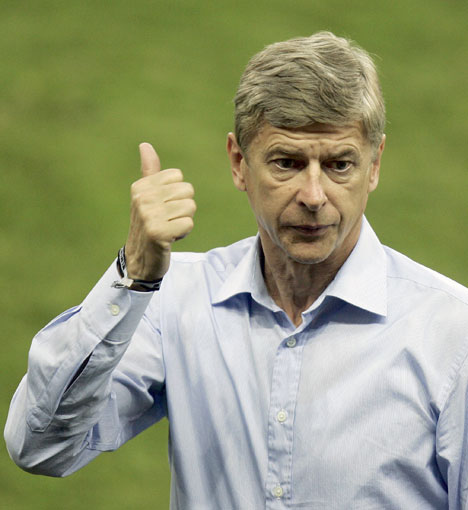
Arsene Wenger points out death-by-taxes

With all the furore around bankers' pay; people have ignored footballers wages. Did you even know that footballers wages when printed in the press are always quoted post-tax? Yes that £150,000 a week John Terry earns is in fact nearly 40% in real money. (2 years ago Labour whined about this, they seem strangely reticent today?)


Link

To the point though, the Premier Leagues had its deadline day fro transfers yesterday and very quiet it was too. Only Manchester City, backed by Oil billions, have spent this summer. Without them, the spending would be nearly 50% down on last year. All the top players are leaving Man Utd and Liverpool and heading for Spain.


Why Spain? Well it often takes an outsider to show a country's folly. Arsene Wenger in this case, an economic graduate, says that in Spain a footballer can pay tax at 25% for 5 years. That is longer than the average contract. They are paid in Euro's too which has been appreciating against the Pound for nearly 2 years now.

The combination of a sickly Pound and impending 50% tax on the rich means that in real money terms, Spanish clubs can pay 70% less to give players the same wages.


Premier League football will be unable to remain the dominant force in Europe when placed at such a disadvantage. German clubs are competing now too. And whilst you may not care much about that, there is a read across to all of our other industries where people are mobile too. In the City it is Hedge Funds, but you can also add IT Contractors and even perhaps Lorry drivers and a myriad of other professions into the mix. High taxes and a weak currency are going to ruin our economy and sadly that is the path the Government is taking us on.