Showing posts with label FTSE100. Show all posts

Thursday, 4 January 2024

Competition: Predictions for 2024

So here we are, crystal balls at the ready, testing our predictive powers on the year ahead.  What will 2024 bring?  Some of the big unknowns for this year are rather obvious "known unknowns", of course, but please address yourselves nonetheless to the following questions:

  • UK GE:  date (month);  and number of Labour MPs after the GE 
  • US Presidency: who wins?
  • Size of V. Putin's share of the Russian vote (as announced)
  • By how much, and in what direction, will the FTSE100 change between midnight UK GE polling day and the end of 2024?
  • Length of Sam B-F's gaol term upon sentencing (note: zero is a number).  Extra point for size of the fine in USD
  • Where will Man Utd rank in the Prem at the end of the '23-4 season, and who will be manager?

Go for it!

ND

Wednesday, 13 January 2021

Seeing the future in the markets?

At the time of writing the FTSE100 is off around 2% on the day, a small blip but still well up in the beginning of the year.

Most years, after a Santa rally to get their bonus' in, fund managers re-allocate their funds in January to safer plays adn let the market drift whilst thier benchamrks for the year are set. 

All very old school. 

This year is interesting, there is a huge race on in the UK to vaccinate as many people as possible before Covid takes too higher toll - on people mainly but also on the economy, a lot of which remains closed.

To me, the FTSE at 6700 odd seems like a very positive readout given the economic damage wrought by Covid. The market investors must seem to think the vaccine race will be won in short order and some normality begin to return. Then again, they can soon turn down, but it is an interesting indicator to watch - more insightful than Twitter...


Monday, 21 September 2020

Watch the markets - 2020


We all know that September is the time for big market crashes.

 1929, 1987, 2008 - All the doom was in September and October.

This year to date, despite the huge Covid-19 crisis, the markets have been quite resilient, down around 15-20% despite the GDP also being down at that level in a historic reset. 

This has been explained all year by those in the know as due to the the free money printing of the Fed and other central banks, plus the low interest rates meaning stocks with dividends have still proved popular. 

However, today has been a big hit in the markets, the FTSE is down 3.6% today alone. It could be the start of a long week or a re-bound tomorrow. 

With the Covid situation across Europe moving from good to bad though, the idea of a V-Shape recovery and the markets seeing through the downturn maybe over. Instead this could be a rocky time indeed and the start of the deep recession long-predicted. 

I guess we will know soon enough. 

Friday, 4 September 2020

Apple bigger than the FTSE100

That is quite some going for the old fruit farmers. 

Apple of course is hugely successful company, able to sell its over-priced wares all over the world to willing consumers such as myself. 

But bigger than the FTSE100, Apple bigger than say HSBC, BP, Tesco and Unilever put together?

Of course there are reasons here, the US markets are on a roll but the nexus of investment in just a few stocks is a new phenomenon. In past decades the US system would have moved to break-up monopolists like Google or Microsoft, certainly Facebook and Amazon would not survive a real Anti-Trust investigation.

However with an Election year, Republican President and worries about US pre-eminence no such action is forthcoming. 

So instead 70% of US Equity value sits in literally a handful of companies. All I know is that this is unsustainable and not a reflection of value in the real world....but the markets can remain wrong for a long time before reality bites. 

Perhaps it really is different this time?


Monday, 23 March 2020

What purpose does keeping financial markets open serve today?

In normal times, markets are a keep lifeblood of a capitalist economy. They send the singal to participants and the Government about the state of the economy and are a general barometer of health for a market economy.

But in times of crisis they are scary places. The markets are run these days by both human traders and their pet algo's. This means they experience both euphoria in the good times and fear in the bad times. Sometimes the algo's are designed to exploit the fear even further.

At this unprecedented time of crisis, I don't see the point of the markets remaining open for stocks and shares. We know the crisis is only going to get worseover the next few weeks. Then hopefully better. As such the markets are just going to keep dropping on every bit of bad news.

Meanwhile, Government's like the UK have stepped in to effectively nationalise the workforce. A completely unprecedetned move. Plus loans and tax holidays for businesses. These may work or may not work.

So to me the unknowns are so large that the markets will have no real option but to fall much further. This only unbalances the economy further for any recovery - hurting savers and allowing well-heeled Private Equity a chance to buy up lots of companies on the cheap at a future date. The answer surely must be to halt trading for 6 weeks.

Forex can continue for trade as can commodities as these are life essentials for a function global economy. But stock markets are a one way bet and the lack of price information is not going to change how our Governments make decisions in the next few weeks.

I am amazed at the lack of discussion of this in the media - this can only be because the responsible types at the Financial Times worry that this discussion will cause a stampede to cash by retail and other investors and thus another steep fall.

However, we need to be rational, a collapsed market will not be the basis for a quick bounce back and reset in a few months time if we are lucky enough to get to that point.

Debate needed..

Friday, 6 March 2020

Friday Fun - Viral Market Turmoil

How low will the markets go?

In what proved to be a dead cat bounce for a couple of days, it seemed that Global markets had rallied off the lows. I spoke to a few city types who assured me the Hedge funds had closed their shorts and gone long.

But then today has proved another tough day with the FTSE down 3.5% to a new low for the year and Global markets all in risk-off mode?

So for the weekend, where are the markets going to go. Oil is down below $50 a barrel and staying there, will this itself cause a bounce as that has a deflationary effect across the whole world? Will that save airlines (I doubt it)? Will the market carry on witht he FTSE headed toward 5000 and the Dow 20,000?

Or is this all overdone and the bounce back be strong next week?

Interesting times ahead.

Wednesday, 26 February 2020

Corona virus finally breaks through

Market performance chart


So the Corona virus has hit the World stock the markets as the bears have exepcted it too for a while.

I have been travelling a lot of late (hence no posts - thanks Nick Drew!) and my twitter and other feeds have long been full of doom-saying Hedge fund managers who have bet bit against the world markets and gone long gold.

They have been rewarded at last with the spread of Corona Virus. Actually, sad as it is the economic hit is already much worse than people realise. China, a huge chunk of the physical global economy in its hands now and much of this has shut down. Electricty demand in China is down by 2%  - but this is a big chunk of the industrial output. This will affect supply chains aroudn the world and of course the oil price as demand sinks for energy.

We can only hope that the virus is controlled by the heavy handed approach of the Communist party. other Countries seem less concerned, the Iranian health minister was interviewed on live TV yesterday whilst sick with the virus.

Even, with control, it seems the Virus will push the world into the recession that has been in the works for a long time. Perhaps by bringing it on early it will be less steep than expected, perhaps too a recession will concentrate the minds of the EU and UK on reality of the need for a deal on trade rather than the current round of grandstanding.

Wednesday, 25 April 2018

Top of the retail coffee market indicator?


So reading the tea leaves so to speak , Whitbread has been forced by activist investors on its shareholder register to spin-off its Costa Coffee business into a separate entity.


The Activist investors think this ill result in extra shareholder value and allow Whitbread to concentrate on its Premier Inn hotels business.


Both businesses are well run and have been very successful, in fact Whitbread in its markets is a super business and has been for many years. Well managed and targeted, with no airs and graces at its Luton HQ that is for sure.


However, noting in the UK as we did here last week, with the massive preponderance of coffee shops on the high street due to rapid changes in the retail market, surely this is a great top of the market indicator!


Globally, the growth for Costa with its awful 'machines' that you find even in France at motorway service stations, may well be a big opportunity. China is a key target for them (this rarely works out well for UK Companies - its another sign of exuberance and arrogance) and so perhaps there is a lot to this business.


But in the UK surely not with the abundance of competition to sell hot coffee to everyone, everywhere.


(My one reservation is I am typing this with a Costa Coffee sat next to me on my desk which I feel is somewhat undermining my prose....)

Monday, 22 January 2018

Are QE pension deficits a big hidden problem in the economy?

Whenever a big company goes under these days, much of the post-collapse discussion surrounds the pension entitlements of former employees. The UK Government even has a Pension Protection Fund set up to try the best for the employees who are rightly seen as victims.


Dominic Chappell, of BHS infamy, even lost a court case this week for not sharing the information on his companies pension scheme with the Protection Fund - he may even get locked up for it.


But what has worried me for a long time is the destruction of the Pension industry since 1997 and Gordon Brown's raid on the tax relief on dividends in pension funds.


Since there all the UK defined benefit schemes have closed, these were more generous and could not be sustained after the raid. Also, the pension deficits of companies have grown, long-ago now are the pension holidays companies used to take in the 1990's.


In fact, the total amount raised by the Gordon Brown tax is around £150 billion (about £10 billion per annum, twice what it was alleged to be at the time). Today total FTSE350 deficits are around £17  billion, far from healthy.


On top of this then we have the Quantitative Easing fiasco which should ended 5 years ago. Now, we a very low interest environment thank to Banks and Funds being for by regulation to by Government Bonds which have increased in price, thanks to demand, and shrunk in yield. As a result, despite investing at around 6% more each year and having Pension assets double in the past ten years, pension scheme deficits are rising.


With all the money invested into pensions schemes, companies show less profits and in turn have less money to invest. One of the drivers of the UK economy, in a negative sense, is the lack of productivity driven by low investment. Companies that are struggling end up with no profits at all, see Carillion and others - pension deficits are a key driver toward corporate failure.


QE on top of the Brown reforms has destroyed the UK pension scheme industry. Weirdly, a re-balance economy with the end of QE would quickly see Deficits fall and pensions back to health (in their new defined contribution form which is about 1/3rd as good as the old defined benefit schemes).


It is a big underlying macro-economic challenge rarely addressed and as ever was an attempted Labour reform to the private sector gone wrong!

Tuesday, 9 February 2016

Are the bank about to collapse 2008 stylee?

In short, no.

I feel compelled to write this again as the media is full of dark thoughts about the banks and the world as a whole.

I personally blame the constant storms in the real weather as having a zen like influence on the traders of the world markets.

In the UK for example, Barclays, Lloyds and RBS have more or less closed their investment banking groups.

The remainder have Tier One equity of 10%+. They have been lending little real money except on mortgages and credit cards; of this, little has been securitised, let alone put into CDO's.

The current issue really is that with all the secy stuff gone, the Banks are making no money and the regulators continue to find new crimes for which they get fined. I have little sympathy with the Banks or their shareholders on this.

But we are a long way off 2008. What wold be more troubling at this time would be a huge run on Government bonds, as that is where the real debt expansion has been. However, the threat of QE means that even the top hedge funds of the world are unlikely to try and fight that war in the West.

Instead we have a profit problem - itself predictable in world of a zombie economy and commodity induced deflation.

On the plus side, it means banks look cheap at the moment and he medium term benefits of oil prices are yet to work themselves out (i.e. a boost to the consumer economy) - so the economic future is brighter than it appears right now potentially.

CU

Monday, 4 January 2016

New Year, New Crisis

So a stock market fall in the first week of the new year, is a very common occurrence.

In December, Fund Managers and Hedge funds load up on stock with their spare cash, this drives up equity market and helkps them to hit their targets for their bonus's for the year; hence the term, Santa Rally.

At the end of 2015, this was more muted, as world events meant that shocks aplenty abound and even manager desperate for bonus' don't want to be loaded with stocks that fall in value.

The flip side fo Santa rally is that Fund managers sell in the first week of January ever year, book some losses and then take on cash which they can play with for a whole year - the losses they have some time to make up and their all important bonus' are paid in Feb on last years results.

However, could it be different this year? The markets are very wobbly in China, where a real terms recession is underway in many industries while the property market bubbles away agin, and also macro problems in the Middle East (as per the whole of recorded human history, 'tis true) are not going away. Hence a rather sharp 2.5% sell off on the FTSE this morning.

That is much more of a crash than usual and sets the index up for a tough year already, off the back of what was a losing year last year. With US interest rates rising and weakness continuing in commodity markets, there will be a lot of downside risk on the FTSE in the first quarter at least.

It is not a very happy share buying environment unless you want to try high risk pharma companies that seem to have replaced E&P oil companies as the high risk, high reward AIM bets.

It will be an interesting year.

Thursday, 28 May 2015

How long wil lthe boom last?

Chart forFTSE 100 (^FTSE)


Predicting 9 of the last 3 recessions, as co-writer Blue Eyes often rightly criticises me for, it s mugs game. Even the informed writers here knew the 2008 crash was coming, but how deep and when eluded everyone - markets are just not predictable.

But when we look back at the FTSE all share, a very rough guide to the UK economy over the decades since 1984, we can discern some key pointers:

1. Thatcher and Major oversaw a huge strengthening of the economy from is weakest point which was probably around 1982/3 in terms of the post baby boomer period.

2. The 1990 recession slowed growth in share prices from 300% to 25% until around 1995. Although there is a clear upturn from 1993.

3. From 1995 the dotcom bubble really distorted the picture until the crash of late 2000/2001, which also cross over with 911. A min-recession took place in the real economy in the Tech and Travel and Hospitality sectors, but the rest of the country survived relatively unscathed - stock prices took a big dip as the effects of the dotcom bubble wore off. The indices returning to its pre-1997 levels.

4. Then we have the disastrous leverage boom of 2003-2007. How so much damage could be done so quickly is frightening. Still, stock prices bounceback within 18 months and have been steady ever since.

5. However, since 1999 there has been zero real growth in the FTSE, even allowing for the changes in constituents, the index has shown little growth.

6. Reflecting the UK's wider productivity issues remarkably well, the indices has been suffering from slow growth since 2011 - 4 years now of slow chugging up.

So what next? Well from 1984 it took until 1987 for a crash and then the overall recovery too to around 1993. This boom then last until 2001. So a 4 year expansion, then a 7 year recovery period, followed by a 7 year boom.

Then we have the dotcom crash, a 3 year downturn then another 4 year boom. Then a huge crash followed by a weaker 7 year recovery period.

On balance, this means we are likely due a 3-4 year boom phase before the next crash. Given property cycles are often cited as 18 years - then this would also match with the next big bust not due to the early 2020's in theory.

What seems unlikely now from a historical context is a huge recession in the next few years. It maybe that with technology changes and volume of interactions that phases are getting shorter - but still, its hard to be a bear even now.

Of course, event dear boy, events - an EU Grexit or Brexit or the final realisation of the massive Chinese bubble in printed money  and over-investment can jinx historical moves. But then again they always could.

Thursday, 23 May 2013

EMED, bugger


Chart forFTSE 100 (^FTSE)

Never can I recall owning a share like EMED mining where the event driven news was moved forward by one quarter, every quarter. This is now going on for 4 years, so that is 16 postponements of opening the mine in my book.

Unsurprisingly the share price is down again to and now at almost 5 year lows. Sigh, my investment nous has long since departed and my share portfolio seems to ride around every year and somehow or other end up with a zero increase or decrease overall. Very exciting, boring and unrewarding all at the same time.

What a day for EMED to release news though on the first real big day of market sell off that we have had for months. As they say, timing is everything!

Sunday, 13 January 2013

The FTSE has started strongly but some sectors look ripe for a pullback

When and where will the party end?

The New Year has seen big increases in stock prices amongst most major markets since the last minute fudge over the fiscal cliff in the US. It seems that the markets have become somewhat sanguine with regards to the shenanigans by US Politicians in their brinksmanship over all things economic and largely take things in their stride, with volatility back near recent year lows even as we hurtle towards the debt ceiling issue in a little over 8 weeks….
With the backdrop of continued QE in the US, there is a good feeling amongst investors at present it seems.  I posted some months back that despite the doomsayers, the FTSE should be trading at 6500 if it were to stick to its long-term trend from the 1980’s.
Markets though do not go up or down in straight lines and the last 3 years have seen early New Year bounces fade away as the largely bad macro news gathers pace. In the UK for example, the economy likely shrank again in the last quarter of 2013 and we could well tip into a technical recession yet again in this current quarter.
In the meantime, the rally could continue for a week or two yet.  Two of the sectors that are doing the best are Banks and Homebuilders. Indeed, Taylor Wimpey and the other homebuilders now stand at post recession highs as of Friday. The de-regulation of the planning laws has given these companies a boost, along with their strong organic results. The re-rating is to my mind, a little too high now though at approaching 100% in just a couple of months. I can’t see this being sustained when mortgages are still so hard to come by and the UK property market outside of London remains largely in the doldrums. As soon as the market turns there will be a big pullback here on such overbought stocks such as Taylor Wimpey and Barratt Developments. although short interest is currently declining as can be seen in the graph below for Taylor Wimpey, where shorts have been hit hard this past few months and probably explains a large part of the strength in these 2 stocks in particular:

Taylor Wimpey Short Interest
 
 Taylor Wimpey and Barrat Developments 4 year Chart


 The second sector which is undergoing its traditional start of year boom is the Banking sector. Every year it seems, in the run up to their results, the bank’s share prices increase by at least 50% as investors hope that profits and dividends will return. Every year they disappoint and this year I expect the disappointment to be worse than predicted due to the Libor and other fines as well as a terribly weak investment banking market. Yes, the workout areas of the banks have started to reduce loss provisions substantially from a year ago, but the former factors will still weigh heavily on their results. RBS, to me, at over 400p is certainly ripe for a large pullback and Lloyds and Barclays have similar issues to that could warrant open short positions.

This post is sponsored by our site sponsor, Spreadbetmagazine.com

Saturday, 18 August 2012

Does the FTSE still offfer value at 5800+?


This post is from www.spreadbetmagazine.com - visit the site for live and regular updates on all matters stock market related.

In the midst of a so called "summer" (holiday over for me too!), with volumes  very low, it is often the case that the main stock market indices can move around in quite a volatile way. Not this year however with a slow grind higher being experienced week by week in total contrast to last summer where bad news on the Eurozone front created the worst August conditions for many a year. A near 1000 point fall was a hefty kick in the" what-not's" for many investors.
The last 15-20 years have been interesting to say the least. Starting in 1996 with the Dot Com bubble that was borne in 1996 and  which juiced shares to all time highs on the eve of the new millennia - levels which, in the UK, have not been seen again. Indeed, we are still some 20% lower nearly 13 years later...
After the heavy sell-off that took us to the current millennium lows in March 2003, Alan Greenspan rode the rescue and introduced a new era involving massive liquidity and low interest rates. This in turn sowed the seeds of the global property  and leveraged based financial boom. We all know how this ended in 2008. Even today in 2012 we look out at a mess of Quantitative Easing and easy money trying to desperately re-balance a world that is heavy in manufacturing capacity but with little in the way of decent investments to be made. Throw into the mix the phenomenal amount of de-leveraging which is required by Governments, banks and individuals and we have an extremely moribund growth profile ahead
.

Today the FTSE stands at 5850 and there are many commentators of a bearish viewpoint who suggest that the current low volumes and economic perma-crisis mean that the markets are on the edge still and poised for a third big dip.  The fundamental backdrop is one of high cash balances on corporate balance sheets, an attractive valuation from a dividend yield and PE perspective and no real alternative to equities with Gold yielding nothing and Bonds massively overvalued.
Take a look at the 15 year monthly chart below. Nothing in that chart picture looks to me as if we are going lower - we are just about to probe a near term trend line from 2007 around 5950 - a break through here will be very bullish. The 2 red circles show the 9 & 27 month exponential moving averages - you will see that a cross over of these is very bearish with prices falling precipitously when this has occurred. Contrast that with today where we have the bullish cross over to the upside still intact. With a supportive RSI that is nowhere near overvalued that has created a ripe background historically for falling prices, positive momentum on the MACD and similarly supportive stochastics and I fear the bears will be disappointed in the months and years ahead.
The chart below is definitely worth watching - should the FTSE roll over however down to the 5600 and the 9 & 27 month moving average cross down through each other - watch out as on each occasion before that this has happened, serious doo-doo has hit the market and the world in general.


Tuesday, 29 September 2009

October Market Correction due?

I was very convinced the markets were not going to rally through September and October; although some of the information coming out was good enough to mean there should be no repeat of the crash of 2008.

However, here we are 29th September and the rally has continued. From 4819 on September 1st to 5150 today.

I received an email this morning warning that the Elliot Wave analysts are predicting that this is really still a huge bear market rally ready to come crashing back down again. I am not so sure about that, but there is huge risk in the market going up with no corrections when the economic situation is so poor.

One bright light for shares is the collapse of the Pound Sterling. The pound is down over 10% this month, which tracks the rally up - so in global terms the FTSE is going sideways. Perhaps the current devaluation trend will continue to push money into shares.

Now though I have withdrawn some money from the markets and am looking into safer havens for it. Euro Bonds are featuring high on this list if I can find an easy and liquid way to invest.

Tuesday, 11 August 2009

Has the FTSE topped at 4713?


Some of the technicals like the MACD would say so, but I am not so sure. One thing is unlikely, that the FTSE can go much above this level in this year. My prediction was the FTSE to be flat year on year at about 4400, I still think that will be the case, although it will be more rollercoaster ride up until Xmas.

Monday, 20 July 2009

Sell in May 2009; no by George


The strategy of sell in May and go away is a city lore that comes true more often that not. Whilst the summer silly season lasts it is hard to see the markets move on low volumes. Just at the minute though, a renewed rally is taking shape. The FTSE was up all last week and the index is up again today, over 4500 to its highest level of the year.

To date that would have been the right as per usual, the FTSE drifting from 4414 down to near 400 over the summer; but since last week things have changed. There is definitely a change in sentiment, even the dreadful business that is CIT has been handed a lifeline today.

The FTSE is now back up over its May high and heading North. With all the positive vibe, this rally may well last into August. The index is currently over its 50 and 200 day moving average if it closes at this level today then there will be a sustained rally.

Moreover Lloyds bank has been buoyed by the news George Osborne may not break it up. How much of a signal is that the government is finished, when comments by an opposition politician move a share price by 5%+!

Tuesday, 23 June 2009

Is the FTSE going to tank now?

Friday and Monday have seen over 4% wiped off the value of the FTSE 100. That is a nice reminder of how things were back in Sept-October last year.


With this fall, there is much commentary in the finanical press about the end of the bear market rally and the next big dip.

What I think is less noticed is that the FTSE100 is still 8% down year to date, and that is after a year where it fell 30%. This is not exactly a great time for investors. If the FTSE falls now it is likely to be by a few more percent, not decimation.

As much as the comment now is that the rally is overdone, it is possible that the opposite is true too.

Having said that, I am preparing stop losses and positions generally for a renewed collapse in September/October of this year. We will need to see sustained improvements in many of the economic figures being published to say that we really have hit a bottom. Counter to this though, I expect inflation to kick-in next year and in an inflationary environment the stock market will be your friend

Tuesday, 10 March 2009

UK sliding fast; good news?

The latest figures out today show yet more very grim reading for the UK economy. Manufacturing sliding a the fastest rates since 1981, UK house sales at all time lows.

The world economy is too on the skids and there seems to be no good news coming from anywhere. The phrase 'off a cliff' is over used, but it is appropriate to describe what has happened since the autumn of last year.

On the brighter side, I note the FTSE today is showing some resilience to this bad news, as if most of it is already priced in.


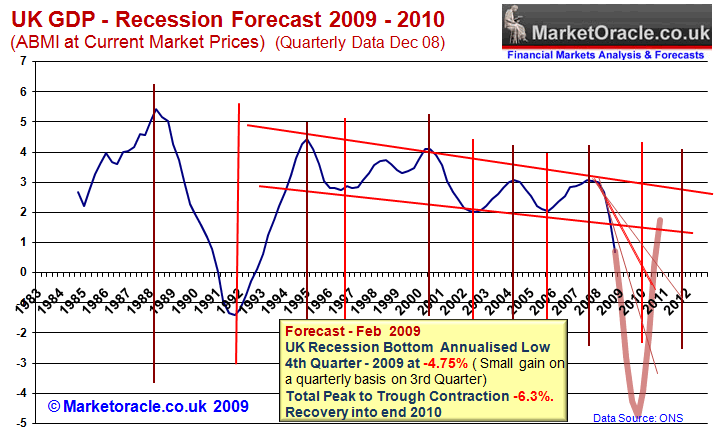
A look at past UK recessions as well shows up an interesting point. The UK is very prone to fast falls and then fast recoveries, more so than other economies. So as much as the news is bad today that everything is getting worse quickly, this also allows for the bottom to be reached faster and the turn around to start sooner. A slow drift down would be much worse.

With a hat--tip to the excellent market oracle site, see the graphic for how the 1990's recession looked. The 1980's was the same, as was 1974.
At the moment we have the sharp fall, painful and frightening, but maybe it is bringing forward the bounce?