Showing posts with label Economics. Show all posts

Monday, 13 June 2022

Recession incoming?

 It is amazing really how long the Government and the media take to cotton on to real world events. 

As readers here will know, as soon as the Ukraine war broke out and sanctions were applied to Russia, an economic disaster was set in train. 

There was no hope of controlling the oil price, a weak pound and strong dollar has accelerated the damage. Then we have China with a frankly insane covid-zero policy that has hugely derailed their economy and will continue to do so. 

The effects of the above are galloping inflation, a huge excess of supply over demand across the West and energy input costs up nearly 300%.

With all of this a recession is to be expected, indeed the Government must want the demand destruction of a recession to help reduce inflation. 

The idea that a -0.3% read, hugely impacted by the reduction of spend on test and trace, is only a passing feature is for the birds. 

More likely this summer is petrol and diesel at well over £2 per litre and a further big drop in the stock markets. Until the global supply chain is sorted out, there will be no let up to the economic stress. 

As for our Government, they continue to profiteer from energy prices via VAT. They are not alone, much of the inflation now is profiteering with suppliers sensing they can push up prices if they want too. 

The inflation genie will be very difficult to control now. However, time also to keep an eye on sovereign bond yields across the EU. As we know from the 2011 Euro crisis, Italy and other economies cannot withstand inflation pressures in the Eurozone when devaluation is not an option. Germany may find itself bailing out the Euro as well as Russia. 

Monday, 9 May 2022

The cost of living crisis to come

 to come you say?

YES.

You see what we have today is just the foothills unfortunately, baked into the pipeline are some rather big nasties.

A - Diesel  is now $600 a ton, up from $200. Diesel fuels everything, tractors, ships, trucks. All the real stuff, even a decent percentage of cars. It is 3x more expensive that it was a few months ago. Russian crude was very good for making diesel and so their refineries were experts and pumped it out by the millions tons a day. Now we are not playing with them, they are not doing that. Worse, the Western refiners that made diesel used Russian crude. Now that is not available to them either, though they are giant things, oil refineries are calibrated carefully to the right API for fuel and other key factors - typically they are supplied from the same wells for years and years and forever in Saudi! With Diesel at this price the costs of globalisation, farming and much else are not coming back to earth anytime soon. 

B - China, has gone nearly as mental as Russia, only this time on its internal population. Life has stopped in many major cities, the factories are closed and the ports are full. This is a huge dislocation in the global economy and it was exactly this kind of thing that started the inflation super-cycle in 2020 when the pandemic hit. 

C - Market crashes - as the markets catch-up with the factors in the real economy, investment will drop. In the medium-term this is a good thing as it stops money supply growing so fast (investment is matched with bank created fiat money everywhere), but it also leads to lower productivity and output. Right when the economy is short of supply rather than demand. 

I remember writing how fearful I was of stagflation in 2011/12 after the great recession. Inflation did peak but the commodity prices crashed and China was much less effected so continued to supply the goods which kept supply and demand matched. 

This time there is no counter-balance that I can see. The only one will be a huge reduction in demand - job losses, high taxes, much higher poverty etc, the creation of scarcity. 

The Tories won't survive this it needs to be said, no Government would, in the same way Labour could not escape 2008. People will need someone to blame for the misfortune of an unstable world and perhaps more rightly for some poor policy choices that may have helped around the edges. However, what will a new Government do faced with the same situation. Only printing money will arise as a solution with inflation at 10%+....

Monday, 25 October 2021

Hardman Rishi - does he have the grit for the job?

It is budget week in the UK and Rishi Sunak can hardly be described as a hardman or dictator. But the challenges facing the UK now are very hard to answer by democratic political targeting. No amount of money can fix the NHS, the concept is not right for modern medicinal costs. The hardest up in society will always want more, the cost of fixing the economy to net zero is incredible. Minor tax rises wont be the answer. 

If Government could look to the long-term there maybe a way forward that involve some very hard choices and some real ones - guns or butter - nuclear power stations or nuclear missiles? The lights going out or more tax breaks for relatively less polluting gas. These don't seem insurmountable even in a democracy, but the way that say Singapore or Dubai are able to take steps forward seems much clearer to making hard choices - there is a ruler and that it that, no pesky polls or the Guardian to assuage. 

Within the ruling Conservative party what is clearly missing now is any political guidance, we are left with post-Blair focus group leadership - what is right is what is popular. The media have undue influence, but worse, the policies of today can be changed tomorrow. Even worse still, the policies of today make no sense for tomorrow but have the votes and popularity today. It is a rum state of affairs, literally. 

Things therefore are a very bad short-term mess and the Chancellor has a dud hand to play with. All the more reason to start taking some serious long-term positions. Look how well George Osbourne did with his 'long-term economic plan', such that it was. When all around are driven mad, some clear sightedness will come in handy - which is why Rishi has to grab the chance that Boris is not capable of and make some hard nosed decisions this week. I am hoping they will be of a capitalist bent and not socialist dreaming.

Thursday, 14 October 2021

Stagflation - umm, how?

All the comment in the media around the world today is of the coming stagflationary scenario and a return to the 1970's. 

Even at a high level I just don't get it - this is another case of journalists and commentators latching onto something they don't understand and cant be bothered to apply in a few minutes thinking into. 

The key here is the stag piece - inflation is a given as we have a global energy crisis. Longer term this seems to be really quite well under-pinned by a lack of investment in real energy and an over-reliance on renewables fairy stories far ahead of the real supply curve needed. 

This will make Putin and MBS very happy for a long-time to come, even Venezuela might be able to pay some of it bonds and Iraq bribe its way out of civil war. 

Anyhow, the first part of stagflation is a slowing economy. This feels like a very unlikely outcome of a huge bounce back from a lockdown of the world economy due to the pandemic. The idea that there won't be growth does not chime with activity in the UK now, where people are busily spending their enforced savings wherever they can. Town centres are heaving, leisure and retail surging. 

The only thing that would kill this off is a massive stock market crash that hammered sentiment. This is a hard thing to engineer when interest rates are zero-bound and the Fed prints money liberally to feed the system. Admittedly, there will come a time in the next few months when interest rates will have to rise or QE can be cancelled (a longer post on this is overdue) to reduce the impact of inflation. However, real inflation caused by energy price hikes wont really be impacted by higher interest rates - it is not financial inflation after all, but input prices. Lower currency will be a negative too in this scenario. 

However some reckless governments will see this as the easy way out of 150% GDP borrowing, with a few years of high inflation stopping all that painful austerity which instead can be meted out democratically to everybody and blamed on markets and foreigners rather than Government policies. 

So, anyone saying we will see stagflation must really be saying they see a huge market crash coming as the precursor - yet few seem to mention this.

Monday, 4 October 2021

Can the Tories recover their sanity?

 Today is the start of the Tory party conference. Whilst ahead in the polls against the mad left of the Labor party, they reality is this feels alot like 1995/6 to me. Back then, John Major's Government had lost its way, focusing on some bizarre things like the Cones hotline. Their credibility was shredded by the ERM debacle and never recovered. Blair breezed to a landslide in 1997. 

Today the Tories are lost, Boris is raising taxes to pay for the pandemic, they seem to think that wage rises are the way to improve the economy and that Brexit related shortages are not their fault. The thing is, most of them are and for now the public, unhappily, are ready to accept the Covid excuses, that won't last much longer in the face or incompetence. 

Also, the lack of ability to nail some poor behaviours is not helping. Take the DVLA, as we noted here they managed to be on strike and on furlough for long periods last year. Refusing to work at the Unions behest. Now we find ourselves lacking in qualified HGV drivers, the lack of new ones can be squarely blamed on DVLA unions officiousness - if only anyone from the Government could put two and two together. Instead, despite lacking drivers, the Government is against allowing in foreign drivers at a time of desperate economic need. This makes no sense whatsoever, there is no upside to this decision. Get the drivers now and plan for the long-term - don't plan for the long-term during the short-term crisis. 

Wage rises are another example of muddled thinking. Of course, over-supply of labour pushed wages down and effectively, along with China imports, caused the deflation which has left us with record low interest rates for over a decade. Closing off both these taps at the same time is going to be inflationary - what good will that do if rising wages are inflated away? There needs to be productivity improvements to match the rise in wages for sustainable growth - automation and digitalisation are the key drivers here which should see taxes cut for business investment.

The pronouncements of Tory ministers are very far from any complex understanding of the situation they find themselves in and Boris famously has no ideology but instead divines the populist will of the moment. This means despite lots of talk about long-term there is no George Osborne sense of actually meaning it or doing much to deliver it. 

My personal view is the Tories are at the edge, reliant on Labour being so abysmal to allow them to continue, but it wont be long before this is overcome if they continue with the manifold misteps of late. 

Wednesday, 1 September 2021

Can China avoid the Taiwan gambit?

 I am back, after sometime away in a country that makes the UK feel very cheap indeed. 

Watching the Afghan disaster from afar, as we all did, I could not help but see the Chinese rush in behind, like the fools they are, thinking that for them it will be different. As different, as it was for the Americans from the Russians, is the predictable outcome. The Chinese have invaded with money at least, rather than weapons, but it will soon be frittered on corruption, just like home for them.

However, as much as the US did need to back out of the Country, the cack-handed way it has been done has created a new post-Vietnam environment. For a good decade or more after Vietnam, the US was very isolationist and not very interested in policing the world. Reagan made do with an arms race against the Ruskies which he won at a canter, but involved no hot war at all. Only a little bit of hanky panky in Iran and Iraq was allowed, to keep the hawks busy.

Now Biden has really shaken the game, by ending it. The US is engaged nowhere in the world, certainly not Africa and won't be going into the Middle East anytime soon, save for some face-saving drone strikes against ISIS when it can find them. 

Meanwhile, in the economic world, the huge shortage of silicon chips continues to drag on the economy and push up prices everywhere. UK car sales have cratered, as there are a lack of vehicles to sell, just as the second hand market has taken off. Computer abusers have not had new gaming or mining chips for nearly 2 years - unheard of. 

Over 50% of the world's production sits in Taiwan. Just off the coast of China, a boat ride away. Taking this over would give a hug short-term boost to China, just taking the factories off line for a few weeks would wreak more havoc on the West to go with the Virus they gave us. 

President Xi must be very tempted by this play. The US has no appetite for hot wars and would be a huge risk trying to defend Taiwan. China, with good planning, could do a Crimea and present it as a fait accomplit, welcomed by a new puppet Government etc. 

China will do this one day, today is an opportune time as the adversary is weak and distracted and led by a senile and unpopular President. It could well be now. There are risks of course, the untested PLA could prove a disaster and the whole escapade resemble more the Bay of Pigs than Crimea, this will weigh in the thoughts of the Politburo who are very conservative, so we shall see in the near future how they fall. 

Tuesday, 18 May 2021

UK unemployment down - how big will the bounce be?

So unemployment has fallen in the UK, very unexpectedly in the last quarter. Down only from 4.9% to 4.8%, but to fall during a lockdown is really quite something. 

Clearly later this year there is going to be some fallout from the end of furlough, where a couple of million people might well suddenly lose their jobs and almost double the unemployment rate. However, as the economy bounces back the idea everyone is going to lose their jobs sounds less credible. 

Also we lost 1 million people to the work force post-Brexit and Covid - a huge hit. It is why you can't sell a London property at the moment. This worker shortage is going to take up a lot of the Covid pressure. Meanwhile, high skilled labour is still in higher demand and short supply - all those data analysts and basically anyone who is an advanced computer use. 

So we many even see, against expectations, some wage increase pressure later in the year and the beginnings of a large inflationary wave. With the new India variant in circulation, things might go a bit sideways for a while, but it is hard to see 2021 as a bad year outside of airlines and hotels. 

This must all bode well for the markets and the economy as a whole for the near future. One day there is going to be a price to pay for the buoyancy we are seeing now sprayed around by the money printing and debt the Government has taken on. I think 2022 might be a much darker year than 2021 economy wise. 


Friday, 5 June 2020

C@W channels Ambrose-Evans Pritchard

When I was younger I use to always read AEP, I felt he was the most serious economic journalist in the UK, taking a global view of macro economic events, speaking to key participants and reporting in a complex but persuasive way. As the years go by, his track record though builds up, he always thought the next recession was round the corner and with it would be the end of the world as we know it. In effect, he really is a marxist analyst, much as he would reject that label, his work speaks for itself, somehow capitalism will always fail (well, everything will, he is bearish on China too for balance).

However, at the moment I feel very AEP myself. The markets are nice and frothy, with the FTSE barely 15% down from its pre-Virus year high. The US market is UP this week, after the largest civil unrest in a generation and one hundred thousand visu deaths - obviously.

There are though some key markers coming up, the June quarter rent day in the UK will be important. At last quarter end most rent got paid, but lockdown had only been in place for just over a week. This time it is 3 full months. Landlords have made preparations for this event but it could get ugly. If not enough rent is paid, borrowing covenants will be breached and banks will start to call in their loans. This may set of a chain reaction and credit crunch - not on the scale of 2008, but very bad nonetheless.

Also at the end of June the Q2 GDP figures will come out across the West. These will be bad, with 15-30% falls - for just one quarter. This is far worse than anything in living memory. Maybe if the viurs recedes markets will live with this and look to a better future.

But to my mind, even if we get a quick bounce back, markets can't stay at a mere 12% off pre-crisis levels when the economy as a whole is smaller than this and only is at that level because of hundreds of billions of Government spending and debt creation all over the world.

To me the only question is how big the dip will be in the summer.


Monday, 16 December 2019

Can we focus on the economy now, please?

Thanks to Brexit, the madness of Corbynism, climate change and the emergence of 'woke' identity politics, I can't remember a time when the economy was less important in terms of the national debate than now.

This blog started in 2006, the economy and its impact on politics was a cornerstone of the UK debate, even in the aftermath of the Iraq War. Into 2007 and the beginnings of the financial crisis and it became the all-consuming topic and this lasted into the faux-austerity years right up until the Brexit referendum in 2016.

So the really interesting point is that it is now 3 years with little practical focus on what is going on. In the main this is good news, the economy has ticked along in its new slow growth post-Quantitative easing way. Employment is very high by historical standards and jobs still low paying but improving at the margins.

There has been no major faffing with the tax system since George Osborne changed the stamp duty rates which flattened the housing market in 2015. This year we have changes to IR35 which will cause some dislocation, but a yet to be determined amount and anyway - there are plenty of jobs that need doing so it is likely that this will cause a shift in labour and how it works more than any lasting impact on the economy as a whole.

Of course, we did see a lot of high level macro-economic nonsense in the recent election campaign - stuff about nationalising rail and, er, broadband. All for the birds as it turns out and surely even a crazed Labour party is not going to run on such an extreme position in the future.

So now, with a return to a more normal environment for political discourse, what will we see, after all there are some big challenges to be had:

1 - Climate change is a big issue now, there is scope to change the tax base more radically to address this in the tax system...whilst...

2 - Somehow finding more money for the NHS and Social care, neither of which are going to be funded properly with a greying population. Clearly an extension to the pension system and better tax free private provision will be needed to get more money allocated to this sector

3 - Not forgetting Brexit, where trade negotiations (which lets face it are marginal in the overall scheme of things) will determine whether the Government is brave enough to significantly reduce tariffs to enable a low import cost base and juice the economy that way.

Plenty more to discuss, I look forward to it rather than having silly conversations about tens of billions for magical thinking theories on communism! Happy days ahead.

Friday, 9 August 2019

UK Economy shrinks by 0.2% in Q2 2019

Quite a surprise today that the ONS has the UK economy shrinking by 0.2% in the second quarter.


Just a couple of days ago the services PMI read came out as 54.5, well above fifty and as the largest part of the economy, normally enough to carry the overall GDP numbers up.


However, a further drop in construction and also a drop in manufacturing (where stockpiling for a March Brexit boosted Q1) has been enough to see the economy slide into negative territory.


There is no much good news to be had here, with another Brexit shock due to hit in Q4 there won't be any recovery in Construction or much in Manufacturing - which is hugely hurt by the disaster of diesel car sales which disproportionately UK factories were set up to produce.


Services can help to keep the UK out of outright recession, but it will be touch and go as Politics is set to head into meltdown in September and that itself will temper optimism and business investment, as well we job hiring.


The UK really needs to go sign a Brexit deal and move on. Hard Brexit, on the back of what will already be an ailing economy now, will push us into a nasty recession. Not 2008 levels, but certainly early 90's pain.


The FTSE100 will hold up due to dollar earnings, the 250 and AIM are going to fare less well.

Monday, 10 September 2018

Emerging Markets on the edge, again

the modern world is so interlinked via financial globalisation. The economies of the world, whilst they have their own rhythm to some extent, after often treated as pawns by the veracity of the global markets.


Some Countries are undoubtedly victims of their own political issues - see Erdogan in Turkey or Putin in Russia, even the South Africans have been busily running their own economy to achieve domestic political ends. (And in Developed markets, the UK too...)


However, just as many are buffeted by the markets. Egypt and India stand out here. Egypt because as a geography and demographic entity it is a nightmare. An arab country with no oil, but also not enough food or water for its fast growing population. Indeed, Egypt must for these reasons alone be one of the most unstable countries in the world as it matters little what its politicians do faced with such a dismal situation.


In India, they have had a strong, reforming government for a number of years and indeed, though no China, things have been going well for India. However, India also has no oil, so the companies there which import are suffering from huge increases in import costs and the rupee has fallen to all time lows against the dollar. Of course, India exports a lot and receives plenty of foreign currency so its stock market and its bit exporting businesses are doing very well - but the economy as a whole still ends up on a knife-edge. Adding to its complex situation, the US is demanding India comply with new oil sanctions on Iran - but India imports a million barrels a day of crude from Iran at huge discounts to market and this helps it to limit the level of oil price inflation entering its economy.


Finally, we have not even mentioned Argentina, itself in another IMF rescue but with a huge government deficit, weak currency and 30% inflation - so trapped is Argentina by its poor performance that even many economists have given up trying to find a way out for the Country.


Collectively, these countries account for a big share of Global GDP - yet all are in crisis somehow even whilst Trump engineers a boom in the US and the EU slowly recovers from the financial crisis and Global growth is strong. Emerging Markets are always at risk of currency flight back to the West and this seems to be happening again with China trying in a limited way only to interfere when it spots resources to be bought on the cheap (hence of these countries, only Russia really appeals).


Will the crisis spill over - it does not seem so at the moment as the causes of the distress are a benefit to the main markets, but politically there are big risks especially in Turkey and Egypt - as well as Russia of course but there at least the Government is safe and there is no foreign debt to worry about.


Thursday, 16 August 2018

August always a bit of a worry...

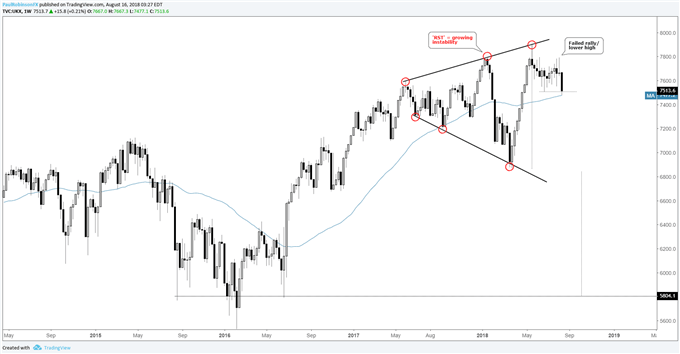
FTSE weekly chart, RST pattern


As long time readers of this blog will know, August is always troubling in the markets. Everyone is away but events go onward in the meantime. In 2007 the weeks leading up to September were very rocky and a prelude to the deluge.


With Trump pushing the US economy on, high employment, low inflation and UK government debt under control, it does not at a macro level feel like things are set for a tough autumn...but there are a few signs:


As above, the FTSE looks like it is making lower highs and that could see a big drop over the autumn IF the trading patterns stick. Interesting too to see Copper falling very rapidly, in world where we need copper for everything and mining it is getting harder, not easier, it remains a leading indicator of trouble ahead.


One reason the US is currently doing well too is the big shitty stick Trump has been using in world trade. This, for example Turkey this week, is causing a flight of capital from Emerging markets including Iran and Russia (really bad there, rouble well off).


For the UK, the other week I posted on how record personal debt has been accrued and how sensitive people will be to interest rate rises - but also, given where the debt is levered against, house prices and share prices.


So many contra-indicators make for a situation that must be impossible to call, except to say I don't think I will be pouring more savings into the FTSE much before the pre-Xmas rush.

Friday, 20 April 2018

House of Closure?

Not a great end to the week in yet another of the long-drawn out retail sector decimation.


Debenhams has don't he usual trick of blaming the weather for its very poor Christmas when in the next breath its CEO admits that Clothing is a massive problem for it, but maybe all the other Chinese tat that it stocks will save it.


House of Fraser also has called in the insolvency specialists. This I can relate to with some anecdata - there is a House of Fraser opposite where I work in the City. I can honestly say I can't afford a single product they sell - it is very high end tat indeed with prices to match. The store always seems busy but you rarely see people walking out with actuals bags. It really does not surprise me to see them struggling, who the hell wants £250 shoes or £200 perfume on a regular basis?


Pre-pack administrations and CVA's  - where companies reduce their rents on in one swipe to try to survive are common practice and no doubt what House of Fraser will be aiming for in this case.


Overall though, the internet continues to destroy retail piece by piece. Still the Governments of all stripes happily let the internet retailers work out of cheap warehouses whilst high street rates and rents are simply beyond imagination - they have been declining a while now even in London but from stratospheric levels. It is beyond me as to why Governments cannot do anything to preserve the high streets and culture of the Country - its not nothing to do with Capitalism in the sense of change must be allowed to happen as technology alters the commercial landscape, yet the tax system is simply being abused by the new entrants to the market. This is causing the harm to city centres which will be hard to recover from, I am amazed that so many coffee shops can currently exist and that demand is there. The collapse in tax revenues from retail also hits local jobs and local government incomes disproportionately - the fact it is ignored by Government continues to amaze me - but it has been this way for over 15 years now!

Thursday, 12 April 2018

Will UK interest rates ever rise?

Of course they did, quite recently, back to heady heights of still below 1%.


But the Bank of England, giving its favourite 'guidance' suggested that this was the first move of many and that rates would soon be back to normal (well, over 1%).


Then, as always, reality intervenes. There is some fairly grim economic data out today. Firstly Manufacturing is estimated to have shrunk in the last quarter; then imports have increased as our oil refining capacity slips and exports have grown only a little. Throw in some underwhelming services sector growth and some bad weather and we will be lucky to see much first quarter expansion at all. The economists seem to come in at a consensus of around 0.2% of sclerotic growth.


So the Bank will be left with yet another dilemma in May, to raise or not to raise?


The longer-term issue is that the recovery is eight years old now. Lots of things, like the London Property market,  the Stock Market, the level of consumer debt are all looking like they could easily move down. This is without the panic inducing international political situation interfering. Even the good old oil price is back to $70 - a high level compared to the past couple of years.


But if we were to go into another recession with very low interest rates and a small Government deficit  there are going to be precious few macro levers for the Government to pull to keep the economy going. No doubt most commentators will say this is all the fault of Brexit, but it absolutely is not, these factors would be there in any other situation too, given the length of the bull run.


The saving grace may end up being that the real economy is running with enough spare capacity that slow growth can continue for a long time; even whilst capital owners are stuck for investments and returns.

Thursday, 1 February 2018

Situtation normal?


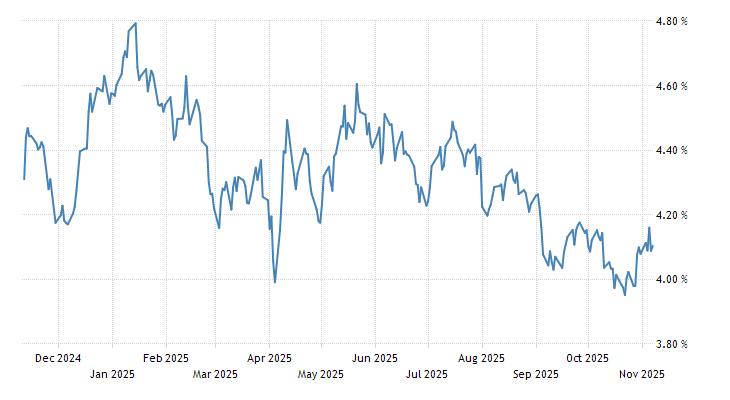
Compare and contrast the charts below, on the one hand there is a nice rise in US Bond yields (which is making markets jittery - of course, should be the opposite, but what do the machines and algo's know,eh?). This is a sign at last of the end of the Financial crash, 11 years after it began. Historically that is about right, for major financial crashes. Interestingly though on a longer term view, US yields still need to go above around 4% for them to be at 'normal' levels. That may be possible this year with Trump's pump-primed US economy kicking into gear.

Let's hope the more nervous and sclerotic UK economy can follow in due course. 


Friday, 5 January 2018

Upbeat news - UK productivity growth...unless you read the FT

If you want to read good news stories, check this out in the Financial Times.


Even by the standards of the #despitebrexit media this is a masterpiece. In what is quite a long and intelligent article they managed to get over the good news very quickly. In fact, they managed it in five lines before devoting the next eleven paragraphs to why in fact, everything was indeed terrible and we are all doomed, doomed I tell ya...


I have not been a fan of productivity as the obsessive measurement of it in my own industry leaves much to be desired. From obsessions with productivity come ideas like presenteesim in the office and other pointless paraphernalia of modern working life.


However, for the UK macro there are a few of truth bullets which really paint the picture:


1. The decline of the North Sea production and the easy productivity that went with it (a few people on rigs churning up billions of pounds per quarter) has been disastrous for the UK. This alone accounts for a huge chunk of the measured drop in productivity.


2. There is little retrospection in these numbers, so Financial Services are now way more unproductive than they were 10 years ago for worker output. But, um, most of the output was bullshit and the country had a huge recession, so were the original productivity measures also rubbish - almost certainly yes.


3. Mass immigration and an abundance of low wage labour has kept investment down and wages low. As a huge bonus to this we have had a cheaper cost of living and near deflation in many parts of the economy as well as near full employment - even with the immigration wave. Sadly, all this hugely lowers productivity - why invest in machines when there are people who will do the work for less.


I note the FT lightly touches on the 3rd point but only in passing and dismissively - whilst selectively quoting economists who agree with it and generally hand-wringing. Instead the above tells me we should not overly worry about productivity - the measurement is wrong, its a crap predictor and we cant do much about it anyway, so why worry.

Friday, 17 March 2017

Discussion thread: Impact of immigration on UK wages


Interesting comments yesterday sparked by BE, so more on the topic for today is in order.


Economics is hard and open to interpretation. However, since 2010 there have been around1.5 million new UK jobs created. At around 250,000 a year, more than the EU combined, albeit less than Germany and but Spain and Greece have seen big declines to the net is greater in the UK. Osborne's boast was technically true.


During that time the population has increased by just over 2.4 million (crazy eh!).


A proportion of the population 'growth' is really due to ageing of the population over pure immigration.


According to ONS date, net migration has been just over 1.25 million during this time. Which is why overall the UK unemployment rate has fallen - as job growth has been stronger than immigration (some immigration is for students too rather than pure job-seeking immigration, then again, official stats do not account for the black economy, which probably invalidates much of the data!)


Of course, immigrants doing jobs adds to GDP, so more jobs will beget more jobs to some extent. Economists calculations around this concept though are a severe overstretch of credibility however and they arrive a wildly varying conclusions, unsurprisingly aligned on the starting political viewpoint.


As ever though, nobody accounts for the fact that new jobs are increasingly lower paying than previously - this is the car washer effect. At the bottom of the wage stack, study after study shows wages being held down, even when the gaurdianistas are trying to prove otherwise.


Still too nobody has worked out how to account for the impact on the welfare state. As a proxy I can see the NHS spending is going up over 8% and yet the whole service is in crisis and the social welfare bill goes up even as the Tories are accused of hideous bedroom taxes etc.


Additionally, the tax income for the Government has grown at a far slower rate than the economic expansion would expect (i.e. below the expected net increase in GDP).


All this circumstantially points to the conclusion that overly open borders promote low-wage immigration which on balance detracts more than benefits the country as a whole; this is before we get to any social cohesion aspects.


Where the balance is, is hard to know and worse, because we can only ever look at historical data, we will never be able to get it right, Brexit or no Brexit.


What do you think?

Monday, 2 November 2015

Back from the basement...

Map of Middle East


After two weeks of travelling in the Middle East (well the non-warring bits, so a very small area sadly), I come back for once to find not much has changed. Luckily, we have avoided a stock market collapse in Sept/Oct for another year so we can look forward to the lukewarm rise into the New Year.

Also, a total obsession with this Tax Credit thing, which in the annals of Government is really very small beans, rumbles on. Moves are afoot to change the Lords no less - an annual discussion that has now been going on for 100+ years so we know where that is going!

As for the Middle East, a strange place it is indeed. Oasis of wealth and security in amongst hatred and misery; rather like a large version of London with better weather.

The biggest thing that I can perceive is the rapid descent of Saudi Arabia. Fighting a war in Yemen and against both Asad and ISIS in Syria and Iraq; all the while the price of oil remaining subdued. The country is really screwed in the short-term. So much so it is hurting the Hedge Funds of Mayfair, diddums for them of course. In the longer term Saudi has enough money to ride out a five year storm; but the sort of projections here I feel are fantastical when it has used up 10% of its foreign reserves in one year.

My travels made me think of a challenge though; which is the more decrepit civilisation - Iran or Saudi. Clearly this is a bottom fishing exercise but equally it would perhaps guide us to who will win their Middle East cold war much as the USA beat Russia in the global cold war.

Wednesday, 14 October 2015

Putin goes for agricultural investment

Is this the first sign of Mr P.'s rather desperate gamble coming off the rails?

Russia is to re-focus investment away from Oil and Gas. Which on an economic strategy level is pure common sense. Having 90% of your economy of the same level of tax levels from one industry does mean you are a little exposed when said sector has a major international crash.

More interesting though is Rosneft CEO, Putin's best buddy Mr Igor Sechin, merrily saying that this is crazy plan and a fall off in investments will mean a long-term decline for the industry. This is not normally allowed in Russia, or to be more accurate, normally contemplated as a strategy by those wishing to remain free of tax investigations.

Perhaps Mr S. is so close that he gets free rain to criticise. Alternatively, perhaps the power of Mr P. is in slight decline. Certainly his Syria gamble which will fail (only because all interventions there will fail, given the complexity of the situation and the issue that all outcomes there are bad), has the feel of desperation. No doubt he is looking to trade his Syria intervention cards for a Ukraine acceptance card with the West.

This may work or not, the West collectively not really being that bright at realpolitik at the moment they may miss the hints....

Anyway, not many Russians I have met recently who live in Russia are best pleased with the 50% depreciation in currency and collapse of imports.

Monday, 24 August 2015

Back form hols...all a bit worrying... all very 2008 too?

Baltic Dry Rates - Asia to Europe:


FTSE 100:

Chart forFTSE 100 (^FTSE)

Brent Oil Price:


At least I can think of a few good things:

- No interest rate rises for my mortgage!
- Xmas toys will be cheap
- Filling up my car for under £1 per litre very soon

Apart from that, oh dear.