Showing posts with label Economy. Show all posts

Wednesday, 28 April 2021

Pandemenomics for UK plc

Quite a bumpy set of results out from major UK companies today. Big banks like Lloyds Bank and HSBC have returned to strong profits already. Plenty of transactions for them, a buoyant housing market and growing business sector have helped them. Additionally, as I wrote here a couple of weeks ago, there is no recession likely now for a long time, so they have been able to reduce provisions for bad debts. 

On the other hand, Dixons has closed all of its airport shops. What am I going to do when bored at the airport if not look at the over-priced electronics and gadgets for a few minutes? This is due to both Brexit, with the UK ending airside tax breaks and also the pandemic with passenger numbers likely to be low for a long time to come. 

Sainsbury's has chosen a kitchen sink moment too (this is when the CEO decides to out all bad news at once with an excuse, such that they can do better in future and earn their options then). The excuse is covid but how the only shops to stay open in Covid lost money is beyond me. My local Sainsbury's has been heaving with people all the time. The truth must be that the internal re-organisation has been less successful and cost more / saved less than thought by some margin - but covid is a better excuse to use to try to bamboozle investors. 

it is good to see the banks joining in the profit making and seeing happy days ahead - these days banks are very conservative so that is a strong position to take. On the other hand, Dixons shows and example of how airports are going to look very different in the future, this scarring will be very deep in the travel sector and maybe will take a decade to repair. 

Wednesday, 27 January 2021

When will it end?

The UK media remain keen to depress us all with gory details of how 100,000 people have died of Covid. To me the number is flawed, the real number should be excess deaths and not this easily disputable number. but it makes it easier for the loony 'Boris the Butcher' headcases to argue for lockdown forever etc. 

On that note, the excellent progress in vaccination should mean that light is at the end of the tunnel, just when we are at the worst point of the pandemic yet. 

It looks like all (ish) over 80's will have been vaccinated with an initial does by the end of January or early February. This will continue to bring case number down (which have fallen even faster than they rose, not that pundits seem to want to comment on that) even further. 

The tricky decision will then be when to release lockdown. there are many knowns, the state of the economy, the lack of education, the lack of cancer and other treatments - these are not minor considerations. 

The known unknowns are also hard - how effective is a one dose approach? will the younger population still suffer and end up with many deaths and hospitalisations if restrictions are reduced a lot? How long do the vaccine's give protection for? Will a new variant arise that nix's the whole strategy?

it is quite a balance, the Government do not want another lockdown after this. As such they will push it for as long as they think they can manage given the parlous economic circumstances, to buy the most time for the vaccine programme to work. 

With that view, I think the idea schools will be back at end of February to be unlikely, but not impossible given the rapid vaccination rate and relative fall in numbers cases currently. With vaccine success, the end of March is a more likely time for Tier 3/4 in most of the Country.

If the lockdownders win, then end of April will be the worst case. Spring sees the virus struggle to transmit so easily anyway for a few months and cases will remain low whilst they carry on with a wider vaccination programme.

The worst case news is a variant develops that is vaccine resistant currently, such that it causes a 6-8 week delay in the current plan and end up with restrictions for a lot longer. I can't see Wimbledon or any sports having fans until the autumn and I am very glad I don't own a nightclub right now. 

Monday, 2 November 2020

Lockdown 2 - Lockdown's revenge

So that was all worth it then. According to the figures I saw yesterday from the Boffins we are in exactly the same place as early March. Back to square one, gone right down that snake to the beginning of the game. 

Which I have to say I find a little bit depressing if not unexpected. I also recall from March a chart which showed we would have repeated patterns of lockdowns until a vaccine was found, the virus mutated to a more mild form or herd immunity had built. 

So I fully expect this lockdown will drive the R<1 for a little bit, we will then be freed for Christmas which will start the spread again and so another lockdown, after a bit of dithering in Feb or March time. Hopefully by then, some sort of vaccine will be in the process of being rolled out and with the summer too, it maybe the worst is behind us then. 

In the meantime, somehow I have to control myself from the judgey environment this has created, as well as the mild physical threat. It seems to me plenty of people are ready to screech and report any minor misdemeanour (in their eyes), such as not wearing a mask in a field, meanwhile another section of crazies storms around without a mask shouting we are all lemmings or some such. What a time to be alive!

I'll get to a review of the economic impact of this later in the week, but it is not going to be pretty to say the least. Whilst I am quite an optimist on the virus being controlled, the economic damage we are taking makes me far more pessimistic. 

Friday, 3 August 2018

Interst rate rises...now....really?


OK - so this post is very counter-intuitive for me, having long argued we need to raise rates on this blog to normalise the economy. But as it happens there are many signs in the economy of the top being reached and an uncertain global economy - a few facts to consider:


- Chinese stock markets down 20% Year to date


- Copper price, a real bell-weather for all industrial production and the general economy, is also down markedly on the year
6 Month Copper Prices - Copper Price Chart


- As BQ oft reports, the high street is beyond on its knees and into catastrophic meltdown after 10 years of hard bashing by government policy and digital transformation, major brand names like House of Fraser are finished

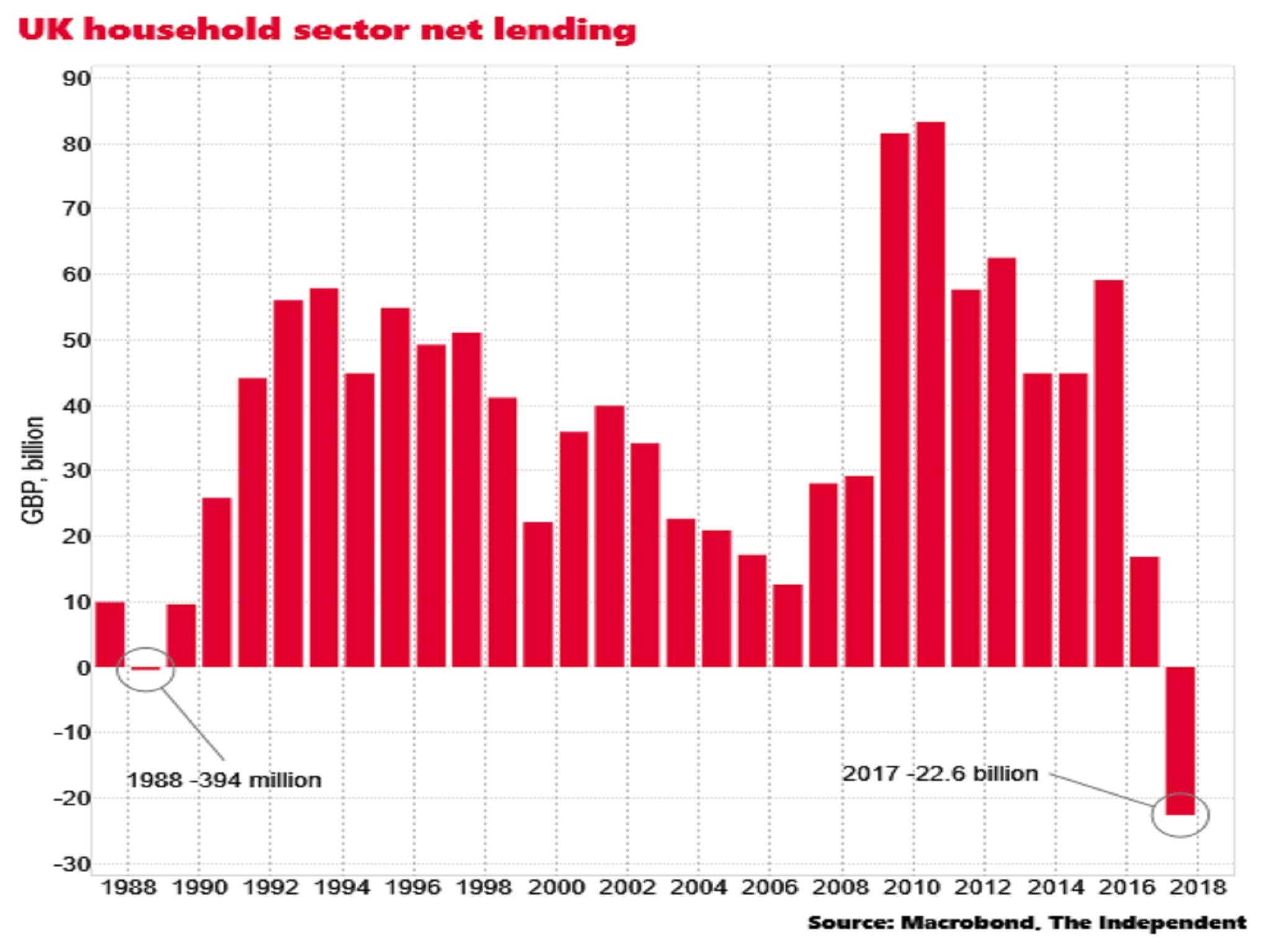
- UK private debt is at record highs with a negative savings rate:


All the above point to a notable inflection in the economy. The boom has been going for nearly ten years since the crash, it may yet last another year or two, but housing is toppy. The UK Government is still in debt and still is running a deficit, even as private sector debt grows. The corporate sector debt is the one area where there is room for expansion, but the doom-laden atmosphere around Brexit is really lowering investment by corporates.


In this environment, basically until Brexit is sorted out satisfactorily, it seems weird to raise rates right now when there is no evidential inflation pressure. Of course, Remainiacs at the Bank of England may want to slow the economy as a tool for helping the Government renege on Brexit. Historically, the BOE always get things wrong of course so this interest rates rise may well be a sell signal!


Wednesday, 14 March 2018

Austerity! Austerity! Austerity!


We have finally reached and inflection point in our economy. After the horrific crash of 2007-8, it has taken exactly 10 years to get our national finance back into some kind of order. Predictions for the future are not worth much, but we can at least believe the Tory Government when it says it will stick to controlling spending until the election; look at the track record above.


Whilst there could be a big quibble about how fast we could have cut spending in 2009-10, it will remain academic forever. Unlike Labour's current incarnation of blaming the Government for all the ills of the world and hysterically shouting "Austerity! Murderers!" at anyone sober enough to see reality.


The sad irony to all this is that, as it often the case in the UK, now that Government has control over its finances, the keys will be handed over in a couple of years to reckless Labour to start all the cycle all over again.


Also though Government is struggling with what to do now. It's whole mantra has been controlling costs, how can it slowly turn the taps on and if so where. Certainly many of the bloated public services we had in 2008/9 are now reduced to a level which delivers poor returns. The Government will be hounded to spend money on the NHS above all - but politically this is a mistake, Tory Governments never get any credit for health spending. Better would be to localise some of the gains and re-invigorate local government which felt the worst of the cuts of the past decade, people seeing improvements in their local areas across the country would surely be best. Or, if they were braver than they are, cutting some headline taxes like VAT. It is about time people were reminded of what it is like to keep more of your money to counter the socialist noise currently being made about handing over more and more to the'benevolent' state.


What would you do with a limited budget  for change in the next 4 years?


Tuesday, 21 January 2014

IMF Upgrade for UK

It's always nice to see some real humble pie being consumed. As most readers will be aware, the UK remains in a parlous financial state, as does much of the Western world. The whole recovery will be de-railed sooner or later by the next stage of the Euro crisis and by the sheer unsustainability of the debts accrued across the West by their over-purchase of Chinese goods.

However, austerity is not the cause but offers partial solution. Better still would be the re-structure of the welfare state in the West along more Hobbesian lines, but for now that is incompatible with democracy. So austerity of some sort remains the best approach. The Coalition government at least did apply the brakes to Labour spending and after some time is now reaping the rewards with a more stable growth than has been achieved in say the US. The IMF were very quick to blame Osborne for his crazy (read, un-French) policies and now the UK is prediceted to be the fastest growing Western nation this year.

It must make for a little bit of extra spring in the Chancellor's morning jog today.

The real challenge lays on two fronts though. Firstly that there seems to be no political benefit to the 'hated' Tories for engineering a recovery - after all, it's what they said they would do. Secondly, with interest rates at 0.5% and QE in place, we are still deep in the middle of the woods with no clear path out yet identified.

Friday, 22 January 2010

Obama and the Banker quick shuffle


Let's start with the basics. Politicians spend other peoples' money freely. When it comes to looking after themselves we have the expenses scandal. Bankers' are equally wreckless with clients money, investing in risky assets and trying to make big profits but not worried about losing too much. However, with their own money, i.e. bonus's recent days have shown that no matter how bad the effect, the money will be paid to the bankers.

Morgan Stanley allocated 62% of its income to staff remuneration this week - the highest ever in the history of investment banking!

So on the surface today's huge announcement by Obama that effectively Glass-Steagall was back and that banks had to be split up to reduce risk seems like a victory for the little guy.

However, Wall Street paid for the Presidency and the senior economic advisers are always ex-bankers.

What I think today's announcement is about is protecting the income of the wealthy. Investment Banks will now get out of the TARP and regulated system, where senior management remuneration is monitored and controlled by the US Government. Instead, the prop desk guys get to go to hedge funds where the remuneration is orgasmic beyond their dreams.

The Investment bankers can become partnerships or private companies and remuneration and bonus payments will disappear from public view. The public is left looking at utility banks where earnings are not so astronomical, although high.

Look at Goldman, I bet it can't wait to not be a bank holding company anymore, it never wanted to be in the first place.

All this US action will affect the UK banks, HSBC and Barclays will have had a blow to their strategies, especially the latter which bought the US Lehman operations.

This is a great cover for bankers keeping their earnings through a populist measure. Wall Street ain't stupid after all....

Sunday, 5 July 2009

So, will it be doubel -dip or not?

The Independent on Sunday is one of the better Sunday Newspaper business pages these days; shame about the rest of the paper.

It's prospects are not too good either, with Tony O'Reilly caught in the Irish maelstrom.

However, this article judges the time we live in quite well. There is no doubt that we are on an economic knife edge. A fall from here will be very painful, perhaps even worst that the year we have just suffered. But a if somehow we muddle through, then it will be a great result.

At the moment, my heart is with the latter, my head with the former.

Thursday, 19 February 2009

Turnover isn't profit.


Thornton's, the chocolate people, have reported a sharp decline in half-year profits as deteriorating high street conditions forced it into extended periods of discounting. For the 28 weeks to January 10th Thorntons experienced a 39% drop in pre-tax profits despite an overall sales increase of 1.3%.

Thorntons are also blaming Woolworths for the decline in sales, something that we felt would happen last year. Woolworths effectively forced DVD/Sweets/Toys/General goods stores to slash 20%-40% off prices just to compete with the wholesale administration clearout. We thought that the slide of discounting would be particularly bad news for card retailers.
Clinton Cards has voluntarily decided to enter talks with its lenders to renegotiate its debt, believed to be around £72 million. The debts, which are held with Royal Bank of Scotland and Barclays, comprise a £60 million working capital facility plus a £12 million loan facility. 6,000 jobs are at stake.
Clinton's rivals the
Cardfair and Card Warehouse chains closed down, without the Woolies fanfare, in January of this year with the loss of 1,400 jobs.

As stated previously retailers won't sell goods for no profit. As the Thorntons example shows, generating a lot of turnover just generates a lot of VAT payments. Store prices are NOT falling. Water charges rising by 4-5% too. So
we are going to start our money printing without the hoped for - 0% inflation.

Tuesday, 27 January 2009

The peasants’ struggle against the landlords


Yesterday..

Threshers owner to close 400 stores

First Quench Retail, the owner of chains including Threshers, Wine Rack and The Local, is to close up to 400 stores in order to cut costs and improve profits.
A spokeswoman said: “We are in negotiation with the landlords of unprofitable stores. The number of stores that could close is dependent upon our capacity to reach suitable agreements with these landlords”.

High Street shoe shop chains Barratts and PriceLess have gone into administration, it has been announced.
Barratts and PriceLess are owned by a Bradford-based firm, Stylo. The parent company is not in administration, but its shares have been suspended."the board has concluded that current and projected sales cannot support the current cost base of the business, in particular the high rent obligations," Stylo's statement said.

And from MFI last month
"It is however disappointing that the landlords of the shops pulled the plug and did not give the management time to turn it around."

It has emerged that two more big names had asked their landlords for help with rents. Focus, the DIY chain, and Land of Leather, the furniture retailer, have asked for rent reductions and monthly payments across their portfolio to ease cashflow. {Focus pretty much succeeded too.But large firms have more clout}

The Daily Mail's 'Fair Deal for Small Firms' campaign announced it was seeking a move from quarterly to monthly rents for owners of three shops or less. Well.. that was October..
Last month The British Retail Consortium was still trying to get 3 months in advance rents reduced to a month in advance and has issued businesses with a template letter and draft contract. The BRC has been calling for this for a while, with some success, notably pension fund manager Hermes

A conservative MP has called for the government to provide more support to small businesses after learning that an award-winning and much-loved local bookshop has been forced to close. Yep, one of thousands by the end of the year..


A massive overhaul of retail renting is long overdue and would benefit all retailers and landlords too. To move to a monthly rental for the smallest would be pretty easy, with an administrative charge being added to the rent, and some changes to terms.
If the government really wanteds to help really small business it would have acted before the January quarterlies were due.Dealing with a crisis isn't easy, but Lord Mandelson has been supportive of this scheme . Time to move it up the agenda before many more firms go bust when the March quarterly arrives,which needs to be paid from the three weakest months trading, in the worst economic climate since 1991.

Oh, and the quarterly VAT bill is due same month.


Wednesday, 12 November 2008

"prices will plunge on the high street" says Daily Mail


Daily Mail yesterday predicted "prices will plunge on the high street". This is because of the 1% fall in factory gate prices for October, the biggest drop since 1986 and will mean cheaper goods.

The Mail also has the headline "Pound hits all time low against the Euro" The article goes on about how holidays will be more expensive now that a pound is fetching just 1.22 euros, down from 1.42 last year. The dollar also gets a mention as Holidaymakers travelling to America have also seen the pound fall from a $2 high in July to $1.57 now. Poor holidaymakers. Especially as that isn't even the tourist rate which is more like $1.48.

But the Daily Mail fails to join up the two stories even though
THEY ARE ON THE SAME PAGE.

All your consumer white goods electricals, shoes, clothes, garden products,mobile phones, packaging, Plasmas etc are purchased in dollars. That's the basis for the Daily Mail's forecast of a record spending spree? A 1% fall in factory gate prices measured against a 25% loss in the value of the pound against the dollar. "Prices are being slashed by up to 70% by some stores with retailers promising the biggest bargains in 30 years" the article claims.

Maybe . If she'd looked a bit closer she would have seen they were in complete size scales and colour ratios meaning that they had only just gone on sale. These are "sale only" goods that have been purchased back when the $ was nice and high at $1.95 ish in the spring. All shops have them.M&S are doing a 3 for 2 on their Xmas decorations. But then they did that last year too. And the year before. And so do Boots. And Waterstones. And Republic. And... Retailers knew the downturn was coming and have shrunk inventories accordingly.

However sales figures alone {British retail consortium showing 2.2% fall} are bad enough to mean there will be some heavy discounting in December whatever the factory gate price or the dollar price may do.

Saturday, 1 November 2008

Retail sales fall more sharply


Blacks Outdoors 5.2% down continuing the sad trend of falling retail sales.
John Lewis down 9.8% following Debenhams -6%.
Plenty of talk of big reductions for Christmas but it won't be quite what the commentators are talking up.
Currently retailers are putting out the Xmas stock and it will be coming out by the pallet load now Halloween is over. That's earlier than usual as stores hope to take your pound. That is, to take your pound from their rivals. The competition will be between shops and the losers will be the ones that start to slash prices.

But back to Blacks. Record numbers of UK families had a home isles holiday despite the awful summer weather. If anything they should have sold much more waterproofs. Media reported the "revival" of the outdoor sector but the reality is they are affected by the same factors as every other retailer.
Price..Quality..Desirability..Necessity. Blacks Leisure have realised that the boardwear fad may be over. They may want to dump it. Probably other clothing stores will follow suit and heavily cut back ranges that aren't safe"basics".
So jeans and a navy t/shirt and beige trousers and a plain jumper all round for spring.
Next may get a revival after all!
For retailers the interest rate can't come soon enough. With the pound so low clothing prices will skyrocket next summer.But many may not be around to worry if Christmas fails to ignite. The rate cut if its coming must come soon instead of waiting for another grandstanding World Leader opportunity.

Monday, 15 September 2008

Learnings from a day of chaos

At least I am not clearing my desk like those at Lehman Brothers, however it has been a truly terrible day for the US and UK financial sectors.

To lose 2 major investment banks in a day in the US is more than careless. It also shows the futility of the nationalisation of Bear Stearns, so much US taxpayer money down the drain. By implication the same is true of Northern Rock.

I don't know what the US will do about the request for help from AIG, but it seems sensible to ask them to go away and sell themselves. We will find out tomorrow.

In response markets have fallen, the sky is falling in being the cry. Yet oil fell in price today and gold did not shoot up. Commodity falls are a good thing, they lower future inflation and will allow the Bank of England to cut rates over the next few months as inflationary pressures ease.

But the worry for the UK is our banks, HBOS is heavily exposed given its funding model and mortgage profile. Not surprising, its shares fell heavily today. RBS and Barclays are in the mix too and even HSBC.

Coudl it happen here? Yes.

UPDATE: Looking at things overall, will be interesting if a hedge fund goes down because it was stuck with all the stock it was trying to short...must have hurt George Soros quite a bit.

Wednesday, 17 January 2007

UK Skills & productivity - Leitch Review

Sir Digby Jones, the new ambassador for Skills in the UK was on the Today programme this morning to discuss the Leitch review.

The Review was published last December as a review of the way skills are developed in the UK. Overall there it takes a dim view of our achievement to date. We have 5 million adults who cannot read even the yellow pages and 11 million who could not count their change in a shop properly.

Interestingly the report notes how adult education is critical to learning, as we will in future have fewer graduates and school leavers due to demographic change.

My view is that our educational failure is the main cause of our low economic productivity relative to competitor countries such as the US, France and Japan. Also the report notes we spend about 1% of GDP on higher education, with 2% spent as the OECD average (see here how poorly we do in the various tables) . Also in China and India much greater store is set by learning and education.

I hope Digby, always outspoken in his career, will lead the charge to improve the situation. No doubt government will take a nannyish role; especially with the weak Bill Rammell in charge.

We need to get our population to want to train itself, have the self-motivation and even be willing to pay for their own training. Sadly, I cannot see a Labour government and associated quango's being able to change the mentality that all your education is courtesy of the state and finishes when you leave school. I hope the Tories can come up with some better policies in this crucial area.

UPDATE: Ian and Newmania have rasied good points in the comments section.

Tuesday, 16 January 2007

More bad economic news

Many economists wrote earlier this week that the decision to raise interest rates would mean a peak of 5.25% or 5.5% at most (here).

Not me, even though not a 'real' economist, it is painfully obvious that the macro-economic situation has tipped.

Today the ONS, whom are not as neutral as they say they are, have released their inflation figures (here). These make for poor reading, CPI up to 3%, RPIX up to 4.4%. This means inlfation has taken hold at the highest level since the disastrous peg to the Mark (see ERM) in 1991.

There are few downward trends, with the Government having to hope fuel costs fall back significantly and that clothing falls in price. The first is unlikley given the political instability of Iraq, Iran and Venezuela.

The second is unlikely as the sales and Christmas are over, meaning retailers will move away from discounting to selling full price summer ranges.

So be prepared for 6% interest rates this year.

If all that does not convince you, read this article by the investment strategist at Goldman Sachs, courtesy of the Telegraph.