Thursday, 10 February 2011

Question Time quiz-i-guess

This week its Bristol, which is public sector heaven. I toured the 'government agency' super office blocks a few weeks back. Expect 'crippling cuts' to be the continuing theme.

David Dimbleby is joined in Bristol by Francis Maude MP,{Cabinet sec, Tory wet..someone on Radio on 5 recently said Was that Francis Maude? I like her, she's all right."}
Sir Menzies Campbell MP, former leader of the yellows. Knows a bit about ageism. Might he question why at 73, Dimbleby has had a five year, £3 million quid, extension to his question time job?"}
Jacqui Smith, {The woman who bought in regulation to ban strippers in pubs. I suppose her husband was working against that regulation, in his own way.}
Mehdi Hasan {loony attack dog of the Ed Balls school of politics and deficit denial. New Statesman fantasy plans will abound. There is no debt.}
and Douglas Murray {journo and ..anti-Islamist..Hard for anyone to be on the right of him. Even Hess might have asked him to tone it down a bit.}

YOU choose what you think the panel may be asked by the audience. YOU put those guess questions into the comments... points are awarded for accuracy, style, exclusivity, humour and sometimes just randomly.

Winner gets to choose anew format for this ageist show. Question time meets million pound drop? up on her Evening Standard reader's offer.

BQ chooses

  1. Abdelbaset Mohmed Ali al-Megrahi and the former government in shocking not telling the truth horror
  2. ASBOs no a longer a good enough mark of respect. Youth demand a better badge of honour
  3. Big Society is getting smaller by the day. Councils and fake charities want the money not the volunteers.
  4. Human rights and votes for ax murderers. Could this rubbish non issue actually break UK from Euro Courts?
  5. Rouge Lib Dems. Activists and councillors prefer promising everything to delivering only some things. Coalition to split?

Week 5 UPDATED. League Table

BQ -- 14.5
Timbo614 -- 14.5
Botogol - 13
Miss S-J -- 13
Malcolm Tucker -- 11
Nick Drew --11
Hovis - 10
Miss CD --8.5
Hatfield girl --7.5
CU - 5.5
Dick the prick -5
Budgie 5
Appointment to the board - 4
Anon -4
Blue Eyes - 3.5
Andrew --2
Woman on a Raft -1

Silver & The Great Conspiracy

There's never a dull moment in the silver market. Recently we discussed the merits of investing in physical, rather than paper commodities, and my personal preference for physical is neatly underscored by the current rash of conspiracy theories concerning a perceived black hole in vaults where big deposits of the shiny stuff should be.

Google any combination of silver, conspiracy, backwardation and JP Morgan, and enjoy the show ! Strongly reminiscent of the more lurid aspects of Enron: larger-than-life businesswomen, rumours of huge out-of-the-money positions, anonymous sources detailing nefarious trading plots - it's all there.

My own recent position is in the money - just - but the bid-offer has widened as things start to go a bit haywire, which is no time to do anything except watch. If the more colourful reports are even part-way true, a battle royal is raging out there, with scope for all manner of mischief and mishap.

ND

Wednesday, 9 February 2011

Osborne; Don't buy Bank Shares

Hmmm...lots of comment on the Merlin talks and Bank taxes today. Ed BAlls made a fine point about Public Sector workers having their pay published and not bankers; OK one set are tax paid servants, but in the politics of envy world perhaps it would be easier if we just published what everyone earned. Then perhaps people would get seriously angry with the Hedge Funds who make the Bankers seem like paupers.

On a trading note, I see the Banks can still pay bonus's in shares, which is dilutive to their current share holders and also that the new tax is on them as institutions, not on the individuals. So the banks will swallow hte tax phit and by default, there will be less funds for distribution to shareholders. I already see Banks as a masssively unattractive equity position, this has made it worse.

I do wonder how with these types of measures the Government can hope to sell its stakes at breakeven or a profit. Perhaps the more sensible thing would be to let them make hay now and whack 'em once you have stuffed some Soveriegn Wealth Funds with the Equity; this is what the City tries to do with IPO's after all.

Wikileaks: Peak Oil Frenzy

Within the oil industry it has been assumed for years that the Saudi's regularly overstate their reserves of oil by some margin. The massive Ghawar filed has been pumping for decades, at some point the reserves have to be exhausted. The Saudi's though are protective of their position as the leaders of OPEC and so have long been thought keen to maintain this by saying they have the most oil.

So another Wikileaks document saying that this is suspected to be the case by US Diplomats is not really all that exciting on the face of it; except that if the US estimates of a 40% overstatement are correct then the oil prices we are seeing now of over $100 a barrel are here to stay forever, in fact a doubling from here would not be that much of a surprise.

Let's hope this estimate is just more Wikileaks stirring, if the world runs out of oil this fast then we will be cast back to the dark ages (let alone a depression too) in pretty short order. Perhaps selling off those transport stocks and topping up on oil exploration plays is a good personal hedge.

Tuesday, 8 February 2011

Gazprom's Little Games

As bankers fulminate, and fuel protesters carry out their promise to bring the country to a halt (you sure about this ? - Ed), the real action is elsewhere as our old friends at Gazprom continue their long push for global domination.

First up, Shell are rushing forward in BP's footsteps to get more deeply entangled in Russia. They'd like to invest even more at Sakhalin, and so they need to offer Gazprom a little sweetener - in the form of a gift of some assets. Doesn't sound much like a 'conventional' business proposition ? Hey, this is Russia ! Where a win-win deal means - heads we win, tails ... oh look, we win again.

But why puzzle over this in silence ? Courtesy of the FT EnergySource blog, you can ask the man himself - Alexander Medvedev (no relation), Deputy CEO of Gazprom. Here's one for openers: yo, Sasha! what's the mark-to-market value of your UK industrial sales portfolio ?

Sorry, a bit disrespectful there. Still, they like a joke at Gazprom, them and their musical energy policy. Turn off all the gas! What wags.

Don't mention the shale gas, though ...

ND

AIM's success is the City's pet hate

Front of the Telegraph business section today is another attack on the AIM market. Poor old AIM, it cannot live down its reputation, forever sealed years ago. The thing is that companies on AIM are often small and somewhat poorly run. You can't excuse a Desire Petroleum for potentially misleading investors, but you can many other firms for running into business model difficulties.

The attack from the big money managers is always that AIM companies are poorly regulated through the LSE and this lax regulation allows crooks to abound.

Yet AIM companies are where retail investors have a chance; the stocks are under researched so if you bother you may find an angle that big city houses miss. Companies are tied to events and not the FTSE, buy many FTSE100 shares and you may as well have a FTSE tracker for all the difference it will make.

Many AIM companies these days are natural resources companies, they are looking to develop mines and oil resources in the midst of the long-term commodity boom; its high risk, high reward stuff. But the rewards are there, for every company that fails and lose shareholders money there are some who make fabulous rewards. GKP, subject of the last post, was under 10p just 2 years ago and is now nearer £2.

Of course money managers also have some ulterior motives here, they have large amounts of money to manage which means their risk weighting in small companies does not add up for them. Also they want even more funds under management and are not very happy when private investors want to chance their own funds rather than invest in their huge, low return vehicles; not very good for one's bonus after all.

AIM's success is also shown by some recent moves in the Spreadbetting world. The companies are de-listing AIM shares if possible - see CMC Market's this week. CMC say due to volatility; logic says they are losing their bets to canny investors and bookies don't make markets to do this, hence they are closing it. That is not telling me that AIM is a failure, it is saying that finally retail investors are gaining power against the City. With the power of the internet to research and free technical analysis tools, small investors can be equipped to do better against the "Market Machine" than ever before; it's still not a fair fight, but is a vast improvement on past years. The internet is a great leveller throught delivering access to information.

The calls of 'risk' and 'casino' are not coming in the main from small investors, but from big institutions (and America, where the NYSE has had no similar success). Of course regulation can always be improved and the LSE can look at this, but AIM is an interesting market and a force for good for smaller companies seeking finance for risky ventures. Also, plenty of main market companies tip up too, look at Connaught or Jarvis recently, the idea that it is only AIM that is high risk in recessionary times is delusional.

The constant sniping of the City Funds and their pals in the media proves it.

Monday, 7 February 2011

GKP: He said, (s)he said

A weird weekend of news that shows just how difficult it can be to make judgments about Companies investing in more exotic parts of the world.

Firstly we had Iraqi President Al-Maliki saying in public that he was going to agree to the Kurdish terms and accept their contracts that they have signed with foreign oil companies. This is huge news, as this has been the political stumbling block for the past few years. In southern Iraq the terms offered by the Iraqi government are not very profitable for foreign firms, on the other hand the oil is there and it is an operational matter of pumping the oil and delivering it to market.

In Kurdistan it is an exploration play, and indeed, some of the hardest onshore drilling in the world to find the oil. Many companies, like Sterling Energy have invested a lot of money for no success. So the Kurds feel right to have offered these companies better terms.

However, later in the day today former Iraqi minister al-Shahristrani said that al-Maliki had been misquoted and the Government position of demanding re-negotiation or cancellation of the Kurdish contracts was still the position.

Given the complex nature of the political situation, with the Kurds holding the balance of power in the Iraqi parliament, one would expect that they will get their way sooner or later; but the progress makes for interesting trading opportunities!

Oil at $100: Murky


One of my predictions for 2011 has oil above $100 by the end of the year and staying there forever:
... It will cross the 100 line earlier than that, but there is scope for some dithering on either side initially.

Brent hit the magic number a few days ago, then promptly dipped back below. This is in contrast to 2008 when it powered through, and famously peaked at $147 before plummeting.

What does $100 mean this time around ? Firstly we need to note that the Brent-WTI basis differential has mushroomed, from irrelevantly small to a highly significant $10 or more - for background go to Alphaville where they speak of little else (who she? - Ed). Significant ? I have known US oil companies to hedge their North Sea production with WTI contracts, on the grounds that they are active in that market and the correlation is - or was - 99%. Not now. Something is amiss - these markets should arb pretty well. The reasons lie somewhere in the arcane delivery logistics that bedevil both blends: some blame Brent, others WTI. Whatever the 'true cause', and notwithstanding Brent sets the price for more than twice as much oil worldwide as does WTI, we can't say that oil has unequivocally broken through the $100 just yet.

The second point relates to a question I was asked by one of our commenters a while back: when will we know we are seeing something significant ? I suggested that to cancel out the effect of the declining US$, we should watch for a sustained rise in oil denominated in Aussie dollars, i.e. a commodity-based currency.

Look at the graph above. If we go with WTI rather than Brent, oil in AUD remains more or less range-bound. So by this criterion, no significant breakout just yet.

But when it does, strange things may happen. A while back I did some work with a huge buyer of oil - both as fuel and petrochem feedstock - and observed that in risk-management terms they had a tidy and seemingly stable business model, being able to pass through essentially all their oil-related costs to customers. I asked how robust this would be against oil prices in 3 figures, and they said they had tried modelling it, but couldn't. $147 lasted such a short time, it didn't really test anything to breaking-point. So far as they are concerned, above $100 on a sustained basis, all bets are off.

It's significant all right. And coming soon, to an economy near you ...

ND

Sunday, 6 February 2011

Barclays the Bank of the Future?

Being a Sunday, my attention was drawn to this article in the Sunday Telegraph. Which is not really an interview with Bob Diamond but a piece on the future of Barclays which has clearly been done with quite a few insiders chipping in.

It makes for an interesting read, BarCap is talked down (as you would expected of insiders keen not to show Barclays is a one trick pony) and the plan for Barclays Wealth is bigged up as if Wealth is some small time show instead of a great business already. The referral to Project gamma inside of Barclays Wealth gives it good credibility though.

There is also talk of not having a bad bank inside Barclays, again no great surprise form the Bank that refuses to mark assets to market and remains happily opaque which has served it well right through the crisis.

Also interesting is the note that Bob's style is so similar to Varleys in application, something that could not be less true. A brash New Yorker the same and an urbane English lawyer; just nonsense.

The final giveaway that this has been informed too much by the 'flaks' (Barclays PR's et al) is that Bob has only taken one of his side-kicks with him. The truth is that the UK Commercial bank is entirely run by ex-Barcap staff and all the main management have been cleared out in the last 18 months - its a Barcap takeover for sure.

Perhaps journalists when trying to get a story should try and speak to some people who are not onside, but then again, they are looking forward to all those interviews with Bob Diamond over the next fwe years aren't they?

Saturday, 5 February 2011

Alphaville


If FT Alphaville can have their own theme tune why not Capitalists@Work?
But what should it be..
Money for Nothing? -
Takin’ Care of Business

Fidelity Fiduciary Bank Sing Along


Suggestions and video links into the comments.

Thanks for your updates. Quite a play list. Seems the Beatles wrote the most songs about money. Can't buy me love, eh Paul?


Friday, 4 February 2011

6 Nations: Those Rugby Songs

Here we go ... the 6 Nations - sponsored by our very own RBS !
(and I do mean
our very own). Altogether now -


The fate of old Hosni Mubarak

Is grimmer than anyone thinks

At the height of the rioting season

He tries to hide in the Sphinx

But the Sphinx’s secret passage …


ND


Hmv - start of the breakdown


Alexander Mamut, the Russian entrepreneur who owns 6.1pc of HMV Group, the troubled music retailer, has appointed investment bank Credit Suisse to advise him on options for the retailer, it was reported on Thursday night. Options are likely to include the break-up of the group


Not getting any better is it?

Today Last
22.8
Change
- 0.25 -1.09%

Market Watch


Ocado posts first quarterly profit
Ocado posted its first ever quarterly profit. Fourth-quarter profit came in at £300,000.

Good for them.
But on sales of
£551 million .. ??
Annual losses still £12.2 million.

Still .. it floated in July 2010 at a disappointing 1.80 but yesterday was up to 2.49.

Is Belfast the new Bombay?

Shocking news in the sedate world of the legal sector yesterday. Magic Circle firm A&O has decided to open a big office in Belfast that will do some work for clients as well as moving up to 180 jobs from London to Belfast (read that as London redundancies).

Now A&o call this'onshoring' rather than off-shoring. But for a beast like A&O that only has an office in London, and technically there is a sea between Northern Ireland and Britain; so I am not so sure.

What it does show is finally (although Herbert Smith opened a Northern Ireland office) the Legal sector is being affected by cost drivers that have long driven Finance, HR, IT and other support departments. This is perhaps not so good for those £1 million plus partners who work at these top firms and manage to avoid the brickbats of being bankers despite earning more than your average banker by some distance.

The reason is that their clients have caught on to the fact that law firms aim to have 30% margins and nice swanky offices in the major cities around the world, whilst their clients move their head offices to Newbury, Cheshunt, or even Dublin. Given the UK legal sector is something of an oligopoly at the high end, the Magic Circle firms reality has been avoided for some time.

Also, Magic Circle firms are worried about 'brand' issues. They have the best people so sell on quality. Employing Northern Irish staff on lower wages and getting them to offer lower level services is a big brand extension and whether this will work is unknown. Also there are a multiple of UK City and Regional firms that already do this work, so A&O is not exactly creating a new market here, but trying to defend its position from the non-Magic Circle firms that are challenging it.

Interesting too is that the move is alot about moving back office staff and so reducing A&O overheads; the bit about saving clients money is kind of secondary and for the future. The initial savings are to be for the Partnership and I guess clients if they can manage to negotiate well on fees.

The wider background is interesting too, the Legal Marketing Act comes into force this year and it is expected that Accountants, Consultants, Private Equity and Large outsources are going to try and move on the UK legal market; this is one of the first steps taken to try and pre-empt this move. Hopefully one of two law firms will go down the route of listing on the FTSE so that we can have a play with their stock too.

Belfast must be a happy place though, all these high value services moving to the Province can only be a good thing for its local economy.

Thursday, 3 February 2011

Question Time Compo


No news on who's on it this week.

So..into the void,unprepared..

YOU choose what you think the panel may be asked by the audience.
YOU put those guess questions into the comments... points are awarded for accuracy, style, exclusivity, humour and sometimes just randomly.

Winner gets to take Sally Bercow up on her Evening Standard reader's offer.

BQ chooses
1.Egypt. Should Britain support the protesters?
2. New google crime maps. Spot the chaviest house in your county.
3. Save the trees! Save the trees! kill a beaver!
4. Australia flooding..USA under snow..is the evidence for climate change overwhelming? -Well, yes.

5. Price of footballers at Liverpool vs Liverpool city council's cuts and threats.

Week 4. League Table

BQ -- 12.5
Timbo614 -- 11.5
Botogol - 11
Miss S-J -- 10.5
Malcolm Tucker -- 9
Nick Drew --8.5
Hovis - 8
Hatfield girl --7.5
Miss CD --7.5
CU - 5.5
Anon -4
Blue Eyes - 3.5
Dick the prick -3
Budgie 2.5
Appointment to the board - 2
Andrew --2


The EU in favour of a free market shock

If this decision, to deny SKY the right to stop pubs using foreign decoders is held up then it is quite momentous. I have to say I kind of agree with the Premier League that this sort of decision should really be taken by the European Parliament; but nonetheless it is a potential big step forward for the free market.

If we have to have the European Union then it s a good idea to have as free a market as is possible in order to generate the maximum wealth benefits.

When the case comes up again I still think it will get struck down, but if it does not then it will more more than just the lawyers who are happy (though they will be ecstatic of course).

Market alerts


Thomson Holidays, have warned today that the continuing unrest in Tunisia and Egypt could cost the group as much as £30 million in lost earnings.
TUI has cancelled all holidays to Egypt with the exception of some Red Sea packages leaving from the UK. Should the British government choose to change its current stance and warn against travel to such Red Sea resorts (as other governments have done), it could cost TUI an additional £5 million.

Wednesday, 2 February 2011

Imperial pastimes

Amongst the subjects discussed in the friendliest PMQs in history was 'What are we going to about Egypt?'

Hopefully nothing.

Warning: Obscure History post.

Egypt is in Britain's Imperial past. Since sinking Napoleon's fleet in 1798 and then building the Suez Canal in the 1850's the British have ruled in the desert. Isma'il Pasha The Khedive of Egypt borrowed huge sums from Britain and France, and when he couldn't pay them, Britain got the Suez canal. Later the French ran out of cash fighting the Germans, so Britain took over completely the whole of the Suez canal zone, and , effectively, Egypt and Sudan. Lord Cromer was the most famous administrator.

He ruled on and off as consul General from 1887 until 1907. Charged with sorting Egypt's chaotic finances {the country was way beyond bankruptcy} Lord Cromer , formerly Eveyln Baring of a certain famous banking family, put the country on its soundest financial footing for probably a 1000 years. Egypt, still nominally part Ottoman Empire was really ruled by the British. That Suez control agreement allowed Britain to keep military forces in the country to protect the canal. And Britain kept plenty of forces in this most strategic of strategic regions.

Lord Cromer fixed the economy, but only by working exclusively with the ruling elite and shutting everyone else out. This caused great resentment and led directly to the growth of Egyptian nationalism. When WW1 broke out in 1914, Turkey was on the wrong side, and Egypt becomes completely taken over by the British Empire. Not as a colony, but a protectorate.
{It had long been such, but never openly admitted to.} In 1918, Britain decides against giving Egypt independence, locks up anyone calling for such, and carries on.

Situation got very tense. Eventually in 1922, The British Empire agreed to an independent Egypt, with its own government and King, and promised to leave very soon, as soon as the situation stabilised.. Britain to remain in control of the canal, and really, the entire country, and although promising to move out almost every week never does. In 1936 the situation is formalised when Britain agrees to leave by 1950.

When war breaks out, the British in the middle east are in a neutral country, with Italian enemies on the borders. Axis success with Rommel leave the German and Italian armies at the gates of Cairo, with the British army defeated yet again and in full retreat.
The British ambassador, noticing that a large number of swastikas are appearing on the balconies of Egyptian slums decides that its time for a change of ruler..

The British army surrounded the Abdeen palace {photo is of dining room }of the very unpopular king Farouk. The King lived a Hollywood, playboy lifestyle and was despised by Egyptians and his British masters.
Ambassador Lampson pretty much took it on himself, whilst reminding the king that Britain was fighting for democracy, to insist the king either dismiss his government and sack his Prime Minister and appoint a new one, 'the Wafd party' of Lampson's choosing. Or abdicate immediately so that his heir could carry out the instructions, or get shot accidentally.

The miserable 'fatty' Farouk, as he was called by commonwealth troops in every bar and brothel in Cairo, dumped the government, for the Wafd, which Lampson thought much more pro-British. A major incident, a coup in a neutral country, passed off without too much bloodshed, apart from the usual settling of scores as the new ruling party took revenge on the old.

However.. The effect on the people of Egypt was dramatic. There was an enourmous amount of sympathy for King Farouk and his humiliation by the British. Instead of a joke figure he was a hero. The Egyptian military was particularly incensed and a groundswell of nationalism
took hold that remains to this day.

Eventually Farouk and the Wafd party lost support whilst the military gained, resulting in the officer's coup of 1952 led by Gamal Nasser of the Egyptian military, that forced Britain out of Egypt.
'We were leaving anyway,' the British said...before trying to get back in with a truly illegal war that totally failed when America said it would call in all debts if UK and France didn't get out immediately. In gratitude for saving his country Nasser made a speech about how American had sent 200 jets to bomb the Abdeen place with him in it.
This story was believed across the Arab world despite the fact there were no American planes or carriers in the Middle east and America was incensed by the invasion and brokered the peace.
It was believed because America had backed Israel in the 1948 war, which Egypt had humiliatingly lost.

So what should we do about Egypt?

Leave it well alone. We'll only make it worse.

Vanity Capitalism & EMI: Guy Hands Over

On the subject of vanity investing, this looks like the end of a little saga we've been mocking since the start (ya see, ToryBoys, we know all about this irrational capitalists thing).

Yes, the grip of Guy 'Shaky' Hands on EMI has finally faltered. What a crazy story. The great master of creative securitisation (second only to Enron - believe me, they did a few) wound up doing this ridiculous vanity deal, his due diligence
consisting in large measure of asking (wealthy) teenagers of his acquaintance how much they'd be willing to stump up for downloads.

Three years and much grief & comic drama later, it is over.

But seriously though, one last word on 'irrationality' and capitalism. Markets depend on people taking opposing views and backing themselves. Without this there is none of the creative hubbub that makes the world turn upon its axis. Think 'dialectic', you lefties out there, and maybe you'll start to understand.

And contrary views competing in the marketplace is a damn' sight better than fighting in the streets.

ND

The price of oil is breaking the Middle East; What will OPEC do?

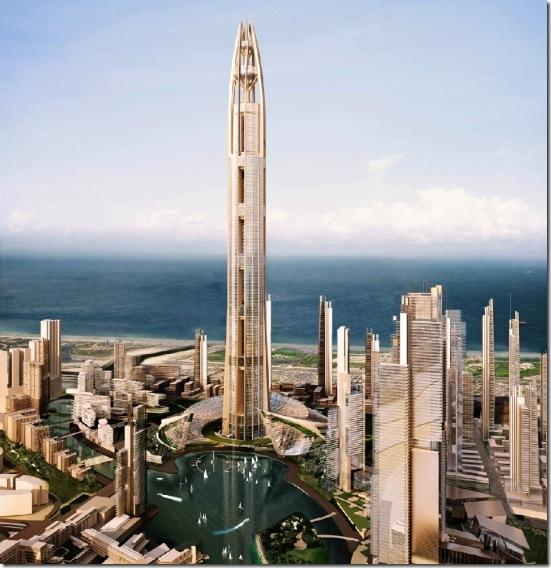
This may sound somewhat counter-intuitive. The Middle East holds the largest known reserves of oil on Earth. Thanks to this we have buildings like that pictured and indoor ski domes in the Desert. Oil has made what was once one of the worst places to live on Earth into a paradise fuelled by pertro-dollars.

Of course, the way that this wealth has remained tightly controlled is an issue for the people in these Countries, but that has not made them riot and protest in the past.

What is different today and since 2008 is the swift rise in the price of Oil. This matters not because it makes the wealth gap worse, but because oil is intrinsically linked to the price of food. When oil goes up so do food prices. There was a tough spike in 2008 which blew off because of the Global Financial Crisis. Now though we are back with oil over $100 and many predict it is not going to go lower again. This, along with crop failures, has pushed up the price of wheat in 2010/11.

Arab Countries are deserts as a rule, so they have to import most of their food from abroad. This makes them especially susceptible to global price changes in soft commodities and they have become acutely aware of the problem. One solution for the Arab leaders may be to increase their food subsidies and lower the fuel subsidies they give their populations.

Another solution which no one is yet discussing is for OPEC to increase oil production to lower the price of oil. To date all comment has been about worries of supply disruption, but sooner or later it should dawn on them what the solution is.