Showing posts with label Financial Crisis. Show all posts

Saturday, 14 February 2026

When does the AI bubble burst - and what then?

That AI is currently inflating a mighty economic bubble is a commonplace observation.  A vast proportion of US economic growth (as conventionally measured) and stock market value is related to AI.  Every damned company on the planet is trying to portray itself as somehow AI-contributing or AI-powered - and they are frequently getting a gratifying share-price kicker from it[1].  Presumably, the pension industry is pretty addicted by now.

In the real world, the vast and (we are told) exponentially-growing demand for electricity - 100% secure baseload electricity to boot - made by data centres is seriously distorting electric power-system planning for many a nation.  Coming atop the average grid's already torturing itself - and its hapless bill-payers - to accommodate the diametrically opposed demands of a decentralised renewables-based future, this is a serious spanner in the works.  And of course governments everywhere are anxious to play host to new data centres, Starmer's as much as any; and are making this a policy priority.   But the (would-be) data centre builders have twigged that these contortions on the part of conventional grid operators may very probably not prove successful - and thus are talking about joint ventures with nuclear generators and ... sponsoring nuclear fusion development! [2]  Yup, it's a completely irrational bubble.     

But what does that tell us about AI itself?   Not much, beyond the obvious fact that it has gripped the universal imagination to the extent that dollar signs rotate in every businessman's eyeballs.  

Well.  Railways had a mania, and many a railway company went bust.  The technology and much of the infrastructure they built is still evolving and very much in use.  We had a dotcom bubble.  It burst, alright, but it didn't mean the internet was a phantasm.  Enron was a bubble: but it didn't mean the Enron vision for how energy markets should be configured was wrong.  (Even China is trying to figure out how to bring that revolution into its own constipated energy sector.)  Etc etc - these techie-based phenomena are not like Dutch tulip mania: nobody needs tulips, but everyone needs railways / electricity / the www / .... and, probably, we'll continue to want and need the advances that are made under the banner of 'AI'.

So: if history is any guide, it'll be a painful financial collapse; a reshuffle of the runners and riders in the "AI industry" (for those who don't break a leg & are not shot by the vet); and the underlying new tech rumbles on to find a more stable way to become a permanent fixture in all our economies and our ways of life. 

Views?  Predictions?  Timing ..?

ND

UPDATE: a bucket of cold water over certain claims for AI:

________________

[1]  Even Drax, FFS - a floundering, downsizing biomass-burning power company.  

[2]  On the eve of the 2007-09 financial crisis, a high-end energy-specialist VC firm of my acquaintance was looking for opportunities to invest in unsubsidised nuclear powerplant development.  When money is aimlessly sloshing about on that scale, that's when you really know a financial crash is coming soon.

Sunday, 19 June 2022

Shorting Germany?

Anon, BTL previous post - "any investment suggestions?" ... 

Well we can't and don't do financial advice or recommendations on this blog, so DYODD etc.

But here's something from Capx which is a clear enough recommendation from somebody else: buy dollars and Italy, sell Germany! 

Blast from the past: 2010
The rationale is basically that the Germans are about to cop the bill for the Mediterranean economies.  Hmmm - that's a bit like nuclear fusion, people have been predicting it for a long time.  But maybe now's the hour.  You can also chuck into the pot Germany at long last being called out / caught out as being the mainstay of the Russian economy (both as importer of stuff and exporter of tech), which may not be allowed to last much longer.  What other game do they have to play that could be equally lucrative?  Well, China, of course as regards the tech exports - but the USA won't let 'em have a free run at that, even if they've (the Germans) been surreptitiously sleeving, not to say laundering for Russia these 8 years.

Personally I went 'buy USD' when the whole current thing kicked off which I date to Feb 2021 (when I first reported far-east gas prices going through the roof here) - a general rule of mine over the decades.  He who underestimates the latent strength of the USA is often doomed to a big disappointment.  Saved me in the late '00's when I shorted GBP @ 2.10 in '07 (hat-tip CU, I might add: I can even tell you which pub we were in).  We tracked its glidepath down on the blog, all through the financial crisis.

Gold hasn't been quite as effective this time around.

How much further down can £ go?  Well 1.05 (1982) is the all-time low (That's what it says when I looked it up just now.  From memory, it actually went a bit lower that year).  The psychological floor represented by 1.00 is apparently quite sturdy.  That's not a prediction, by the way.

ND

Tuesday, 1 December 2015

Some Actual 'Prudential' Regulation Ahead?

The usual rule of thumb about articles ending in a question-mark is that the answer is 'no'.  (Nice Grauniad example today: "New generation wave energy: could it provide one third of Australia's electricity?")

But let's not be too cycnical.  So now the Bank of England has been conducting another round of stress tests.
The Bank subjected seven major lenders to a hypothetical scenario that involved a dramatic slowdown in the Chinese economy, prolonged deflation, a reduction in interest rates to zero and a huge increase in costs for fines and legal bills of £40bn. The test found that profits would fall more than than they had done during the 2008 banking crisis – by £100bn by the low point of the hypothetical scenario in 2016 - but capital cushions remained strong enough to withstand the downturn while increasing credit to the economy by 10%.
I have long-held reservations about these banking 'stress tests':  they are rarely stressful enough; and technically, stress-tests should involve a scenario that is a shock to the system, not an ongoing pressure like 'prolonged deflation'.  However, doing something like a stress test is better than doing nothing.

The BoE has reached some conclusions, the headline being rather complacent airy: "The stress-test results suggest that the banking system is capitalised to support the real economy in a severe global stress scenario, which adversely affects the United Kingdom".  Well let's hope they are right. 

But there is a line-item detail that may, just may, cause them to act; namely the easy terms on which buy-to-let mortgages are available (once again). 
While it did not take immediate action to cool this sector - where lending has risen 10% in the first nine months of the year - it said it was reviewing the lending criteria adopted by firms and stands “ready to take action.” It will also be watching the impact of the extra 3% stamp duty announced last week by George Osborne in his autumn statement.
This might, then, be an actual British 'counter-cyclical prudential intervention'.   Correct me if I am wrong, but I think that would be a first -  the relatively new-fangled Prudential Regulation Authority hasn't really done anything at all along these lines as far as I know.

Of course, other countries act in this way from time to time as a matter of course, and were doing so before the crisis.  Our 'PRA' is a belated effort to catch up a bit.  Will they or won't they?

ND

Monday, 3 August 2015

Stop Press: 14 Years for LIBOR Rigging

Now this is sensational:  14 years for LBOR-rigger Tom Hayes.  Around these parts we have long advocated punitive measures against convicted banksters and this is the kind of sentence that nice middle class people can't confortably contemplate.  If it can happen to Hayes in the City - and Jeff Skilling at Enron - surely there are wider applications.

The remaining issue is: when do the senior managers find themselves coming to this salutary and bracing pass?  And what's the statute of limitations in such matters?

ND

Wednesday, 14 May 2014

UK jobless at 5 year low

Some interesting thoughts though in reaction to this news:

- There are still heaps of part-time workers who cannot find full time work or don't want to.
- The massive rise in self-employment continues unabated

Both of these two measures may well herald a permanent shift in the jobs markets. People are feeling from full-time PAYE work in order to work less but potentially earn more post-tax. Self-employment certainly is more likely to result in lower taxes than PAYE, even if it also correlates with lower income.

- Overall joblessness is has dropped quite a lot in the year, about 250,000

 Surely this is very bad for Labour and their constant attacks on the economy, cost of living etc?

Finally, years and years ago I wrote that all studies show it take 7 years to get over a financial crisis and here we are , just 2 months of the seven year anniversary of Northern Wreck going under!

Thursday, 26 September 2013

The Enron Domino Lesson: Brown Delusion (3)

Quite slowly, actually
The C@W trio doesn't normally sing in unison, but on the Brown Delusion we are for once very much ad idem.   To wrap up CU's and BQ's points that plenty more could have been done by Brown in the full year or more of precious time at his disposal before Lehmans et al went under in Sept 2008, and in case anyone thinks this is being wise long after the event, here is a 'told-you-so' extract from a C@W piece from 14 Feb of that year, entitled Lesson from Enron: How the Dominos Fall 
"Writing as someone who witnessed the Enron saga from *ahem* very close proximity, I learned an important lesson. Well several actually, but this one is to do with how the dominos fall, and the answer is – surprisingly slowly. 
Enron, the pre-eminent market-maker in the global energy sector, went under in October 2001. This brought down the vast and burgeoning ‘merchant energy’ sector, and after that the project finance sector; and at the time I assumed this would happen in weeks, if not days. Not a bit of it: the big energy merchants crashed at the rather leisurely rate of one per month, until the final bankruptcy (TXU Europe) a full year after Enron. Project finance hit its nadir the year after that. 

There isn’t space here to discuss why this happens in such slow motion. The point is that what we are currently seeing on the vastly greater theatre of world finance, indeed the global economy, needn’t be anything other than protracted agony. We can expect wave upon wave of Bad News, each time emanating from some new and unexpected quarter. IMHO, we’ve only just begun - Happy Valentines ! "
Yes, there's usually time to do something - presuming you know what to do.  But then, Brown was a genius - wasn't he ?

ND

Monday, 23 September 2013

The Brown Delusion

The UK under Gordon Brown

Hmmm....I don't think we should let go unchallanged these assertions made about Gordon Brown in the new damian McBride book. If only becuase they show the usual one-eyed perspective expected of an apparatchik. Apprently Brown as amazing during the 2008 crisis because he managed to discuss getting troops on the street. Not only that but he was allegedly very clam with other world leaders and showed good leadership during the time of crisis.

Seriously?

How exactly did this crisis come about? As my colleague Nick Drew described eloquently last week, the banking crisis started in early 2007 and really kicked off when Northern Rock went under in the middle of 2007. Its peak was in October 2008. What did Brown and everyone else do for a year whilst the banks went under. Where were the stress tests and emergency capital calls that could have saved RBS or HBOS or indeed any of the other mutuals that went under. Or where was the preparation to allow the banks to fail whilst preserving the banking system and the deposits of small retail customers? No this was the time for great rhetoric from Mr Darling in hte 2008 Budget; he spoke of 'this other Eden' and about the opportunities that awaited the UK. Even in the teeth of the Financial Crisis there was to be a budget surplus in 201 and growth prediced at 2.25%.

It is hard now, just 5 years later but with so much having happened, to remember just how absolutely delusional the Government was at the time, not even realising there was a crisis until September 2008 and then being left with no alternative but to take over the bust banks which it had encouraged through the noughties to lend money and not worry about that pesky regulator or commercial reality. Tax income was too important for that.

Even in the crisis to say that Brown of Darling were statesmanlike is laughable. They knew nothing until the crisis was upon them and then had to make obvious decisions in the space of a few hours. Where was Brown counselling Bush against letting Lehmans fail or stopping the Wall Street domino crash of investment banks?
Nowhere to be seen, that's where.

They were worrying instead about how to reverse the 10p tax gimmick that had gone wrong. Worrying about whether the current budget was Green enough for Polly Toynbee.
That's where there were busy.

Could any Government have avoided the terrible crisis we have endured, probably not, could it have been handled much better than it was? Certainly. Idiotic scorched earth policies like 50% tax rates show how important political points scoring was over economic reality and also how they were happy to predict a future of easy growth to justify their vast over-spend ahead of what was obviously going to become a huge recession.

Leadership? Bravery? Do me favour. It's a horrific episode in our history that will scar the Country for the rest of my lifetime. Brown and Darling should be arrested for treason.
Finally, let's nto forget that at the heart of this Government, giving advice and inside the small cabal, were Edi Milliband and Ed Balls, the men who will likley be in charge to create the next economic crisis.

Thursday, 29 August 2013

Merchants of Doom

A cheerful banner across the Telegraph's online Finance page this morning.


Just when you thought it was safe ... emerging market rout ... budget disaster ... cannot save Greece ... lose control of inflation ... mass unemployment will return ... world slump

Oil up, Gold up ... quite like old times.

ND

Saturday, 15 June 2013

Capitalism Works - Well Of Course! Up To A Point ...

Some good weekend reading here, from the DTel's Jeremy Warner.
This crisis has proved that capitalism works. The G8 protesters have little support – there’s no public appetite to blame the free market... on the whole they don’t seem to be fulminating about the free market system as such. It’s financial excess that is blamed for our travails, not market failure.

Discuss, as the exam rubric goes.  I'll chuck in a couple of thoughts.  First of all, I strongly agree with Warner's pivotal statement: "Capitalism is nothing if not supremely adaptable" - which trumps all your leftists and euro-dirigistes every time.  But actually, it isn't really just capitalism: it's the whole ruthless 'Anglo-Saxon' policy-making complex that au fond has a stronger grip on how markets actually work, and what the tools and levers are - and isn't afraid to use them.  (Bailing out banks isn't intrinsically capitalist at all).  Again, these are advantages often not shared by your lefties and dirigistas (although that Mario Draghi seems to know a thing or two).

Secondly, he has some sensible things to say about Anglo-Saxon labour-market flexibility - particularly his observation that this has virtually nothing to do with government intervention. At least, not direct intervention in the crisis: there were certainly interventions in the 1980's to diminish the powers of UK unions, for example.

The final point though, surely, is that it's not over yet - despite the recent rash of upbeat pronouncements, which seem to me to be premature in the extreme.  As Warner says, bailing out banks and printing money  "are creating massive distortions that may be piling up problems for the future." Oh yes indeed. 

ND

Thursday, 13 September 2012

Ego unbounded and unbent- Peter Cummings

It is very lucky today that I am going to work early enough to avoid breakfast; otherwise on reading the paper I may have choked this from the Telegraph:

"In a statement Mr Cummings said he rejected the FSA's findings but would not be appealing the fine.
He said: "Many people must bear collective responsibility for what happened, including governments and regulators as well as the boards of the banks themselves. But the fact that I am the only individual from HBOS to face investigation defies comprehension.
"The decision to single me out for investigation is even more grotesque given that even the FSA has to admit in its notice that other senior people were involved in the critical decisions for which I am taken to task. This is tokenism at its most sinister, and has made it feel throughout like institutional oppression."


Poor Mr Cummings, responsible in the main for signing off dodgy loans with markers like 'approved for business development purposes' when the Credit teams at HBOS had come back saying not to make the loans as they were too risky. Mr Cummings, who indulged in the ultimate 'pig and pork' banking whereby you lend equity and debt (senior and mezzanine) to a client who if they go belly up you will be guaranteed to be over-exposed and take a massive loss. Real banking 101 stuff. Lo and behold, HBOS lost so much money in 2008 a Government rescue via Lloyds was the only way out. Lloyds has not recovered, still writing off billions in losses on real estate loans, of which almost the whole book came from HBOS Corporate Banking wherein Mr Cummings was the boss.   Of course, he wants to blame regulators (who could have sacked him) or Politicians (who could have given backbone to the regulator) - but no one made him sign-off on these loans.   By my guesstimation he has ended up costing taxpayers a bailout of around £20 billion. A ban from working in the City and a fine is getting of lightly - in the US he would be looking at a long stretch, in China possibly the death penalty.   I generally am happy with the Government proposed reforms to the banking system, they will make it safer - but Mr Cummings did not do anything criminal under current or proposed laws. This should change, if it were me he would be done for treason.

Friday, 9 March 2012

Greek Denoument

Crisis Over.

In the end simple really, get the ECB to declare it can;t take any losses, agree there to be no restructuring of any Sovereign bonds and impose instead of this a 75% loss on £125 billion of private sector loans. Why should Government's face losses when their are private market players to mess with?

Hey presto, the Greeks are saved and can be lent money by the Eu to help them push austerity further onto their Country which has a currency 20% overvalued and youth unemployment at over 50%.

All is well, Merkozy have completed their work.

What can possibly go wrong now?

Thursday, 26 January 2012

The Great Depression

If you put five economists in a room and ask a question, you'll get seven definitive answers. The IMF seems to have covered all its bases by suggesting ever more stimulus for America, a little stimulus for the UK and austerity for PIGS.

Three economists on Newsnight debated the merits of Keynesian economics. The New Deal got its usual airing. What surprised was that they never seemed to point out that all the major combatants of world war two had a different approach to resolving the great depression. And all were cut short before the effects of whether they were a success or a failure could be realistically measured.

The Fascist Germans pursued arms production with a vengeance, but needed to have an export market to obtain the hard currency to buy the missing rubber, steel, copper and oil to feed the factories. So Germany's pre war boom was accompanied by frequent busts as it struggled to balance its economy. Germany funded its boom with a mixture of taxation, confiscation, restriction and promises. The Mefo bills his 12 billion RM of debt. Unemployment was tackled by removing women, by benefits for staying at home having children, and Jews and undesirables, by imprisonment and death, from the workforce. What would have happened to Germany if they hadn't embarked on war? The opinions at the time were that it was running such unsustainable spending that it would eventually be unable to continue funding its war machine and the cost of all the arms and armaments that it had created, and just implode. But at the same time Germany's 1930's recovery was seen as a miracle, similar to West Germany's.

The Japanese devalued. Abandoning the gold standard that had trapped them, the Japanese devalued the Yen by about 40% and Japanese exports, especially textiles, soared. Large Japanese stimulus spending was used for large drainage, irrigation, land reclamation. Arms spending was also great of course. The worlds third biggest navy had to come from somewhere. All this was funded by government issued bonds. The government issued bonds to the banks and the banks sold them to private investors. Japan was on a Keynesian road to recovery by 1933. Unfortunately in attempting to control inflation and an overheating economy, the finance minister , Takahashi Korekiyo, cut military spending and so was assassinated by militarist radicals that destroyed the Japanese during the 1930s/40s. It is not known if the Japanese economy could have been deflated successfully without setting off a second recession. It wasn't tried. Military spending followed Germany and went ever upwards. And as all countries found rearmament forced up the price of raw materials, so forced up the costs of rearmaments, so increased inflation..

The British Empire tried austerity. Austerity first was the UK solution. The decision to rejoin the gold standard in 1926 had caused harm to the only slowly recovering export trade. Wages and jobs were cut to make factories more competitive and led to unemployment and the general strike. And from then it just got worse. the Wall Street crash was followed up with government tax rises and wage cuts which just removed purchasing power from the economy and unemployment soared to 3 million at a time when the population was just 50 million and women were not working in many workplaces at all. Coming off the gold standard and trade tariffs with the empire helped, but did not end, the damage done, and the recovery was a very long time in coming. Chancellor Neville Chamberlin was a firm believer in controlling overspending and defending the value of the pound. His limited rearmanent policies had not created the booms experienced in Japan and Germany, but hadn't created the debts either. Great Britain could have not have fought long if it had gone into WW2 with an empty treasury.
Even so, with the stimulus in arms spending from 1938 unemployment still failed to fall significantly in the UK, probably as much of the money went on air defences. The aircraft industry, unlike the navy, requiring fewer, higher skilled, workers.

France tried everything in the late 1930's and failed at all of them. It reversed policies so many times it ended up with debt, austerity, unemployment, giant stimulus spending, frightful unproductivity, devaluation and shortages. France was in a terrible position to try and resist the German arms race, partly from having fallen into the depression last and pursued policies that meant it didn't emerge until last either. In 1936, in France, the Keynesian stimulus was spent on increased wages and social benefits rather than increased output and so caused ever increasing inflation that ate up all of those 1936 wage gains by 1938, without the necessary investment to lead to increased productivity. A reminder of how government spending in the 1970's didn't raise living standards, but actually decreased them through stagflation.

And the USA. The New Deal. Well, we know it worked. Sort of. The slowing of the stimulus spending in 1937 led to a big rise in unemployment. up by around 5% to 20%. The US economy stalled that led the right to complain that all the government spending had done was to push up wages, cause thousands of strikes at a time when workers were desperate for jobs, and lead to too high taxes on business. It all got very acrimonious. But what can't be denied is that stimulus had not ended the great depression of 1929. Even the orders for arms from Britain and France that poured in from 1938 didn't sort the economy. What would have happened if the war had not broken out? Could Roosevelt have just continued priming the pump indefinitely? If any country could, the USA could. But would it have worked? Or would each time government spending was reduced, economic measures fall?

World War Two turned all democracies into totalitarian, centralised, bureaucratic economies. Debt and consequences weren't an issue and so the answers to which countries were the most right in ending the depression can't be known.

Thursday, 17 November 2011

Mr Drew Takes a Haircut

Being a big believer in diversification, and having no great faith in the FTSE, four years ago I invested one of those structured products: Protected Capital and Growth, meaning a guaranteed minimum 21% return - or more, if the FTSE over-performs - and my original investment is secure. Note how I didn't use inverted commas there, trusting soul that I am. You know what's coming.

So. Today Legal and General write to me. It starts innocently enough.

"We'd like to let you know ... oh? that's kind ... about an important change we've made to your investment ... and how it will affect what you get back when your plan ends ... but isn't that, err, 'secure', to use your word ? ... Your investment works by investing in a fund, which in turn invests in a number of financial institutions ... go on, I am beginning to get the picture ... These provide the return of your original investment plus growth potential."

OK, so by now I am guessing that the next bit will effectively read: "Or not, as the case may be." Right?

"The institutions invested in were: A, B, C, D, E, F, and ... wait for it ... Irish Life & Permanent plc."

Bastards !

"As you can see, one of the institutions was Irish Life & Permanent... Irish financial institutions are less likely to be able to pay back what they owe. We've sold this investment earlier than intended and received less than the original value ..."

16% less, in fact, resulting in a net haircut of 2.63%. AND it is not covered by the Financial Services Compo Scheme, it seems, because Legal & General itself has not failed to meet its obligations. Or so they tell me.

And this, I suspect, is
increasingly what we will all be confronting as the postman makes his daily deliveries.

Still, good old A, B, C, D, E & F; and praise the Lord for diversification, eh? Until the next letter hits the mat...

ND

Wednesday, 3 August 2011

Meltdown ?


Back to business: it's looking ba-ad. Alphaville calls a meltdown and who's to say they are wrong.

Back in 2008 we wrote that the dominos fall in slow time: Sackerson responded then that at least that gives one time to do something. They started falling in 2007. What have we all done in the last 4 years ?

ND

Link

Monday, 1 August 2011

Gold etc etc etc - Safe Havens for Troubled Times

The FTA has solicited views on what might be a safe haven for such assets as you have left. Sitting back and watching gold contemptuously dismiss the American 'compromise', as a service to our readers here's a summary of the answers, clustered for ease of review. Never say we don't look after you.

Philosophical

- just about any asset not US based will do - the safest thing in the entire world is surely a bouncy castle (nice one, Izzy !) - education/schools in developing nations - family - invest in human capital: invest in your children - secure white-collar private sector employment with annual pay rises that outpace inflation - t
he most effective flight to safety is the one picked as consensus

Financials


- cash - japanese government bonds "but FX hedge is needed!" - Bitcoin - Singapore Dollar - Australian Dollar - US dollar - SEK - Renminbi savings account - New Reichsmark - Swiss Franc - Terra Trade Reference Currency - gilts - SDR version 2 - New Currency (could even be a parallel currency to say the SFr) managed by responsible people [sic]

Equities etc

- global mega caps Microsoft, P&G, Philip Morris, etc - Moody’s 20 Cash Kings - Mongolian mining stocks - Sturm Ruger & Co - The Ocado business model - poundshops

Physicals

- silver - gold - basic products like food, and drink, internet services - energy - turnips - coffee - chocola
te - rare earth minerals - copper - oil & gas - Dominos Pizzas - Apple iphones - prime London real estate - land

Survivalist

- farmland - cows - mixture of deciduous and coniferous woodland - mixed use agricultural land - assault weapons - tinned beans and digging a deep bunker - safe houses - solar - literally bunkers - food stores - small farm in Canada with (golden) cows - a croft in Sutherland, Scotland with it's own Irn-Bru still and water rights

Broader perspectives, *ahem*

- inflation adjusted stupid-government-insured CDS, with also synthetics and squareds available - human urine - whiskey - Hermes ties - Irn-Bru - dope - grade 1 opiates - Hershey's Nuggets - constant maturity put options on Bove's strong buy calls - doughnuts - beer - booze and wine - creme eggs - teenager-backed bonds - a giant floating mattress in the Atlantic

= = = = =

Well, there you go. No financial advice here, of course ...

ND


Monday, 15 June 2009

Bank Regulation to the fore


Over the weekend the first leaks of what changes to financial regulation seeped out of Washington and London. Peston has the highlights and his take on it here.

What is missing though is anything either exciting or bold. It is firmly in the lets tweak things a bit and hope it never happens again bit.

There is for example no core consideration of preventing banks from becoming too big to fail. This was the biggest issue in the crisis. AIG, a non-bank but still a big trader, has cost the US Treasury over $100 billion, which will never be seen again. Indeed much of that money seems to have come the way of Barclays and RBS banks'.

So no big knife to cut up the industry, little comment on the need for any accounting changes or thoughts about what may cause the trip up next time.

What does this tell us? That in their hearts, the US and UK Government know that they were the prime cause of the crisis with low interest rates and large money supplies warping the system. If they did not think this, the changes put forward would be more radical.

Tuesday, 10 March 2009

UK sliding fast; good news?

The latest figures out today show yet more very grim reading for the UK economy. Manufacturing sliding a the fastest rates since 1981, UK house sales at all time lows.

The world economy is too on the skids and there seems to be no good news coming from anywhere. The phrase 'off a cliff' is over used, but it is appropriate to describe what has happened since the autumn of last year.

On the brighter side, I note the FTSE today is showing some resilience to this bad news, as if most of it is already priced in.


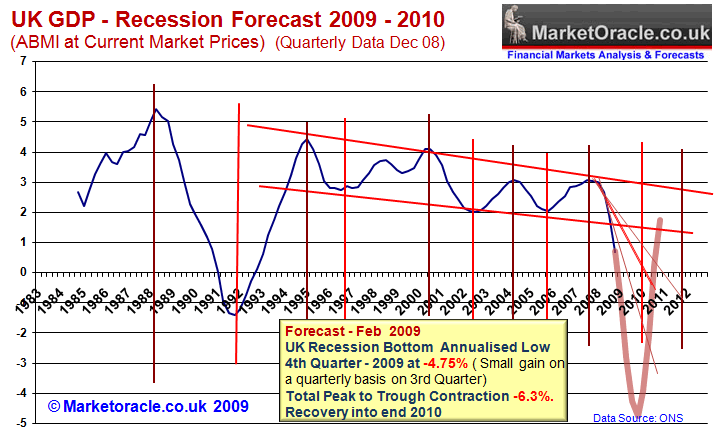
A look at past UK recessions as well shows up an interesting point. The UK is very prone to fast falls and then fast recoveries, more so than other economies. So as much as the news is bad today that everything is getting worse quickly, this also allows for the bottom to be reached faster and the turn around to start sooner. A slow drift down would be much worse.

With a hat--tip to the excellent market oracle site, see the graphic for how the 1990's recession looked. The 1980's was the same, as was 1974.
At the moment we have the sharp fall, painful and frightening, but maybe it is bringing forward the bounce?