Tuesday, 1 March 2022

Mr Putin: What Are You Like?

Some folks around here suggested that mention of the Sudetenland was in bad taste.  I can't think why; the analogy seems pretty clear (in that excellent podcast we were referred to yesterday BTL, Starkey essentially agrees) and as with any analogy, it's there to be considered for its heuristic value.

Nothing daunted, I'm going to suggest another similarity between the two little dictators:  both seem to believe in their own abilities as military strategists and tacticians, with little compelling justification.

We've read in several places that Putin has proceeded very cleverly in strategic terms, "laid a trap for the West", built up substantial financial reserves, squared China away, allowed Germany to become hooked on his gas etc etc, and perhaps there's a decent argument along those lines - right up until he fired the starting-pistol.  But where's the shock-and-awe sudden victory?  Or, conversely, what's the merit in allowing the military stuff to unfold as messily as it is?  I can suggest only one, and a heavily qualified one at that.  Maybe he wants to occupy a really big chunk in perpetuity, and doesn't want to damage the infrastructure too much, or piss off the inhabitants.

Well.  That would have depended upon a very quick rolling-over by the defenders; or the spontaneous anti-government uprising he called for; or for the West to pull the rug.  As things stand, none of these being self-evidently just around the corner, it looks as though he'll need to contemplate something considerably less than ideal - (a) stepping up the destruction in a big way (which can always "succeed" in its own terms, but hardly glorious);  (b) continuing to look stupid in public (and pathetic to the Chinese);  or (c) settling for some near-term outcome that is rather lame-looking against the apocalyptic circumstances and his extraordinary rhetoric. 

On (c), it was widely suggested that Putin has available to him a fruitful strategy of "bloody a few noses, seize 50km, freeze the new border, wait for the waters to close over, rinse and repeat, from Tbilisi to Tallinn".  In other words, that's not to be characterised as I just did, as a less-than-ideal outcome: it's maybe what he wanted all along.

I'd be interested to know if any of our BTL-ers who espoused this view still reckon it flies.  He certainly has his 50km if he finds that satisfactory (though at the time of writing I'm not sure Odessa is in the bag).  IMHO, the flaw would seem to be: just how long is it that the professional Russian military etc is willing to be humiliated by the distinctly unfunny pantomime they're being made to participate in?  (Then again, people probably said that about the Wehrmacht in 1942.)   Additionally, the whole of NATO - including Germany! - has been royally stirred up; and Tallinn might be feeling a bit more secure than it did three months ago (for now, at least).  The "50km" strategy starts to look a bit, well, glacial: I ask again, how long has he got? 

*   *   *   *   *   *

In my view, then, Putin is guilty of Adolf-style micro-managing the military (the ever-tempting sin I've frequently lauded George Bush Snr for avoiding):  I'm not quite as ready as Starkey to attribute strategic prowess to L'il Volodya, at least in the purely military sphere (nor the 'hero' status in the non-Western world that Starkey confers upon him).

So what would have been the outcome if the Russian military professionals had been given proper delegated authority?  Even more destruction?  No.  [Caveat: I'm working off the 1970-80's Red Army playbook which used to be my concern.  But then again, so (probably) will the current generation of Russian generals.]

The first thing is that speed is always of the essence, and for that, you advance across a wide front avoiding towns, forests, mountains and bogs etc like the plague.  Even if they harbour forces of resistance, you bypass and (de facto) encircle them, to be mopped up at leisure if they are to form part of what you decide, eventually, to hold.  Otherwise they simply impose delay.

Exactly the same principle applies to any enemy strong-points you encounter along the way: you "fix" them and bypass.  Surrounded, they will be bludgeoned by second-echelon forces in due course.  By these clear-sighted and decisive means you aim to make maximum penetration along as wide a continuous front as possible in the least time.  Some kind of finish-line will have been given in advance, or you may decide on a different halt-line based on unfolding circumstances.  Back-filling to this new line is easy because you have the numbers to do so (in second- and third-echelon units): and the firepower in the first wave, coupled with air power and long range artillery, is sufficient to set up formidable defences along the line you have reached.  Maybe you won't hold it all, but that's your choice, to be dictated by a combination of politics, the terrain, and what the enemy is doing in front of you.  All in all, a fairly desirable outcome: and a lot quicker than what's going on today.

It's pretty clear this isn't what's happening.  Why?  I'm not sure inadequate numbers explains it (and if it does, so much for the brilliant strategy).  As noted here several days ago, the forces we've seen deployed are using fairly ancient kit - but then again, it should be adequate for the task.  Nor is it squeamishness - or even due caution - over the amount of destruction caused: the second-echelon "mopping-up" of bypassed towns mentioned above is entirely optional (less dramatic alternatives are available); and in the meantime the engagements will only be with the enemy's own military units, plus a little collateral damage to infrastructure.

I am left with my analogy with the other little guy who told his generals what to do in amateurish, self-defeating detail.  No, not Napoleon - (who knew exactly what he was doing): the other one.  

ND

Monday, 28 February 2022

West taking gambles and risks too quickly

 A goof debate on the last thread, the situation in Ukraine moves quickly and it has become the most dangerous crisis of my lifetime in short order.

Russia is defeated, if not on the ground then in the world opinion. The crazy nations like North Korea, Brazil and Iran are not going to save Russia. Even India and China are staying neutral. 

The huge sanctions placed on Russia are going to bite much more quickly than Putin imagined. Equally, the ground war is taking much longer and maybe much more bloody than expected. 

The West is full of preening Politico's and media today very pleased with themselves at Unity and the usual # mentality - echoes of "#Bring back our Girls".

In the real world, we are at the most dangerous point now. Putin won't stand a loss. Heavy and horrible weapons will be used on cities. Already Katyusha's fall on Karkiv which is a Russian populated city. Putin also darkly threatens nuclear retaliation of the real kind. 

I understand the West is also concerned to send China the right message re Taiwan, that this could be your fate too, but this is very risky. Indeed, I can't believe cool heads are war-gaming this properly because the chance of nuclear weapons being used is climbing - from an infinitesimally low number to something in the low digits percentages. Much like the Cuban missile crisis. 

Of course, if Putin is going to end up destroying the world whether we deter him this week or not makes little difference, it is up to the Russian army alone to fix the problem. However, some calmer thought and more work behind the scenes instead of in front of the camera's is desperately needed. 

Friday, 25 February 2022

Modern hybrid war - it never ends

 The invasion of Ukraine has been long signalled and 10 years in the making.

The propaganda war has included Russian support for the SNP, Brexit, Catalonia and others. Much bribery in Germany in Italy and all across the EU. Even support for President Trump.

Even when Ukraine falls, which sadly remains likely even if it becomes a low grade war much like has happened in Donbas for several years, the hybrid propaganda will continue.

China has conveniently fallen for it, as have the usual leftie-suspects in the UK like Corbyn and Galloway.

Then next stage will show Putin suddenly keen on peace, trying to partition Ukraine and withdraw from Kyiv, whilst still blaming Ukraine. Then a plebiscite is Eastern Ukraine will ensure it joins Russia fully, perhaps Transnistra too.

Meanwhile, the gas vs sanctions will play out, not too long until the summer to Putin new he had to strike now whilst the gas threats might work on Germany. 

Then what, what next will the Maskirovka try to do - undermining the West will surely only step up? 


Thursday, 24 February 2022

Mr Putin's Gas

What plans does Little Volodya have for his gas weapon?   (Methane, that is: large-scale chemical warfare doesn't seem too likely right now.)  Gazprom's great selling point has always been reliability - better, for example, than the Dutch, who in their heyday as an exporter would always interrupt external sales rather than deliveries to their own people.  With Russia it was the exact opposite: Russians could freeze in order to support hard currency sales.  Notwithstanding Putin has been holding back gas for many months now, he's always met minimum contractual obligations and curiously, just today, westward flows of Russian gas are the highest they've been for several days.

"Suspending" Nord Stream 2, as the Germans have done, is virtue-signalling, but meaningless in practical terms:  they'll un-suspend it at the first convenient juncture.  Ol' Uncle Joe Biden said something at the weekend rather bellicose about NS2 but I kinda doubt he has in mind blowing it up, easy and rather satisfying though this would be (there's a James Bond film involving a Russian gas pipeline, as I recall).

So: will Putin turn off the taps, as that long-running and rather prescient little graphic in the opening credits of HIGNFY has it?  More constructively, he may satisfy himself with the dramatic price hike that's already happened, of course.  

One thing's for sure, the Germans (and many others) are in absolutely no position to forgo that gas voluntarily, as we've noted here before.

Which leads us to consider a Big Accident.  If there's too much high-explosive shit flying about in Ukraine, well, all that infrastructure is really quite fragile (although not too difficult to repair).  Quite a big chunk of Russian exports still transit Ukraine, albeit NS2 is designed to put paid to that.  Who knows what any number of rogue actors might think of doing in that very large country, in the fog of war?  There are plenty of people who could profit handsomely from a Big Accident ...

"Short gas" may describe all our positions as consumers right now.  Won't be many commodities traders short gas at the moment, though.

ND  

Monday, 21 February 2022

Oh ye of little faith

 Told you all it was 21st Feb.


Hope you all stocked up on oil and gas futures.


While we wait for Putin ... here's some meerkats

I've long been quite surprised that the market has sustained so many price comparison sites.   Presumably, the software is relatively simple, the overheads are low and their biggest cost is massive prime-time TV advertising campaigns.  It seems to be as competitive as an industry ever gets - ironic, when at the start of energy-price comparisons we notoriously only had the 'Big 6' of actual energy suppliers.  Right now, unsurprisingly in view of the UK energy pricing debacle, they're in trouble. 

You'll have read it here; but I don't recall ever seeing in the MSM recognition of the baleful impact the auto-switchers or 'flippers' had on the health of the energy supply market itself.  It was once impossible for small new entrants to access this market - and quite right too: why should the barriers to entry in a sector like this be low?  But a number of factors conspired to turn this situation utterly on its head, so that any two-bit rogue could play - and play with other people's money, too.  High on the list of new factors was the 'flipper':  all you had to do was register with the site, ensure your price was the lowest for a short while (or, with the less scrupulous ones, cross the flipper's palm with silver for 'special favours'), and be sent as many customers as you wanted.  Simples, eh, Sergei?

And play they did - for a while, until the tide inevitably went out and their lack of swimwear was revealed.  Meanwhile, many a rogue syphoned off a chunk of the free working capital that the energy 'market' gifts to end-game suppliers in the form of pre-payments, and green levies collected but not paid over.  As well as genuine profits in the early stages of this game when prices were falling and they could play the Northern Rock tactic of sell long, buy short - without needing much by way of credit-lines.  Yes, of course it was unsustainable.  

The outcome is costing us £ billions to unwind, even though Ofgem's SOLR mechanisms mean no customer loses their supply in the process.  It has also brought the game into fundamental disrepute.  Ofgem is generally quite a good regulator but they screwed this one up royally.  Thanks, Sergei and that Welsh git.

ND  

Thursday, 17 February 2022

Russia Has A Painful Precedent In Mind

 ... and it's Finland, 1939-1940.

Russia hasn't had stellar success of late, even in Georgia and Chechnya, both a damn' sight easier to chew off than Ukraine.  

But the real pain must come whenever they think of Finland, whose heavily outnumbered forces dealt them a serious bloody nose.  It's generally reckoned the Soviet casualties in the 'Winter War' were of the same order of magnitude as Britain suffered during the whole of WW2 - and that in just three and a half months.  For not much gain  (a bit of Donbass-style land-grab), and substantial international opprobrium.   (Not that Joe Stalin cared very much.  Nor about casualties, for that matter.)

That's what can happen when you take on a nation that is (a) very big, geographically, with unlimited ability for tactical retreat by the defender, and overstretch trouble for the attacker;  (b) fiercely nationalistic.   Given their own dealings with Napoleon and Hitler, we might imagine that for the Russians, this lesson is not lost ...

It's been fairly noted recently that successful guerilla wars are fought by youthful fanatics, not middle-aged populations - with the suggestion that under this precept Ukraine has the wrong demographics for that kind of resistance.  Maybe so: but surely Finland is a much more relevant case study.

Oh, and that extremely interested observer President Xi will also be recalling China's own less-than-glorious attack on Vietnam in 1979.  Still, at least Putin hasn't pooped on Xi's Winter Olympics party in the unseemly way he did with Georgia, slap bang in the middle of Beijing's 2008 summer games, to China's profound disgust.  Well - not yet, anyway.

ND

Tuesday, 15 February 2022

Revealing Pictures of Russian Military Preparations

OK, so I last looked at Russian military kit in detail, in earnest, almost exactly 30 years ago.  And guess what?  Almost everything we've seen so far from the Russian side of that messy border is of just that vintage, i.e. 35-40 years old (because they hadn't done much innovating after the fall of the Berlin Wall).  

We are led to believe they have in fact made some serious strides in, for example, AA equipment, but they ain't showing that.

What do we infer?  There might be several hypotheses, not all mutually exclusive by any means:

  • Naturally, they do have some modern kit - but maybe not in large quantities
  • They reckon they can do the job quite comfortably with the old stuff
  • The units they are deploying - at least for the cameras - are not front-line troops: Russian policy has long been to scrap nothing, but to relegate it to equipping reserve formations
  • They have no desire either to expose the new stuff to close inspection (recalling how much they *enjoyed* their own ringside seat at NATO's extravaganza in 1991 - see my Kuwait account ad nauseam); or, of course, to see plum bits of new kit embarrassingly captured
Anyhow, it's a feast of déjà vu for old Soviet hands like meself ...  If I find a bit of time I might make up a bit of a photo-feature.

ND

Friday, 11 February 2022

UK growth at 7.5% in 2021

Despite what  the headlines will try to say, the economic growth last year merely puts the UK on par with most other Western Countries post-pandemic. 

The UK had the highest fall in GDP and productivity given we were hit hard like Italy with the first wave of Covid. 

Since then, the successful vaccine roll-out and some spirited determination to live with the virus rather than have constant lockdowns, has allowed the UK to play catch-up. Meanwhile, France and Germany have had a harder time with the later waves and so have not seen their economies re-bound as strongly. 

Germany in particular is in a challenging position. It's main export market for manufacture is China and its main energy supplier is Russia. This is not a good geo-political place to be and there is no easy way out of this for Germany politically or economically. 

Still, that the UK has recovered to near par is a good thing. However, the extra NHS spending, endless tax rises and interest rate rises are going to bake in a nasty downturn at some point, it is quite a way down from such high levels of growth but stagflation beckons for at least a year or two. 

Thursday, 3 February 2022

The great game

 Sorry for the long pause, be a bit challenging at work but suffice to say I have a period of free time now….

So, on good authority I have a date for the Russian invasion of Ukraine - Monday 21st of February.

So the question for everyone is, why do I posit this date? 

Monday, 31 January 2022

The Boris Blitz and what it betokens

 ... aside from the fact that the man is utterly shameless and very desperate indeed, a dangerous combination.

Few who pay any attention whatever to anything other than the lowest form of social meejah output can have missed the Boris Blitz of apologia, stunts, diversionary announcements and other attempts to "regain control of the narrative".  We can confidently expect him to visit a slit trench "somewhere in the Ukraine" shortly.  Sadly, we can also be confident he will spend epic quantities of our money on ill-conceived attention-grabbing policies.

It signals two things worthy of note: one specific and one timeless.

(a) He has some competent advisers.  They may not be in the Cummings class in any particular dimension (recall his extraordinary performance in the Autumn of 2019), but they know the basics of their trade (mostly, Lynton Crosby's Dead Cat** strategy).  And they must be broadly "loyal" because, given their shameful brief, they are advising intelligently and comprehensively.

(b) Government always has the whip-hand - or at least, a whip-hand - because like it or not (and Starmer won't like it at all) it can always set the news agenda and has a truly vast array of levers at its disposal: with a little creativity, even more levers than are obvious.  This is something Mandelson always knew instinctively, and exploited to the full.  Cummings likewise, in that Autumn 2019 campaign (proroguing Parliament!)  However, a surprising number of "experienced" politicians don't.  Probably the total lack of creativity, of course. 

It's why the oft-heard suggestion "this is an Election to lose" is always wrong.  Power, when held in the right hands, is always the right answer.  It's like: who doesn't want choice?

Incidentally, none of the above acknowledges Boris' strongest card, which is that the Energy Crisis buys him guaranteed time - and time is always also of the essence.  Playing for time is a pathetic business, but often the very core of political strategy.

Not even Starmer, I think, wants to be PM until after April ... even though that flies in the face of my dictum above.  Lack of creativity, see.

ND

____________

** Before this Crosby coinage became the generally-accepted nomenclature, I used to think of it as the "Royal Yacht" strategy.  Back in 1997 after the great Blair sweep-to-power, Blair disappeared off for an extended summer hol ... leaving Mandelson in charge (amazing to recall).  Several things started to go wrong rather publicly and embarrassingly - the one I remember specifically was the Millennium Dome project.  So Mandelson announced the Royal Yacht was to be scrapped, and immediately grabbed all the front pages.  So easy - when you realise what's possible. 

Thursday, 27 January 2022

"Biden to get gas for Europe" - Really?

It's jolly nice of Joe Biden to say that he'll make sure "Europe is able to make it through the winter and spring" as regards natural gas, if Putin switches off (some of) the taps.  But he'll search in vain for a good precedent.

Oil is proibably the most relevant.  Yes, Saudi Arabia has been prevailed upon from time to time to open the taps a bit - but in terms of total volume, only to marginal effect.  (The effect on the price can be disproportionate, of course: that's how the market dynamic of commodities operates.)  But what about the First Oil Crisis 1973-74?

Recap: Israel invaded Egypt; OPEC reduced overall production and instituted an "embargo" of sales to countries it deemed to be supporting Israel - notably, the Netherlands on some pretext I've forgotten.  So the OECD set up a small working group in its Paris offices, (an organisation that was later to become permanent as the IEA) to coordinate the entire free world's oil stocks.  Everyone played ball, and a scheme of global rationing was put in place.**  It kinda worked, and eventually OPEC backed down.

But let nobody imagine it was a walk in the park.  (a) All motoring was severely impacted, for months++.  (b) Not a few power stations around the western world were oil-fired back then, and there were serious power cuts.  (c) The price of oil went up from around $3 to $12, and stayed there (until the Second Oil Crisis in 1979, of course, when it went to $30).  This of course is widely blamed for the serious western inflation and economic downturn of the '70s, Thatcher & the Wicked Tories etc etc.

And oil is very much easier to re-direct and store than natural gas, even with today's big fleet of LNG vessels.  Biden makes great play of how he's talked to the Qataris about "more gas for Europe" but believe me, at recent prices they and every non-Russian gas producer on the planet has been flat out at max already.  (Whisper it softly but the UK has been importing US shale gas for months now.) 

The parallels of the oil crisis of 1973 if played out in natural gas in 2022 would be extremely painful, possibly long-lasting, and inflicted on populations that have forgotten about commodity privations and how to get by.   (1973 was less than 30 years after WW2, and only 20 years after UK rationing stopped.)   In particular, who can see the Germans - among the worst exposed - going along with it?  As noted here before, Merkel spent the long years of her regime doing absolutely nothing to lessen German dependence on Russian gas (not even a single LNG terminal) because, truth be told, (i) she's a Russophile and (ii) Germany's foreign policy vis-à-vis Russia has long been based on a voluntary Danegeld principle, which privately they've convinced themselves is a positive thing.  They're appallingly exposed; and the rest of us still largely depend on gas for heating, and (across the whole of Europe) balancing the grids when the wind doesn't blow.

So Good Luck Joe, and thanks for the thought, even as we contemplate shivering through until spring.  But you try getting the Germans fully onside.

ND

_______________________

**  They wanted the rationing to be "optimal" (big word, that) so they needed a Linear Programming approach of unprecedented magnitude.  The maths doesn't change with size so it's conceptually straightforward - but not so easy on the computers of the day.  So Exxon offered the use of its suite of mainframes at Florham Park, NJ, and its expert staff of mathematicians (which big energy companies used to have in those days).

++ I was at Sandhurst at the time.  We had our use of trucks severely curtailed, and frequently had to get to training areas on 1930's vintage iron bicycles!  Riding a heavy bicycle, in winter, on unmetalled tracks in full kit with a GPMG on your back is no joke, I may tell you.  Character-forming, indeed ...


Tuesday, 25 January 2022

2 Great Examples of Green Bandwagoneering

For a couple of years now I've been writing that decarbonisation is the only game in town - for businesses, banks, NGOs, unions, leftists, world-governmentalists, subsidy-farmers, kleptocrats, con artists, fraudsters, organised crime etc etc.  Trillions upon trillions at stake; ignore or deny the opportunity to advance your cause at your peril.

Here are two nice examples of self-interested bandwagoneering:  

(1) McKinsey   (I won't tell you which category they belong in) 

McKinsey, which advises many governments and large companies ... warns that the economic transformation will affect every country and every sector ... It estimates that $9.2tn will need to be invested every year for decades

(2) the Race Relations industry, as it used to be known.  (Being old fashioned I don't quite know how they like to be called these days.) 

... a reflection of the racist attitudes built into our political and economic systems ... climate justice is intertwined with other struggles against state hostility and negligence ... If we can’t even talk about racism and the part it has played in climate breakdown, then how do we get better? How do we break down the systems that got us here?

Grand entertainment.

ND

Saturday, 22 January 2022

The Limits to Financial Responsibility

Every capitalist is in favour of financial freedoms: it's fundamental.  Every conservative is realistic about human failings.  Both statements need qualifying; but they are not irreconcilable.  They do, however, add up to limits at the 'freedom' end of the continuum.  Bracing and salutary as it may be to give financial responsibilities to as many people "as possible", there is little point in conferring freedoms where they will inevitably be abused on a scale to be of general disbenefit.  

It's a scalar matter, and there is no merit in striking purist, polar attitudes.  We don't, for example, allow people to sink their pensions into the shares of the company that employs them; nor drive cars without insurance.  There are all manner of constraints on banks etc.  

Another very sensible restriction is that placed on local authorities before 2012, preventing them from getting into commercial ventures (beyond some very tightly limited, essentially de minimis cases).  Heaven knows, I was a local councillor for a number of years and saw at first hand the limitations of a large proportion of my fellow elected representatives - and indeed those of full-time council officers, notwithstanding the genuine specialist skills many of them possessed.

Then along comes G. Osborne - complete with his student-politics talent and deeply unrealistic political attitudes - with his Localism Act, which turned LAs free to enter more or less any contract they fancied.  And away they went, not least in my own home town of Croydon, bankrupt thanks to crazy commercial schemes (mostly in property, in that case).  Croydon, however, is not the subject of today's story.

It's Warrington, another council I've written about before which, in 2019, bet the farm on shares in a distinctly ropey-looking small energy company, "Together Energy".  (How the Together management pulled that one off, one can only speculate: but the words "due diligence" don't quickly come to mind.)  Remember that by that time, Nottingham and Bristol city councils were very publicly staring disaster in the face with their own hopeless energy ventures, "Robin Hood Energy" and the less imaginative "Bristol Energy", so it was already pretty well understood that there was many a deep pitfall down that path.

But no, Warrington Council parted with £18 million of its residents' money for the shares, plus more in loans and guarantees, and then more loans and more guarantees ... and still Together went bust, just this week, when Warrington wasn't willing to allow matters to go even further - as was obviously always going to be the case eventually.  To make matters even more poignant, Together Energy even bought (with hard cash) the residential customer portfolio of Bristol Energy along the way.

Now tell me, Osborne, what possible contribution to the Public Good is represented by allowing such things to happen, as they inevitably have.  Does it teach other councillors a lesson?  Evidently not: Bristol and Nottingham were foundering in the full glare of publicity when Warrington got started.  Fact is, councillors and council officers are proven wholly unfit to be allowed to embark on commercial ventures: and that's a fairly restrained way of putting it.

The challenge of striking intelligent balance in policy-making is endless.  Right now, this one is badly out of kilter.

ND

Thursday, 20 January 2022

Boris: Never Going To End Well

If it isn't this time, something Even Worse will come out next month.  The Tories should do the deed swiftly: can anyone, save possible Starmer, make an argument for delay?  A finger in the dyke now will cause the pressure to build up even more.

Après lui, le déluge?   Boris, we are told, warmly espouses the Great Man theory of history, and no surprises there.  FWIW, in very broad terms so do I, in the sense that individuals can (sometimes) dictate the direction of history at critical forks in the road.  But the clue is in the coinage.  Not Great Charlatan, Great Entitled One, Great Pussy-Whipped Oaf, Great Serial Truth-Dodger.

It's Great Man.  And we don't have one.  So History had just better get on with it.

ND

Wednesday, 12 January 2022

Midweek Reading: Ukraine; Legislating the Internet

Being somewhat too busy for writing, here are a couple of excellent reads for you.

Ukraine:  First, a caveat, I have absolutely no idea whether "Consortium News" is a website of good repute (as regards conspiracy theory etc etc - everyone has to rely on their own judgement, and virus protection etc).  Also, the article I'm linking to here - What War With Russia Would Look Like by seemingly ultra-well qualified former US marine Scott Ritter - definitely serves Putin's purposes, whether or not the author has any leanings that way himself or, as I hope we can assume, not.

That said, it's a really good analysis of the realpolitik in play just now - or kiddy-politik in the case of Joe Biden.  Sobering stuff.  It contains an observation you might have read here at C@W before: 

Russia has studied an earlier U.S. military campaign - Operation Desert Storm, of Gulf War I - and has taken to heart the lessons of that conflict.

Yes indeed it has - being deeply impressed, nay shaken, by how successful was NATO AirLand Battle doctrine on its first roll-out in earnest.  Russia had a ringside seat, and was watching intently.  Here's another good soundbite: 

Russia can survive being blocked from SWIFT transactions longer than Europe can survive without Russian energy.

Yes, that's Angela Merkel's enduring legacy.   A Russophile all her life, she did nothing to fix Germany's dependence on Russian gas.

*   *   *   *   *

Internet:  Hey, we're a blog, and we don't much like the idea of our freedom of speech being curtailed.  That said, we are still bound by (e.g.) the laws of copyright and libel ... so obviously internet freedoms are on a spectrum.  Here's a great piece by my favourite practising American philosopher (and qualified lawyer), Brian Leiter: The Epistemology of the Internet and the Regulation of Speech in America.  (You can download the full paper from that abstract.)

No need to buy into all his conclusions to agree that (a) there's something very wrong with some of what gets pumped out on the www; and (b) the concept of "epistemic authority" is very powerful.

I'm guessing Dominic C agrees with the latter.

ND

Saturday, 8 January 2022

Weekend: Homecoming of a WW2 Pirate's Ship

A very telling episode in British WW2 history is the remarkable story of Sidney Cotton and his associates.  If you don't already know it, a very brief summary appears below.  

Anyhow, the aircraft in which Cotton flew some of his most daring MI6-sponsored missions, a Lockheed 12A, eventually wound up in the USA and has recently been up for sale.

I have it on good authority (and you heard it here first, for sure) that it has been bought by an unnamed British interest and is being readied for return to the UK, restored to its original British aircraft registration G-AFTL.  For WW2 air buffs, if and when it happens, this truly will be a red-letter day.

*   *   *   *   *   *   *

It is often said that when war breaks out, initially it is in the hands of the Gentlemen; but that things will only get properly underway when the Players take over.  If ever a man epitomised this, it was Sidney Cotton.  At the same time, consummate players like Cotton are often, how shall we put it, not always wholly reliable when it comes to things like, errr, facts.  Many of the accounts you'll readily find about Cotton are based on self-serving, highly embellished claims by the man himself and shouldn't be depended upon as regards details.  In particular, he was prone to laying claims to the deeds of others.  But the truth is more than exciting enough and, in very brief outline, goes as follows.

Cotton, an Australian, served with distinction in the Royal Naval Air Service in WW1.  In between combat missions he designed the 'SidCot' flying suit which protected pilots against the cold, wet and flying oil they encountered in the cockpit, a design which remained in production until the 1950s  Along with many early aviators he saw limitless opportunities in using aircraft for novel purposes, and was involved in many buccaneering commercial enterprises around the globe in the inter-war years.  Biggles had nothing on this man.

In the year or so before the outbreak of WW2 the RAF realised it needed to get back into the business of purposeful aerial reconnaissance, an activity and skill that for several reasons had effectively lapsed between the wars.  It commenced an extensive programme of quiet recce, mainly of Italian positions across the Mediterranean and North Africa, using regular RAF resources (mostly flying boats).  But by 1938-9, flying badged military aircraft missions against Germany itself, both for ourselves and the French, was not on.  So, sponsored by MI6 and its French opposite number the Deuxième Bureau, the word went out: can we find a civilian who'll be able to do it on a clandestine basis?  Cotton was "known to the authorities", eminently qualified, and only too happy to oblige.  With secret Anglo-French funding he acquired a couple of high-tech, all-metal Lockheeds and a smaller Beechcraft, along with a daring young co-pilot and a base at Heston.

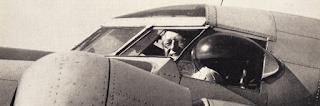
Cotton at the controls
G-AFTL in particular was cleverly modified, James Bond-style, (Cotton and Fleming were friends, naturally) to conceal a suite of cameras behind sliding panels, in the underbelly and the leading edge of a wing root.  On spurious commercial pretexts, Cotton and his merry men flew an impressive series of flights across a range of target areas, most significantly across Germany - sometimes even with German passengers aboard.  One of their sorties was the first operational recce mission of the war - actually, just hours before war was declared - over the German fleet at Wilhelmshaven, bringing back vital photos. 

The war having been declared, the RAF formally took over responsibility for air recce, using its carefully trained fleet of Blenheim light bombers, of which more later.  However, Cotton's "civilian" crews still had an important role.  Belgium, the Netherlands, Denmark, Ireland and Italy were all neutral at the start of the war, but of potential value to the Germans in one way or another.  So up-to-date aerial recce was urgently needed, to map them out accurately and from a military perspective.  The Lockheeds, again on spurious "civil" journeys, were ideal for the task.  They only became redundant in this role when Germany moved against the Low Countries and then France itself late in the spring.

It will be great to have G-AFTL back in blighty again.  Its new owners are being very coy about who, when and where - so, watch this space.

*   *   *   *   *   *   *

So much for the Lockheeds: what of Cotton?  He was lobbying for a revolutionary idea.  First, some perspective.  The original use of aviation in WW1, right from the very first days in 1914, had been for reconnaissance.  The second use was for shooting down the enemy's recce aircraft!  Hence, the received wisdom was that recce results (at first, visual; later, photographic) had to be fought for.  So the RAF's plans before WW2 revolved around a relatively fast armed aircraft - the Blenheim light bomber, operated by Bomber Command, which upon its initial introduction was faster than any biplane then in service with the RAF.  From the very first week of WW2 they started flying Blenheims for recce against German targets, in ones, twos, threes, even in fives and sixes.

Bravely flown as they were, they were shot down in alarming numbers and, sadly, brought back precious few photographs (albeit occasionally of very good quality).   By 1939-40 the Blenheim was no longer up against slower biplanes; and the training of its crews and the cameras it carried were only geared to what would now be regarded as low-level photography.  They were sitting ducks.  Notwithstanding Bomber Command's legendary willingness to take casualties (and this was even before Bomber Harris took over), the Air Ministry at the top was less sanguine.  These casualties "were not to be borne".

They had before them an alternative concept, being pitched by Cotton and others.  Precisely whose original idea it was is open to debate (there are at least 3 main candidates) but the proposal was clear enough.  Instead of fighting for your photos, send an ultra-fast aircraft, at high altitude, with cameras of much longer focal length - and obtain your pictures unopposed.  Bomber Command strongly resisted this idea but, greatly assisted by the secrecy of Cotton's outfit (still officially reporting to MI6), work rapidly started on putting the concept into practice on a very small scale: one aircraft, to be precise.

Of the technical desiderata, the ideal cameras were not at first available; but urgent development work was put in hand to acquire what was needed.  Meantime, there was a really obvious candidate for the aircraft - a Spitfire.  (Needless to say, Fighter Command initially declined to hand one over, but they were outranked.)  Cotton stripped out the armament, ballast and armour, sanded the machine down, painted it blue, made various other clever tweaks to the airframe and engine, added more fuel tankage - and fitted cameras.  The result was something that flew faster and higher than a Spitfire had done before and, most importantly, was comfortably able to outclimb and outrun Me109s.  It was the first of several marks of recce Spitfire, getting progressively more advanced in every dimension as the months went past, that were operational before the fall of France.

Their success rate, both in terms of the photos they acquired and their survival rate, was vastly superior to that of the brave Blenheims, as was immediately obvious to all.  It should have been no contest; but Bomber Command mulishly and indeed deviously resisted the inevitable for many months of intra-service wrangling to come.  They were, however, basically bypassed** with the formation of a well-equipped "strategical reconnaissance" organisation at RAF Benson near Oxford, squarely based on Spitfires (and later Mosquitos, and later still with US personnel and assets).  This was complemented with a new science/art of "photographic interpretation", centred at Medmenham down the road on the Thames - as much advanced from WW1 photo analysis as was the recce itself, and developed just as rapidly; initially by maverick civilians who were the strong-willed equivalents of Cotton in their own sphere. 

The exploits and achievements of this entirely new strategic organisation had no parallel in Germany, and rival Bletchley Park for their importance in WW2.  Stories galore for another day.    

To start with, all this was under the highly resourceful and decidedly unconventional command of Cotton, now an RAF Wing Commander.  During its pioneering development phase, everyone recognised it couldn't be any other way: cameth the hour, and so cameth the man.  And the achievements of his revolutionary endeavour were extraordinary, in a very short space of time.  However, he was putting noses seriously out of joint, up and down the land and over in France.  The final straw came - and Cotton went - after he accepted money from French industrialists to spirit them out of Paris in RAF aircraft just before Hitler arrived.  That was Sidney Cotton for you.  Definitely a player.

Come home soon, G-AFTL ...

ND

_______________

** Such is the bizarre nature of service politics that Bomber Command was allowed to carry on using its own costly recce in parallel to the new purpose-built strategic setup for more than a year.  One of the Command's motives was to ensure that only its own people carried out Bomb Damage Assessment - they were determined to mark their own homework.  Eventually they were called up on this too, much to their disgust - as it was proved conclusively that their bombing was not even remotely as accurate as they claimed.  Though his Command's relations with Medmenham were often strained, to his credit Bomber Harris personally came to value its accurate output.

Friday, 7 January 2022

Holland's energy commitment for the new year - a practical guide for UK energy policy


"The pessimist complains about the wind; the optimist expects it to change; the realist adjusts the sails." William Arthur Ward

The huge natural gas reserves in Holland have meant that the country has been a petro-state for a while, just a very quiet one. There is a reason here as to why it is such an agreeable country, even if my personal business experience of dealing with the Dutch is they are as tough as nails when it comes to negotiating. 

However, as with all of Europe, they have been prone to green-virtue signalling about their energy for a long time. Given the pre-disposition for windmills, you would expect nothing less. However, as is typical across Europe, a lot has been spoken about but not much done. Since 2015 they have though moved electricity generation from green power from 5% to 15% of the Dutch grid. Oh well, I am sure the climate will be thankful for this. 

All the rest is gas, all 85%. 

So of course the recent shift in gas prices has a strange dynamic in Holland, on the one hand the huge Groningen field can still produce a huge amount of taxable profits, on the other the citizens re very exposed to the huge prices increases. 

So, making a sane decision for once, the Dutch have decided to double the output of Groningen field this year, making Exxon and Shell very happy. This will actually wind down the field, maybe even causing a few earthquakes. No matter, desperate times (and profitable ones) and desperate measures. The domestic supply will be sated, profits made and, err, problems kicked into the future if the Russians continue to ignore their customer base. 

Meanwhile, in the UK, we still have politicians wittering on about the need to go green at all costs. The Liberal Democrats are actually suggesting windfall tax on Oil and Gas businesses now, to help the consumers - just as they need funds to open up capacity. The Scots have already cancelled the huge Cambo filed development off Shetland, incredible; the Tories are considering subsidizing the retail energy sellers to help them hedge the market - not thinking at all about supply or the further downside risks of hedging in a volatile market. 

The solutions to the crisis are actually within our grasp, but the politicians we are led by will suggest anything but the obvious and practical solutions. The UK should still be an energy exporter with certainly no domestic shock - indeed, it should be windfall times with our gas reserves. It is totally stunning how stupid and badly advised they are collectively. 

"Oh, what a tangled web we weave, when first we practice to deceive!" (Sir Walter Scott, 1808)


Monday, 3 January 2022

Predictions game 2022

 So for this year, more free form for the predictions game.

The four topics for consideration are UK Politics, Global Politics, Macro Economics and Covid.

Make a prediction for the development of each of these, plus one bonus as a tie breaker.

Get started in the comments!

For me, in UK politics Boris will survive the year somehow, in global politics Russia will not invade Ukraine directly but engineer a civil war of some sort and perhaps then take a police action. In macro economics inflation will fade in some products as goods and trade recover, but remain high as energy costs drive it like the oil crisis of the 1970’s. Covid will be with us, Omicron signalling the end for a nice spring and summer but the autumn will see a new variant. As my bonus, Northern Ireland will cause huge Brexit issues and a desperate Boris will invoke Article 16 as a way to try to drag both the EU and the US into a new round of negotiations.