Saturday, 8 January 2022

Weekend: Homecoming of a WW2 Pirate's Ship

A very telling episode in British WW2 history is the remarkable story of Sidney Cotton and his associates.  If you don't already know it, a very brief summary appears below.  

Anyhow, the aircraft in which Cotton flew some of his most daring MI6-sponsored missions, a Lockheed 12A, eventually wound up in the USA and has recently been up for sale.

I have it on good authority (and you heard it here first, for sure) that it has been bought by an unnamed British interest and is being readied for return to the UK, restored to its original British aircraft registration G-AFTL.  For WW2 air buffs, if and when it happens, this truly will be a red-letter day.

*   *   *   *   *   *   *

It is often said that when war breaks out, initially it is in the hands of the Gentlemen; but that things will only get properly underway when the Players take over.  If ever a man epitomised this, it was Sidney Cotton.  At the same time, consummate players like Cotton are often, how shall we put it, not always wholly reliable when it comes to things like, errr, facts.  Many of the accounts you'll readily find about Cotton are based on self-serving, highly embellished claims by the man himself and shouldn't be depended upon as regards details.  In particular, he was prone to laying claims to the deeds of others.  But the truth is more than exciting enough and, in very brief outline, goes as follows.

Cotton, an Australian, served with distinction in the Royal Naval Air Service in WW1.  In between combat missions he designed the 'SidCot' flying suit which protected pilots against the cold, wet and flying oil they encountered in the cockpit, a design which remained in production until the 1950s  Along with many early aviators he saw limitless opportunities in using aircraft for novel purposes, and was involved in many buccaneering commercial enterprises around the globe in the inter-war years.  Biggles had nothing on this man.

In the year or so before the outbreak of WW2 the RAF realised it needed to get back into the business of purposeful aerial reconnaissance, an activity and skill that for several reasons had effectively lapsed between the wars.  It commenced an extensive programme of quiet recce, mainly of Italian positions across the Mediterranean and North Africa, using regular RAF resources (mostly flying boats).  But by 1938-9, flying badged military aircraft missions against Germany itself, both for ourselves and the French, was not on.  So, sponsored by MI6 and its French opposite number the Deuxième Bureau, the word went out: can we find a civilian who'll be able to do it on a clandestine basis?  Cotton was "known to the authorities", eminently qualified, and only too happy to oblige.  With secret Anglo-French funding he acquired a couple of high-tech, all-metal Lockheeds and a smaller Beechcraft, along with a daring young co-pilot and a base at Heston.

Cotton at the controls
G-AFTL in particular was cleverly modified, James Bond-style, (Cotton and Fleming were friends, naturally) to conceal a suite of cameras behind sliding panels, in the underbelly and the leading edge of a wing root.  On spurious commercial pretexts, Cotton and his merry men flew an impressive series of flights across a range of target areas, most significantly across Germany - sometimes even with German passengers aboard.  One of their sorties was the first operational recce mission of the war - actually, just hours before war was declared - over the German fleet at Wilhelmshaven, bringing back vital photos. 

The war having been declared, the RAF formally took over responsibility for air recce, using its carefully trained fleet of Blenheim light bombers, of which more later.  However, Cotton's "civilian" crews still had an important role.  Belgium, the Netherlands, Denmark, Ireland and Italy were all neutral at the start of the war, but of potential value to the Germans in one way or another.  So up-to-date aerial recce was urgently needed, to map them out accurately and from a military perspective.  The Lockheeds, again on spurious "civil" journeys, were ideal for the task.  They only became redundant in this role when Germany moved against the Low Countries and then France itself late in the spring.

It will be great to have G-AFTL back in blighty again.  Its new owners are being very coy about who, when and where - so, watch this space.

*   *   *   *   *   *   *

So much for the Lockheeds: what of Cotton?  He was lobbying for a revolutionary idea.  First, some perspective.  The original use of aviation in WW1, right from the very first days in 1914, had been for reconnaissance.  The second use was for shooting down the enemy's recce aircraft!  Hence, the received wisdom was that recce results (at first, visual; later, photographic) had to be fought for.  So the RAF's plans before WW2 revolved around a relatively fast armed aircraft - the Blenheim light bomber, operated by Bomber Command, which upon its initial introduction was faster than any biplane then in service with the RAF.  From the very first week of WW2 they started flying Blenheims for recce against German targets, in ones, twos, threes, even in fives and sixes.

Bravely flown as they were, they were shot down in alarming numbers and, sadly, brought back precious few photographs (albeit occasionally of very good quality).   By 1939-40 the Blenheim was no longer up against slower biplanes; and the training of its crews and the cameras it carried were only geared to what would now be regarded as low-level photography.  They were sitting ducks.  Notwithstanding Bomber Command's legendary willingness to take casualties (and this was even before Bomber Harris took over), the Air Ministry at the top was less sanguine.  These casualties "were not to be borne".

They had before them an alternative concept, being pitched by Cotton and others.  Precisely whose original idea it was is open to debate (there are at least 3 main candidates) but the proposal was clear enough.  Instead of fighting for your photos, send an ultra-fast aircraft, at high altitude, with cameras of much longer focal length - and obtain your pictures unopposed.  Bomber Command strongly resisted this idea but, greatly assisted by the secrecy of Cotton's outfit (still officially reporting to MI6), work rapidly started on putting the concept into practice on a very small scale: one aircraft, to be precise.

Of the technical desiderata, the ideal cameras were not at first available; but urgent development work was put in hand to acquire what was needed.  Meantime, there was a really obvious candidate for the aircraft - a Spitfire.  (Needless to say, Fighter Command initially declined to hand one over, but they were outranked.)  Cotton stripped out the armament, ballast and armour, sanded the machine down, painted it blue, made various other clever tweaks to the airframe and engine, added more fuel tankage - and fitted cameras.  The result was something that flew faster and higher than a Spitfire had done before and, most importantly, was comfortably able to outclimb and outrun Me109s.  It was the first of several marks of recce Spitfire, getting progressively more advanced in every dimension as the months went past, that were operational before the fall of France.

Their success rate, both in terms of the photos they acquired and their survival rate, was vastly superior to that of the brave Blenheims, as was immediately obvious to all.  It should have been no contest; but Bomber Command mulishly and indeed deviously resisted the inevitable for many months of intra-service wrangling to come.  They were, however, basically bypassed** with the formation of a well-equipped "strategical reconnaissance" organisation at RAF Benson near Oxford, squarely based on Spitfires (and later Mosquitos, and later still with US personnel and assets).  This was complemented with a new science/art of "photographic interpretation", centred at Medmenham down the road on the Thames - as much advanced from WW1 photo analysis as was the recce itself, and developed just as rapidly; initially by maverick civilians who were the strong-willed equivalents of Cotton in their own sphere. 

The exploits and achievements of this entirely new strategic organisation had no parallel in Germany, and rival Bletchley Park for their importance in WW2.  Stories galore for another day.    

To start with, all this was under the highly resourceful and decidedly unconventional command of Cotton, now an RAF Wing Commander.  During its pioneering development phase, everyone recognised it couldn't be any other way: cameth the hour, and so cameth the man.  And the achievements of his revolutionary endeavour were extraordinary, in a very short space of time.  However, he was putting noses seriously out of joint, up and down the land and over in France.  The final straw came - and Cotton went - after he accepted money from French industrialists to spirit them out of Paris in RAF aircraft just before Hitler arrived.  That was Sidney Cotton for you.  Definitely a player.

Come home soon, G-AFTL ...

ND

_______________

** Such is the bizarre nature of service politics that Bomber Command was allowed to carry on using its own costly recce in parallel to the new purpose-built strategic setup for more than a year.  One of the Command's motives was to ensure that only its own people carried out Bomb Damage Assessment - they were determined to mark their own homework.  Eventually they were called up on this too, much to their disgust - as it was proved conclusively that their bombing was not even remotely as accurate as they claimed.  Though his Command's relations with Medmenham were often strained, to his credit Bomber Harris personally came to value its accurate output.

Friday, 7 January 2022

Holland's energy commitment for the new year - a practical guide for UK energy policy


"The pessimist complains about the wind; the optimist expects it to change; the realist adjusts the sails." William Arthur Ward

The huge natural gas reserves in Holland have meant that the country has been a petro-state for a while, just a very quiet one. There is a reason here as to why it is such an agreeable country, even if my personal business experience of dealing with the Dutch is they are as tough as nails when it comes to negotiating. 

However, as with all of Europe, they have been prone to green-virtue signalling about their energy for a long time. Given the pre-disposition for windmills, you would expect nothing less. However, as is typical across Europe, a lot has been spoken about but not much done. Since 2015 they have though moved electricity generation from green power from 5% to 15% of the Dutch grid. Oh well, I am sure the climate will be thankful for this. 

All the rest is gas, all 85%. 

So of course the recent shift in gas prices has a strange dynamic in Holland, on the one hand the huge Groningen field can still produce a huge amount of taxable profits, on the other the citizens re very exposed to the huge prices increases. 

So, making a sane decision for once, the Dutch have decided to double the output of Groningen field this year, making Exxon and Shell very happy. This will actually wind down the field, maybe even causing a few earthquakes. No matter, desperate times (and profitable ones) and desperate measures. The domestic supply will be sated, profits made and, err, problems kicked into the future if the Russians continue to ignore their customer base. 

Meanwhile, in the UK, we still have politicians wittering on about the need to go green at all costs. The Liberal Democrats are actually suggesting windfall tax on Oil and Gas businesses now, to help the consumers - just as they need funds to open up capacity. The Scots have already cancelled the huge Cambo filed development off Shetland, incredible; the Tories are considering subsidizing the retail energy sellers to help them hedge the market - not thinking at all about supply or the further downside risks of hedging in a volatile market. 

The solutions to the crisis are actually within our grasp, but the politicians we are led by will suggest anything but the obvious and practical solutions. The UK should still be an energy exporter with certainly no domestic shock - indeed, it should be windfall times with our gas reserves. It is totally stunning how stupid and badly advised they are collectively. 

"Oh, what a tangled web we weave, when first we practice to deceive!" (Sir Walter Scott, 1808)


Monday, 3 January 2022

Predictions game 2022

 So for this year, more free form for the predictions game.

The four topics for consideration are UK Politics, Global Politics, Macro Economics and Covid.

Make a prediction for the development of each of these, plus one bonus as a tie breaker.

Get started in the comments!

For me, in UK politics Boris will survive the year somehow, in global politics Russia will not invade Ukraine directly but engineer a civil war of some sort and perhaps then take a police action. In macro economics inflation will fade in some products as goods and trade recover, but remain high as energy costs drive it like the oil crisis of the 1970’s. Covid will be with us, Omicron signalling the end for a nice spring and summer but the autumn will see a new variant. As my bonus, Northern Ireland will cause huge Brexit issues and a desperate Boris will invoke Article 16 as a way to try to drag both the EU and the US into a new round of negotiations. 

Friday, 31 December 2021

How did 2021 Predictions go and our annual winner

The questions were; the price of  Tesla, the price of Bitcoin, would Biden still be President, when will the Tier system use end and the FTSE price.

Quite finance focused but let's see what the real-world results are...


FTSE: ending at around 7400 - up from 6500 at the end of last year, so a decent recovery back to levels of, err, 20 years ago. 

Tesla  - up from 700 to 1090 - wow. a mere 50% gain. 

Biden is still President. 

The Tier system ended in June.

Bitcoin has gone from $30,000 odd to $50,000 odd. 

So if we had all bet our money quite simply we should have made a bundle. Sadly, I was contrarian and as usual missed all of this!


THE WINNER IS:


Electro Kev:


FTSE 7500 (just following the crowd here, really)

TESLA £733.25 (because that's $1000 at present exchange rates and TESLA is technically diverse and trades on myth and legend status.)

Tiers end - 2022, Spring. (They're using the Spanish Flu handbook.)

President USA - Harris (a few senior moments will see to that. He should avoid wearing white trousers in public)

Bitcoin - £32,000 (I just looked at the trajectory on a graph and I think major investors will hold out - also drug dealers are the only people travelling on public transport and are making a killing in this crisis... the stench of cannabis is everywhere.)


A very good effort there from Kev. Most entries were very out on Bitcoin - Kev nailed it. He also nailed Tesla and was only two percent out on the FTSE. 


This must be the best ever performance in the 15 years of the competition!


Thursday, 30 December 2021

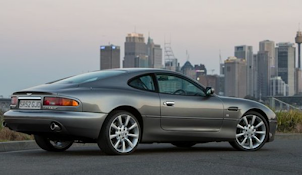
Aston Martin DB7 - best car design evaahhh

The one and only; the original
The other day I happened upon a Kia 'Stinger', of all ridiculous things, and for the 294th time I found myself saying: no prizes for guessing where they got that design ...

Yes, it is the greatest car style ever designed, the Aston Martin DB7.  Which itself didn't just come from nowhere, of course: the marque evolved organically, and by the time of the DB3 the pattern was well and truly formed.  After the DB6, Aston Martin took a wrong turn (in business terms as well as styling) with the DBS, an Italianised parody of a design, albeit very much of its time.  

But with the DB7 which followed a longish while later, they'd perfected the art.  And every single vehicle designer in every car manufacturer ever since has self-evidently had it in the back of their minds at all times.  Sometimes, when the boss has just rejected their nth drawing-board effort for the new model, there's only one way to satisfy demand.  Audi, BMW, Ford, Jaguar, Kia, Mercedes, Toyota, (you can add to the list for yourselves**) ... they've all harked back to the immaculate tapering rear hatch, the lithe haunches, and even - Ford, this especially means You - the grill and front lamps.  (On a Fiesta, FFS!)  It's shameless, it's unimaginative, and it's Not Clever.

Actually, though, it probably is quite clever.  It is, after all, the design everyone really wants on their front drive, whether subconsciously or not.     

Just briefly, a few decades ago, Mercedes had pulled off something similar with its deceptively simple 3-flat-box design, which Ford and Toyota and even Audi raced to emulate.  But that's about as far as it went.   

Essence of DB7.  That's what every car manufacturer wants sprinkled on its products.  Just like they spray that leather smell inside.  Gotta have it.

ND

** and Bentley, and Lexus, and Maserati, and Tesla ...

Monday, 27 December 2021

Energy Supply Carnage: Last Man Standing?

A very traditional business strategy, in sectors where for some reason corporate survival is by no means assured, is "last man standing". Just hang on while competitors go under or vacate the field, in the hope of cleaning up when there's nobody else left and the benefits of monopoly can be reaped.  Well, for a few years at least - until the competition authorities eventually forget how worried they once were.

The UK energy residential supply sector has offered the prospect of this for many years.  The comfortable days of the 'Big 6' - when the barriers to entry were so high that new entrants rarely stayed the course - were always likely to be under threat at some point, with chaotic fallout.  So what were those barriers?  

  • Competence: gas may be a relatively easy business to participate in, but electricity is fiendishly difficult, in several dimensions, as many an apparently competent energy player has found to their cost (Shell, BP, Total, Statoil, Conoco, ...)
  • Branding & trust (a.k.a. inertia): people were fairly well accustomed to, and comfortable with, buying from "the electricity board" (not realising the concept was otiose from the mid 90's, with the restructuring of the industry and the separation of the supply side from "the wires") 
  • Low margins:  the business might have been comfortable for long-term incumbents, but fortunes were not readily made - indeed, once the market settled down after the initial upheavals of sector restructuring, there was always at least one of the Big 6 thinking seriously about jacking it in
  • Capital adequacy:  at very least, in order to be able to hedge the commodity price risk (a very necessary requirement in circumstances of volatile wholesale prices), a basic minimum credit standing is required
This all speaks to energy supply being the preserve of relatively large, competent, well-financed companies.  Was a market of "only" six suppliers necessarily non-competitive?  There are many other sectors where six, competing properly, would be considered pretty good.  To be fair, it can be argued that the Big 6 'competed' in a rather nominal fashion, and did little actively to shake up the significant degree of customer inertia: but the acid test - the trajectory of prices for end-consumers - was broadly favourable, and had been ever since the market opened up.

The picture began to change about a decade ago when a number of aspects came together to facilitate participation by players with quite different business models.

  • government and regulators were very keen indeed on seeing new entrants, and proved willing to ignore the kind of arrant dross that was applying for supply licences (interspersed with a handful of genuine and properly-financed innovators).
  • for the same "reason" (presumably), Ofgem simply hasn't enforced its own rules on smaller players, e.g. the requirement to provide a telephone call-centre service to customers. 
  • one of the major barriers to entry - the need for complex systems (again, particularly for the electricity side) ceased to be an issue with the advent of decent-quality off-the-peg supplier software packages at reasonable prices. 
  • wholesale prices: they started on a multi-year trend of slowly falling.  This facilitates the "Northern Rock" trick: sell long (e.g. one-year contracts at fixed price), buy short (on the spot market, where because of the falling price-trend, it'll be cheaper than when you made the sale).  Buying spot requires minimal credit; which is, errrr, handy for companies that have almost none...
  • the "flipping" model: price comparison firms that offered to switch customers "automatically" (i.e. passively, on the customer's part) onto the cheapest available tariff.  A supplier with next-to-zero marketing capabilty could thereby "buy" as much market share as it wanted, simply by pitching its prices accordingly.
  • some of the social-policy costs levied on suppliers only apply to the larger players.
This helps explain how an inadequate company might be able to get into the energy supply game.  But why would they want to?  There is no single motive, but alongside some perfectly creditable intentions, others of them are very bad.

  • genuine, albeit speculative profitability of the "Northern Rock" model - for just as long as wholesale prices continue to fall AND the supplier isn't going to the trouble and expense of hedging against the possibility of rising prices (not least, because it doesn't have the credit standing to do so! - see above).
  • positive cashflow: notwithstanding various unavoidable start-up costs and system overheads, with a customer base once established the supplier is able to get ahead of supply-cost outgoings via (a) direct debit charges and "estimate"-based payments, i.e. borrowing its customers money; and (b) collecting, as it is required to do, ever-increasing "green" levies, which do not need forwarding to the relevant authorities until several months later (if indeed they are ever paid out at all) - another cheap source of "finance". 
  • ease of syphoning off this cash: small players with no public profile nor recognisable corporate governance can readily and quietly play tricks like borrowing from Related Parties at outrageously high interest rates, "investing" in Related Party ventures, and paying Related Parties for extremely costly "software services" and "consultancy".  How do I know about this stuff?  Because sometimes it's as plain as day in their annual reports!  (That's for the supply firms that aren't so small, they don't have to file full accounts ...)  Where were the authorities in all this?  Evidently, neither Ofgem nor government could give a stuff.    
Until now, of course, when they are dropping like flies.  In the meantime, the Big 6 has ceased to exist!  SSE and National Power have exited: we are left with E.on (German), Scottish Power (Iberdola of Spain), good old Centrica, and of course EDF, probably only still in the game to give it political cover for its UK nuclear machinations.  True, Ovo and Octopus have stepped up to the plate: but then, so had Bulb - until last month ...

At least some of the current survivors will be hedged through to April-ish, when the prevailing energy price cap is scheduled to end (see earlier posts).  Of course, nobody will be making any positive plans whatever until the government has shown its hand on replacing the cap.  If it gets this wrong, chaos ensues, probably followed by de facto nationalisation in some shape or other (like the banks in 2009). 

But there must at least be the chance that Centrica's unwavering 25-year strategy of positioning itself to be the Last Man Standing finally pays off.  And a Happy New Year to all concerned!

ND

Thursday, 23 December 2021

Mr P's bold gamble -but what is it?

Very expensive business keeping 100,000 troops on station and ready to go. Let alone prepare an area with bridging equipment, tanks and all the logistical supplies needed for a war. Sooner or late the treasury will start weeping at these costs and the men will want to go home to see their families. 

Mr Putin has been playing this game for months though, Troops positioned to both expand Crimea to attach to a Greater Russia and conquer the Donbass region with its big cities and heavy industry. More worryingly, the maskirovka is in full swing  - stories of the CIA prepping chemical weapons in Ukraine for example. 

The price would be high though, Ukraine will fight on home territory, they don't much like the Russians and the russian troops - who knows how they will do, many are just conscripts. Russian equipment is both good on paper and poor in performance. 

But the West will not defend Ukraine. Some sanctions yes, severe ones even, but Germany still need Russia's gas. Mr P is currently turning this on an off in a display of his power. How Merkel, so lauded like Obama, has left a gaping strategic wound. 

Can Europe survive without Russian gas? In the short term, no, not without power cuts which will visit the UK too. In the long term yes. Plenty in the tank of Uncle Sam that can be shipped (at a price!) to Europe in a war-footing scenario. Equally though, the yanks might let Europe squirm a bit, having told Germany not to do this for decades, they will be very keen on an 'I told you so' moment. 

For Mr P, the upside is an odd one. yes an expanded Russia but international oblivion for 20 years. Long-term, less dependency on her gas which is the only valuable product they have. Maybe he plans to sell it all to China, who are less concerned about CO2 emissions anyway. 

Maybe it is all an elaborate ruse to get Ukraine to say it will never sign up to Nato and to get Nord-Stream2 approved which will in turn impoverish Ukraine suitably. 

But the troops are there now, the stand-off has a time limit. 

Tuesday, 21 December 2021

The End of Brexit and the return of the Remainers

 Why do I write this you ask? 

Well if you recall the crazy days of 2016 there were 4 very strong Brexiteers. Farage, Boris and Gove with guidance from Cummings. They really led the charge  to the Brexit vote. In more recent times, the brain charged with delivering Brexit has been Lord Frost and he has made his excuses and exited stage left (because of Covid, allegedly). 

Here in 2021, Boris is on the edge, his reputation will never recover from this, even if he limps back up a bit for a while. Farage is a radio host and Cummings sniping from the sidelines, disillusioned by the realities of power. 

Meanwhile, remain leader - Keir Starmer - is happily sitting an waiting for the Covid mess to hand him the keys to No 10. Future Tory leaders like Liz Truss and Rishi Sunak are both europhiles. 

Whilst no one, above all Brussels, will want us back in the EU full time. The machinations will begin to get the UK into the vast majority of EU things, maybe even the army using Ukraine shenanigans as cover. 

Won't it be ironic, that the outcome of the Covid pandemic will be a long-term remainer victory? Even though in reality the jabs, boosters and even-handed approach to the science have overall been very effective from the Government since the early disasters of March 2020. 

Who is there available to the Tories who could credibly lead the post-Boris Brexit faction. The loonies on the right of the party like Andrew Bridgen are only going to make things worse - who is there?

Monday, 20 December 2021

Frost In The Bleak Midwinter

 ... with the usual apologies 


In the bleak mid-winter 
Windy Frost made moan 
“Johnson’s cred is falling, 
Falling like a stone” 
Shropshire North had fallen, 
Polls were running low
 In the bleak midwinter 
Time to go 

How can we persuade him?
“Fall upon your sword!”
You have f*****d up mightily 
Right across the board. 
If you are a wise man, 
(“King of everything!”) 
Drink the hemlock now, man 
Do the decent thing

ND

Thursday, 16 December 2021

Interest rate rise klaxon!

My goodness. 

The denizens of the Bank of England have only gone and done it, raising interest rate by 0.15% today. A harbinger of the doom to come. 

Inflation sits at a mere 5% or thereabouts and surprisingly wages for the year have manager, err, 0% rise. Too much covid and change in the economy to sustain wage rises even though some sectors have done well. 

Still this is almost the first rate rise I can remember! People under 30 won't even really know what the Bank of England does or what the significance of interest rats is - we have been in a zero-interest economy for so many years, nearly a decade and a half now. 

Of course, with Quantitative Easing and inflation, real interests rates are at -5%. Holding cash is very bad for your wealth, much better to spend it or buy assets as quick as you can. 

It is still a long way from going back to a 'normal' economy and I still feel in the end the only way back will be with some very high inflation to erode the debt pile of the West vs East dynamic in the world - and that will be so painful that the politicians might try and put it off for generations yet. 


Tuesday, 14 December 2021

To Whom the (Energy) Spoils? A Genuine Puzzle

There's an interesting dynamic rumbling in the energy sector and associated financial elements, the dialectic of which is as follows:

  1. We can't use fossil fuels in future, oh dear me no.  Perish the thought.  Put my pension into something else.  Let me believe that the ambulance runs on pixie-dust and electricity comes entirely from wind.  Don't allow any more production of North Sea oil & gas.  Make Shell's life hell if it even thinks about such a thing.  I might even start to feel very strongly about all this.
  2. Actual disinvestment starts apace: actual pension funds switch out of fossil fuels by the billion.  For the BPs and Shells, the Centricas and even the EDFs (see below), the cost of capital starts to rise.  They actually sell some of, maybe all of, their hydrocarbon-related assets.  
  3. But in the world outside of all those tightly-shut eyes & heads-in-sand, the ambulance still runs on diesel and electricity is still generated using fossil fuels.  
  4. In fact, the market for fossil fuels right now is pretty tight (see previous post) AND, what with all this wind in the power fleet & other kinds of uncertainty, prices are exceptionally volatile.  They are likely to stay that way, even if in absolute terms they subside from today's level.
  5. Some people are making a Great Deal of Money from this - right now.  And the scope for a great deal more to be made in the coming years is huge: particularly via assets (and managements) that are responsive enough to make hay from all that volatility - e.g. efficient & flexible gas-fired power units.  Even just the continued supply of simple gas to western consumers (whether the green-woke like it or not) has a lot of mileage still in it (at least two decades, I'm guessing).
  6. But the 'traditional players' seem to feel themselves unable to make the usual response to an economic reductio ad absurdum, in terms of investment (long term) and arbitrage (short term) to take advantage of the mispriced assets etc.  
For present purposes, let's put aside the amusing cognitive dissonance that ought to be (though probably isn't) increasingly wreaking havoc with all those who like to mouth "we don't need fossil fuels" but still like to be warm etc etc.  It's the economic & commercial dissonance I'm interested in.

We can easily spot little Volodya Putin and other traditional upstream players making pots of money out of the situation.  They probably hope to make yet more.  China, though essentially an energy importer right now, will probably benefit in relative terms (that is, relative to the West) by being untroubled by 'green' scruples.  All this is easy stuff.  

But what of other business models?  Can 'western' firms somehow thrive in this crazy market?

Exxon:  it's been clear to me for a long time that Exxon, that ailing, blinkered and sluggish beast, is basically hoping it can quietly get on with not changing much at all, and not go down the costly, guilt-stricken route of Shell et al.  But is there anywhere to hide for a US stock-exchange listed firm of Exxon's prominence?  Can any others of its kind, smaller and perhaps less exposed to the limelight, pull off that trick?  

The big commodities players:  there are plenty of these big players - you all know who I mean, but slander is slander - who, if they have any scruples whatsoever, well I've never noticed.  (Ditto their shareholders: well they couldn't, could they?)   Some of these cos are indeed buying up fossil fuel assets: the energy version of money launderers and sanctions-busters.  Are the unscrupulous to be the big western beneficiaries?

A.N.Other Corp: this is where it gets really interesting.  Case study:  EIG Partners - ("Over the past decade, EIG has thoughtfully developed a quiet yet purposeful commitment to integration of ESG factors throughout our business")  - whose website homepage would encourage you to believe they are essentially investors in wind farms and solar.  But lo!  Earlier this year they quietly bought West Burton B, one of the UK's biggest, most modern and efficient gas-fired power plants, from EDF which is busily trying to reposition itself as 100% green.  And what magnificent timing: EIG has already made an absolute ton of money at WBB from the extreme market conditions of the second half of 2021.  

Here's another example: Vitol, who've also bought UK gas assets recently - this time from none other than Drax (who have problems of their own) -  and are likewise minting it this winter.  Here's how they brand this venture ('VPI'):  "We are part of the UK’s pathway to Net Zero, complementing the increase in renewable energy to power homes and businesses. Our portfolio includes hydrogen and carbon capture projects to help lower emissions and develop a future for decarbonised, dispatchable and flexible generation in the UK."  Oh and, errrr, gas-fired power plants.

So: is it all simply about greenwashing?   Maybe you just need the right "communications" firm in tow.  Good old capitalism at work:  assets change hands from those who don't know what to do with them, to those who do.  At distressed prices, if the former are panicky enough ...

Well, maybe.  I think Shell was hoping they could pull this one off, too.  Do we think it's all about shuffling the western-owned assets into less prominent, more media-savvy hands?  Or is it destined to be yet another massive transfer of wealth from the naive & decadent West to the hard-nosed East?   

ND

Monday, 13 December 2021

Energy Crisis: Nobody Seems To Care - Yet

The only time the global energy crisis was front and centre in the UK's dozy media was when there was also a completely coincidental "shortage" (i.e. mass hysteria) at the petrol pumps.  That resolved itself, as it was bound to do: at which point everyone stopped gawping at the levels of international wholesale prices of gas and electricity.

This negligence is of course encouraged by Theresa May's domestic energy price cap, under which most of us will be sheltering as our fixed-price deals roll off, and we can't find anything cheaper.  But of course this time-bomb is set to explode in April.

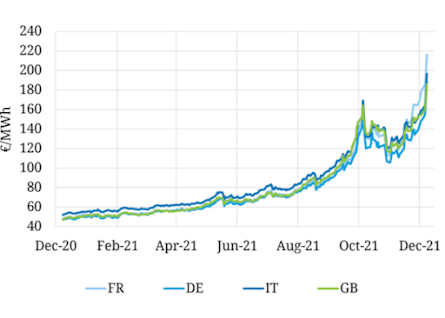
European wholesale 1-year power price for Calendar 2022

Just feast your eyes on this chart; and imagine what's going to happen when this works through to ordinary punters.  I reckon it will be a serious factor in Boris' decision-making on his political future.  Whoever's holding this baby when it goes off will be well-and-truly covered in ordure.   (To mix idioms freely.)

So: when will it get the attention it deserves?

ND 

Friday, 10 December 2021

Friday Post - Fun Tory Time Competition

Who will make the best next Prime Minister? You have to choose a current Tory MP to make it a bit harder.

I start with mine below:

Tom Pursglove. He is the youngest Tory MP but very experienced nonetheless. Rising up from roles as advisor and also from Wellingborough Borough Council, he has already fought and won 3 elections in 2015, 2017 and 2019. As the MP for Corby he is in the heart of the Country and so nicely between the ex-Red Wall seats but far from the Home counties. 

He has been chair of Conservative Youth and has expressed the "right" views on being anti-Europe and also a borderline climate change denier and actively campaigning against more onshore wind farms. A good anti-dote to the green obsessed Boris but still unlikely to undo Brexit. 

Being so young he is also unlikely to die from the ongoing covid pandemic and is not a member of either the Cotswold or Islington sets that have done so much damage to the body politic over the last few years. 


Answers in the comments please.

I'll try to engineer a job as an unpaid Tory spad for the winner.

Thursday, 9 December 2021

Not a very merry Xmas in Downing Street..or the Country

 A new baby, no money, no friends....attacked for a party he did not even go to. 

Boris won't be full of Christmas cheer. 

He has a lot of mouths to feed on his PM salary. Even more now but his happy day is not so much for Boris Johnson. 

I won't be surprised to see him quit in January. He always wanted to be Prime Minister and he has been. Because of Brexit it will always be remembered and Covid would have ruined anyone at the helm, there was just now way to come out of it looking good. Even the Goddess of the Left in New Zealand or Princess Nicola in Scotland have started to come unstuck. 

More worryingly, who will take over. I fear Rishi has not the 'common touch' of Boris. Raab is an idiot who doesn't know where Dover is and Liz Truss is more likely to be another May than a Thatcher. None of us could stand Gove, although  his streetwise and intellectual heft means he is probably the best of the cabinet. 

Luckily for them, they only have to face Sir Kneel of Lockdown and have a stonking majority to defend in any election. 

More widely, in times of Crisis we have typically had more PM's and also in the new media age, I wonder if over-exposure to politicians is reducing their sell-by dates even further. Even Thatcher may have found the endless well of hate emitting from Twitter difficult to live with. 

Monday, 6 December 2021

Life comes at you fast - perhaps we should quickly open the borders now to welcome Omicron?

 The potential was always there. Nature, with its heartless wisdom, always wants success. For a virus, this means more virus. Dead hosts are neither here nor there, what is being looked for is more virus. 

So, all things being equal, less dead hosts and more virus is a better outcome for Nature. 

I noticed one of the comments on the last thread saying there had been no deaths from Omicron - what a terrible scrooge. According to City AM, there are not even any hospitalisations in South Africa. 

So if this turns out to be true, the best thing the world can do is quickly make sure that Omicron out-performs Delta and all other COVID variants. It should mean a kind of global measles-party.

It will be interesting to see how this plays out for Governments if this is the case, for once, our rather rubbish Government tends to be very right about what to do re Covid - after its initially bad response, it has basically been amongst the best. 

Some of our friends in the EU are though haphazard and ineffective and plenty of the world is ruled by the kind of people who just love this for the power trip (see Burma, charging Aung San Suu-Kyi with breaking Covid rules, by waving to a crowd, in order to send her to gaol forever) and will not let it go so easily.

Of course, this is likely wildly optimistic, but medical reality hitting entrenched bureaucracies systems and social media conditioning will be interesting to watch, 

Friday, 3 December 2021

Collapse of Enron: 20th Anniversary

It's the 20th anniversary of the Fall of the House of Enron, folks.  Hard to believe it's been that long.

As this fairly good article touches upon, the influence of Enron on the energy markets (and wider) has always been powerful, such was the enduring solidity of the intellectual and technical innovations it synthesised,  fostered and promulgated.  Energy markets and market participants worldwide are still shaped by the Enron model, even if some don't realise it, and might even resent it.  

Even two decades on, many companies don't manage to operate to the superior level of analytic skill and commercial decision-making that Enron achieved.  It had critical mass of excellence and good practices.  If transplanted through time, intact, into today's markets, the Big E would still clean up.  Provided it could find adequate capitalisation, of course - the failing which ultimately did for it back then.  Cash and credit - the oldest and hardest lesson in the book, however whizzy your other core capabilities.

Unsurprisingly, it was a great place to work & learn.  Enron alumni either went on to other great things, or *ahem* to gaol ...

ND

Wednesday, 1 December 2021

With dumb energy ministers like this ...

Minister says price cap not to blame for supplier failures:   Suppliers which have gone out of business as a result of the recent escalation in gas costs cannot blame the price cap because they should have been adequately hedged, the energy minister has argued. Appearing at the House of Lords Industry and Regulators Committee, Greg Hands said suppliers who were properly prepared have “clearly been in a much better position to ride out the big increases in global gas prices.”

OK, we haven't yet seen the full transcript and maybe Hands said something more nuanced later on.  Maybe ...

Here's the thing, Greg.  

(a) Just hedging volatile wholesale prices alone is hard enough for very small suppliers that have been stupid enough to sell forward at fixed price - which is of course what a very large % of residential gas and electricity customers (the ones that are active in the buying market) expect from their supplier.  

Why?  Because in order for the supplier to fix its own prices in the wholesale markets, effectively entering a forward contract (i.e. a financial derivative), it is getting into two-way credit risk.  Will it still be around to pay up if prices subsequently collapse?  That's the consideration from the point of the other party to the hedging agreement.  Of course, the small supplier should equally be worried about whether that other party itself will still be around to perform, should prices subsequently soar.  But that 'other party' will probably be at least three orders of magnitude bigger than the dodgy little twat-company that is the "small supplier" in Ofgem-regulated Britain: so not an issue the tiddler need worry about in practice.  And on the other side, well, who's going to extend the latter any credit?  So they can't actually afford to hedge much at all.  When they sell at fixed prices, in other words, they are taking a purely speculative punt on what the spot price will be at the time they must make delivery ('Northern Rock syndrome').

(b)  But it gets worse.  Suppliers don't just need to think about fluctuating commodity prices; the government has forced them to provide a price cap.  As eny fule kno, a price cap is essentially a Call Option, in the jargon of financial derivatives; and while (for the provider) hedging a price cap that's out of the money is relatively simple, albeit an advanced technical exercise, the cap that the government forced on suppliers was always fairly close to being at-the-money - a vastly more difficult and sophisticated, costly, dynamic hedging challenge.  (It's deeply in-the-money now! - which of course means wipe-out for the unhedged...)

But we are not talking players who are remotely capable of mastering sophisticated derivatives challenges - we are talking a bunch of opportunistic, under-resourced minnows, some of whom have extremely dodgy business models and that should never have been licensed in the firstplace!

So, Mr Hands, while you may fairly expect the Centricas and EDFs and Eons of this world (and maybe the Ovos and Octopuses ... maybe?) to have their shit together, you should be looking squarely at Ofgem for the rest.   Licensing players with no capital, but then imposing a tight-fitting cap, is a sure recipe for what's happening right now.

ND 

Monday, 29 November 2021

Oh my cri!

 Omicron has done a number on the markets that is for sure. They have bounced a little today, but from sharp falls last week. 

I can't help but think the media is again taking the bad news and running with it. No real time has been spent understanding if this variant is really any worse than Delta or even if it will be able to out compete it - a high bar given Delta was already 6x more catching than Alpha.

It will be a few weeks to see, the Governments across the world are quicker now with restrictions, but it might all blow over very quickly - it is my hunch, so I hope I am right!

Thursday, 25 November 2021

Carbon floor price suggestion from...Germany

 So this is very interesting. 

It shows why COP26 will be successful in the long-term. Other countries in Europe have tried a floor price, but it never worked when heavy industry Germany with its coal power was not playing ball. 

For Germany to get in the game and set a floor, is...err...game-changing. 

It means carbon traders can be sure there will be no big drop and indeed many will now expect the price to go 2x to 3x from here  - nice for trading. 

More widely it shows there is lots of money to be made from the carbon transition - more than say pouring money into arms or oil. Which is why even China and Russia are relatively keen, they can sense there is a lot of industrial kit to sell to Europe and the US - all whilst creaming it on selling coal and gas at massive margins for another 20 years or so. 

Monday, 22 November 2021

Greens and Red-Greens: edging towards violence?

The reputations of the Swampys of this world are for being a bloody nuisance, but essentially peaceful - mostly putting themselves at hazard, in fact.  XR and Insulate are a bit more "above ground", so to speak, but still basically eschewing outright, first-degree violence.  (Death by delayed ambulance is bad enough for victims and their families, but it's at one step removed.)   The occasional window gets put in: and the blocking and slow-walking practised by anti-frackers etc doubtless cost their targets time and money.  Still, the basic thrust of green protest is broadly non-violent.

Many a hardline leftie has long despised these people, on several grounds.  They are predominantly (well OK, almost exclusively) middle class & middle aged (and, errr, white.)  They don't look to lefties for leadership (as obviously they ought).  And they espouse a kind of 'non-agency':  it's all designed to get governments to do things, rather than promoting a classical socialist programme of (e.g.) The Workers doing stuff for themselves, by themselves.  In fact, they seem to eschew effective practical agency as much as they do the rough stuff.

I detect something's changing.  There seems to be a campaign being organised against the French oil co Total for its big new East African Crude Oil Pipeline project; a campaign which intends to use the broadest range of tactics including what can only be described as sabotage, on the grounds that the project will cause Actual Harm (that much over-used word) both locally and globally; and thus, morally, should be stopped by whatever means possible.

The critique of the doctrine of non-violence now being deployed is that, although some greens espouse non-violence for ethical reasons, most adopt it as merely being the best tactic for not pissing-off the average punter, whose support or acquiescence will ultimately be needed.  But (so the new argument goes) to imagine major reforms have ever been achieved historically without violence is "peace-washing"; and climate change is serious enough a threat to demand & justify extreme actions.

We know, on the one hand, how bedsit lefties - while mostly too gentile & idle to lift a finger let alone raise a fist - often drool at the thought of violence perpetrated ... by others.  Marina Hyde's telling observation has been cited here before.  ("You only have to look at the little faces of Jeremy Corbyn and John McDonnell in the photos with Gerry Adams to conclude that they’d have been almost erotically impressed by the whiff of cordite".)  On the other hand, since the perceptive & predictive comment of one of our BTL anons in the wake of the 2011 riots - wait until an officer-class emerges from the tougher strain of unemployed, disaffected graduate-bedsits to take charge of the inchoate looter-plebs - we've been wondering if and when this would materialise.

Well evidently Remain wasn't enough to stir them; nor Corbyn's putative upsurge (though it might have come close around 2017-18).  2019 seemed to have thrown them right out of kilter: even BLM didn't kick off as maybe it might have.

So: watch this simmering space.  If this anti-Total effort develops into something noticeable, what price an anti-Cambo push of more than usual 'vehemence'?  Now that Sturgeon has come down against the development, presumably Police Scotland won't be under any instructions to suppress anti-Cambo organisers.  Could get messy, if Boris sticks to his guns on this one.  To use a phrase ...

ND

Friday, 19 November 2021

Weekend post - what to worry about?

 Which is more important, people going to fancy dress parties in questionable dress 12 years ago?


Or


New random terrorist attacks? 


Or


Russia preparing to invade Ukraine?

Thursday, 18 November 2021

Did Suez End Britain's National Prestige?

Well here's one for History Corner & no mistake.  Did anyone realise Clarissa Eden was still alive?  Until this week, that is, when the grand old lady died, aged 101.

© Imperial War Museum  MH 23509
The 1956 Suez Crisis, which famously "flowed through her drawing room", is always astonishing to contemplate.  The UK and France (the latter closely in cahoots with Israel) mounted, in secret (!), a successful airborne and seaborne invasion by 100,000 men (sic - that's D-Day 1944 scale; and we had a spare armoured division in Libya that didn't get deployed ...), with only a few months preparation, resulting in fighting which on the part of the British and French lasted little more than a day.  Then we packed up and went home, with the whole world against us.  20 (twenty!) squadrons of British bombers were deployed.  Fifteen squadrons of UK carrier-based aircraft!  We royally pissed off the USA (which, however, rapidly swung in behind us when we withdrew, to halt the resulting Sterling crisis), the Commonwealth (who were used to being told what the Mother Country was up to in matters of warfare), and pretty much let Russia off the hook as regards its own concurrent invasion of Hungary.  Back at home, half the country was also greatly displeased: this was no Falklands campaign.  The military, and much of the Foreign Office (which was comprehensively kept in the dark) were extremely irked.  Nasser sailed on, his prestige greatly enhanced.

Hard to envisage, really. 

Of course it's conventional to consider Suez 1956 the precise moment when Britain ceased to be a Great Power.  But the years that followed didn't represent the freefall that was envisaged by Clarissa's husband Anthony Eden, and the roguish, unscrupulous Harold Macmillan (the big winner in domestic political terms, though he was gung-ho for the campaign beforehand).  They both seem to have firmly believed that if they let Nasser get away with nationalising the Suez canal, not only would Soviet-backed Arab nationalist-communism quickly come to dominate the entire Middle East, but Britain would be headed swiftly for the status of a "third-rate power, like the Netherlands".  But no; we remained stubbornly second-rate for many decades thereafter.  Maybe we still are.

One concern that comes through very strongly in the attitudes of the time is the concept of national "prestige", the word I used of Nasser above.  Cultivating prestige, estimating and comparing different countries' prestige, in those explicit terms, was a major preoccupation in them days.  Maybe we ought to worry about it more today: the Chinese obviously do.  (Personally, as a very frequent pre-covid overseas traveller, I generally felt myself the beneficiary of a great deal of residual esteem for Britain.)

I was remined of all this when recently writing an obit for an old soldier of my acquaintance who'd fought in many conflicts and served in many countries from 1944 onwards (though not, as it happens, the Suez 'campaign').  He'd left some invaluable notes by way of a memoir, in which he'd been really keen to stress that in everything he did abroad (which was a lot more than fighting, by the way), he'd worked to enhance Britain's prestige.  It meant a lot to him; and to the Edens, too.  RIP both.

ND 

Monday, 15 November 2021

Back again - quick round-up

Apologies to the readership for the break in transmissions, I was away on an intense business trip all last week. It meant I missed the fun of the end of COP26 - which seems to have been successful in generating the hot air it promised. Also I missed the press get down and dirty on more MP's for their second jobs. 

The second jobs piece is of interest because it will always be skewed, many Tory MP's had real careers and jobs which is a good thing. They then try to carry these on whilst living on lower incomes as MP's - this may or may not be a bad thing, depending on how they are earning their silver. Labour will never suffer the same and most of their current MP's are morons and useless party acolytes. One of the few successful ones is Keir Starmer and the morality police are banging down his door as much as the Tories. They won't be after the deputy Labour leader, who by any estimations is totally unemployable so of course does not have a second job. Labour will always do better here, just as they will see more of their MP's sent to prison for criminal misdemeanours from their stupid and grasping intakes of grifters. 

All of this is pummelling the Government in the polls and quite right too. Labour Budgets, poor political tactics and incompetent leadership - nothing like some large poll leads and some by-election defeats to help concentrate the minds a little onto important matters of state. 

Interestingly though, having travelled in Europe much of the week, it is of note that basically the UK has had the right strategy all along with Covid. So much of the remainer-led criticism has been plain wrong and continues to be. The fully lockdown-enthralled states are not doing any better than us and are gearing up for another heavy wave just as we muddle-through with no restrictions and limited deaths. In politics of course, this is a massive loser being right - because there are plenty of anit-vax idiots and commie-lockdown worshippers to help keep the narrative going of poor Government choices. 

Friday, 12 November 2021

I weaponise my tears ...

Homogenizing performative modalities, and other outrages in the competitive virtue-signalling sphere. Bloody hilarious.


A good weekend to all - 

ND

Monday, 8 November 2021

COP a load of this ...

So that's Week 1 of COP26: can we sum up where things stand?  (BTW, since I'm about to take the whole Glasgow thing at face value, I invite several of our esteemed BTL crew to switch off now, if they've even got beyond clicking past the very headline itself ...)

Actually, summarising has proved very difficult for the meejah - particularly the Graun and their like.  I think we may safely skip "gender" day and "youth" day, if we're taking things seriously.  Obviously with the Big Shots (less HMQ & Xi & Putin) only in town Mon-Tues of last week, it was always going to be the showy announcements up front, followed by the long nights of grinding spade-work in arrears.  Thus, much of the commentary has been "the devil is in the detail" - pretty lame, but basically true.  However, at face value the announcements on coal, methane, deforestation, finance and the like represent genuine steers for business and capital alike.  We still have carbon trading to come.

(By the way, as I've been saying here for 2 years, for business purposes there is Absolutely No Point in saying it's all a waste of time.  As well say in 1941, we really shouldn't have declared war, it's all getting very costly.  Nope: it's quite simply the only game in town.  So, face value it is.) 

The poor old Graun is left floundering, wanting desperately to say both (a) this is really important Last Chance Saloon stuff & deserves our best efforts & goodwill;  but also (b) Boris is a big embarrassment and it's all going badly tits-up.  So easy to snipe; but they have to stay optimistic.

So what are we to make of all these declarations with differing lists of signatories each time?  Pragmatism, I'd say.  Naming and shaming.  Putting China on the spot - and India, and Australia - since they are the big absentees from most of the declarations.  (Nobody, I think, expects anything of Putin anyhow.)  We know that the CPC refuses to acknowledge any higher authority than itself, so they are never going to bind themselves anyway.  

OK, so the CPC will always put continued economic growth ahead of anything (expect Taiwan).   But they do have a range of foreign policy goals in play, which includes building a voting-bloc of developing nations that can reliably be leaned on to stay with China's line on, well, on anything they dictate.  (In return for hard cash, of course.)  The Graun's feeble if lengthy effort to write up Week 1 contains this interesting throwaway line: 

Joe Biden used his final words to take a swipe at China. The Chinese delegation seemed less perturbed, having its own issues with marshalling smaller developing countries, which are concerned that the 1.5C goal is slipping out of reach.

That's the most interesting thing I've seen written down** over the past 10 days.  There's the germ of something big in that.  More popcorn for Week 2, please.

ND

_________________

**And it's by Fiona Harvey, for whom I have low regard   

Friday, 5 November 2021

"The end of the beginning"

 That favourite quote of Churchill, after El Alamein, will be one Boris Johnson knows well. 

After many success and perhaps more mishaps, the latest debacle surrounding Owen Patterson I think will become a defining moment. It comes after weeks of mis-steps. A poor budget, lack of confidence in the face of victory over Covid, a pseudo-war with France, the net zero madness of COP26.

All the events pile up on the ever thinning Tory poll lead. But the ones who really matter when a government has an 80 seat Majority are the MP's. From what I have read, they are very disappointed at the antics of this week. Marched to the top of the hill and down again, all in favour of a man who is almost certainly guilty of that which he is accused. 

The tone in the press is different too, always the right wing press have left him off relatively lightly in the past - notably over covid. Yesterday it would have been easy to decry that Parliament was one of scoundrels with both Patterson and Claudia Webbe as exhibits A and B. However, there is little mention of Webbe. The focus, led by Tory MP leaking, is on Boris and his very poor judgement and actions. 

With Brexit delivered, and despite the remainers never giving up, no real chance of undoing this technically for a long time. It maybe that the Tory minds will turn to who is the leader for the future - beyond Covid and beyond Brexit. I can see how that can be Boris if the level of incompetence continues - of which there is no reason to think it won't. We have written here in the past about how a lack of ideological belief makes Boris unsuited to making the hard decisions and sticking to them. 

It won't be quick, with a huge majority and humming economy (inflation aside) it would be an odd time to toss Boris. But falling behind Labour in the polls, allowing Starmer to lead and have a voice that is listened too, together with the inevitable economic hardship the money-printing is bringing (and the Green taxes now biting ever harder, forever)...the drip will continue. 

No more honeymoon or easy wins for Boris, the mountain has been climbed, the view appreciated and the return journey begun. 

Wednesday, 3 November 2021

COP26 Finance mandate - another free cop out for Finance titans

 If you work in any large organisation in the UK or the West over the last few years, you will be well aware of the cultural capture by left-leaning values that has engulfed CEO's and Human Resources teams. 

Aware that trying to engineer upwards growth for their business all the time is hard work, Chief Exec's have rushed to discover the need to promote diversity and inclusivity and set these cultural targets that are rather easier to achieve - but achieving them allows the same bonus to be earned. 

The new wave of course is climate change and the impact on companies of this. In some ways a big positive, flying junior staff around the world for various not so important meetings has been ended by the pandemic - at no loss the the staff or companies really in the Zoom enabled ear. Lower carbon miles must be a good thing in the round, but this has been a side benefit of the pandemic, not the result of firm action by companies. 

Reducing investments in oil and gas, like tobacco and arms before, has proved easier and also allows for some wiggle room when finding somewhere to blame for poor investor returns. As does overly investing in green energy and infrastructure projects where lower returns can be promised in return for some feelings of moral superiority. 

In fact, many centuries ago the protestant reformation was started by Martin Luther, angry at indulgences sold by the Pope's to absolve people of their misdeeds. The new found obsession with Sustainability seems to have many similarities - look at the rich and famous flying into Glasgow to espouse their morality and direct everyone else's behaviours, much like the Papacy of the Middle Ages. Pontificating in Glasgow has a nice ring to it, eh?

Returning to avarice driven CEO's, the new Net Zero mandate is manana from heaven for them. They will be able to run their large companies with a view to reducing emissions, lets not worry about profits and market share, all very difficult in a competitive market. Instead we can have lots of internal meetings about vision and strategy, employ consultants and come to some obvious conclusions, like abandoning offices and commuting in due course. All the while getting paid the full whack of pay and with ready made excuses for any economic downside "its for the good of the planet."

Their personal jets, houses, jacuzzi's and mistresses jewellery will I predict remain untouched - as much as those of Prince Charles.  Whether the world gets any benefits; maybe, maybe not. 

Monday, 1 November 2021

Good COP, bad COP ... and other awful jokes

I feel the obvious need to pen something about COP but really, there's little point to attempting anything analytic.  The outright contradictions are so many and so stark, it's just rats in a barrel.  If, that is, the rats can actually get to Glasgow with all the transport problems, lack of accommodation, Covid rules, etc etc etc.  As Lil said BTL a few days ago, what can go wrong?

It's all a curious mash-up between virtue-signalling and outright desperation.  The Chinese and Russian no-show (OK, their sherpas will be there but we all get the Big Message) means it'll be null anyhow.  And with the 'leaders' departing after Tuesday of this week, the format is clear: Big Empty Statements up front, followed by days of detailed and ultimately fruitless wrangling.  At least in Paris '15 (COP21) it was the other way around so that (in theory) the 'leaders' could knock heads together at the end and contrive a 'breakthrough' (on paper).

Transitioning, therefore, to a vaguely pertinent business story on the matter of 'leaders' doing 'deals' that must then be transacted by their hapless underlings.  We were a big player in the North Sea (oil & gas) and one day Pete the commercial director convened a small team: an excellent lawyer, a licensing specialist, an analyst and myself (negotiator).  Joe, our fairly dynamic Chairman (American, relatively new in the job, not strong on details) had lunched with his opposite number in another North Sea player (not at all new in the job, ought to have known better) and on their napkins they'd agreed a massive asset swap.  "All we had to do" was draw up the contracts.  So, Pete, what is the deal?  He suppressed all hint of sarcasm and faithfully recounted what had been agreed:  a mishmash of part-shares of producing assets, undeveloped discoveries, exploration acreage both prospective and fallow.

Stunned silence.  It was obvious to everyone in the room that the 'deal' couldn't be done: for one thing, it would breach our licence terms (itself an absolute killer) and for another, we'd need the approval of various joint venture partners, some of whom had pre-emption rights ...   Ladies and gents, we just have to get on with it.

Mercifully, we knew our working-level opposite numbers well, and of course they were in exactly the same bind.  With near 100% good will & cooperation, about two months later we came up with something that satisfied honour: the nearest approximation to the napkin-deal we could jointly muster.  In the meantime, I'd even taken up smoking again.  (To be fair, Joe - there you go, I knew it could be done! - and Pete were deeply appreciative of our efforts.)  

The differences between that set-up and COP are pretty clear.  Yup, a total lack of good will and cooperation!   Not much COP, then (sorry!).  Good luck to those sherpas ...

Your related business stories BTL, if you fancy.

ND

Thursday, 28 October 2021

Too depressing to write about the Budget really

 One of the worst budgets in living memory for me, worse than some of the humdingers during 2008/9.

A Tory Chancellor raising taxes painfully in the face of fast growing inflation, splurging money on the NHS and everything else that the left loves. No attempts at any market reforms to try and make the spending more effective. Just full on into the law of diminishing returns. 

Cutting funding for Defence, even as China threatens Taiwan and the world with hypersonic missiles and the French look to start a new 'scallop' war.

Net Zero and green taxes unquestioned and going up. Not long now until only the rich can fly, airlines will clock on soon to doing away with economy class altogether. 

The press reaction is even worse, pravda-levels of happy compliance because money is being created to be spent on 'good stuff.'

Nothing conservative in it at all. A horrid throwback to Brownian labour budgets. 

And they say they want this guy as Prime Minister?!

Well, the welcome it has now will not last out the spring, with inflation rising and incomes falling the Tories will end up well behind in the polls and deservedly so. If we are to have Labour budgets, may as well have a Labour government whilst the Tories can go back to school to remember what they are supposed to stand for. 


Monday, 25 October 2021

Hardman Rishi - does he have the grit for the job?

It is budget week in the UK and Rishi Sunak can hardly be described as a hardman or dictator. But the challenges facing the UK now are very hard to answer by democratic political targeting. No amount of money can fix the NHS, the concept is not right for modern medicinal costs. The hardest up in society will always want more, the cost of fixing the economy to net zero is incredible. Minor tax rises wont be the answer. 

If Government could look to the long-term there maybe a way forward that involve some very hard choices and some real ones - guns or butter - nuclear power stations or nuclear missiles? The lights going out or more tax breaks for relatively less polluting gas. These don't seem insurmountable even in a democracy, but the way that say Singapore or Dubai are able to take steps forward seems much clearer to making hard choices - there is a ruler and that it that, no pesky polls or the Guardian to assuage. 

Within the ruling Conservative party what is clearly missing now is any political guidance, we are left with post-Blair focus group leadership - what is right is what is popular. The media have undue influence, but worse, the policies of today can be changed tomorrow. Even worse still, the policies of today make no sense for tomorrow but have the votes and popularity today. It is a rum state of affairs, literally. 

Things therefore are a very bad short-term mess and the Chancellor has a dud hand to play with. All the more reason to start taking some serious long-term positions. Look how well George Osbourne did with his 'long-term economic plan', such that it was. When all around are driven mad, some clear sightedness will come in handy - which is why Rishi has to grab the chance that Boris is not capable of and make some hard nosed decisions this week. I am hoping they will be of a capitalist bent and not socialist dreaming.

Friday, 22 October 2021

When Do The Bread Riots Start?

A more than usually speculative post ...

Last week, the price of petrol went up noticeably (~3%), but for me even more significant were increases in the prices of milk at Tesco (5.5%), and - highly symbolic - the brown bread we favour (12.5%). 

Historically, British bread riots were when the price of a loaf went up from, like, 4d to 5d.  So we're halfway to that kind of increase.  In France, received wisdom is that Les Gilets Jaunes kicked off as fuel-price rioters.  There's nothing I can see that will do anything to reverse the current inflationary trend - in fact, quite the opposite.

When does modern British man/woman hit the streets over the cost-of-living?  And - will it be before or after the 'personal' costs of Net Zero Carbon hit home in a really visible way?

I put it that way because this week saw the launch of the fat government document purporting to be its Net Zero Strategy (alongside a distinctly, nay frostily skeptical Treasury document on the same theme).  Ordinarily, as part of our service to readers I undertake to review these things systematically; but this time there's no point.  The main strategy doc is so full of numerical nonsense and indeed internally contradictory numbers, it's an outright embarrassment - are there any Civil Servants left with an ounce of pride? - and can only be taken as something for Boris to wave at COP26.  (He'd have done better to stay with the highly complimentary assessment of the UK in a review from "Climate Transparency"  [one of those proliferating green NGOs] which has us as by far the best performer of the G20 nations - out on our own in a category of one.)  However, one thing is really clear: big costs are on their way.

In one very obvious scenario, COP26 could be a PR disaster.  It took a lot of effort to prevent the same outcome at Paris '21, when host-nation France was putting in 120% diplomatic effort and had a lot of other big nations onside anyway.  Doesn't look particularly auspicious for Boris right now, although Kerry, the EC (if not all euro-nations) and the UN apparatus will be more than a little helpful to his cause.  Crazy promises of cash might be forthcoming to work the trick.  On the other hand, stay-away Xi might put in a dramatic appearance and engineer himself into the position of being 100% pivotal: "either acknowledge me as the saviour of the world, or I pull the plug".  Who could be surprised if COP26 ends in fiasco, with the 'developing' nations stomping out due to their pockets not being adequately lined with gold; then Xi summons the developing world leaders to Beijing for an early Xmas present?

Anyhow, unless Boris engineers a half-triumph for himself, I reckon he's gone before Easter.  Then Rishi can announce the resumption of fracking, etc etc ...  Oh, and deal with those bread riots.  What a good job there's currently no Leader of the Opposition.

Have a great weekend!

ND

Wednesday, 20 October 2021

Evergrande: What Happens Now?

For all their clever CCP-directed, "with-Chinese-characteristics" tweaks to classic western capitalism, somehow they couldn't avoid, errrr, a property bubble.  How demeaning for a communist country!  How ironic.

And how we'd all laugh, were it not for the plethora of predictions that the demise of Evergrande will send out shockwaves across the globe, at a time when we're all a bit fragile.

Really?  Well, perhaps.  I'm no authority on this kind of thing: and in my own sphere I already told you in February that gas prices in the far east were the start of serious energy-price inflation.  But my gut feeling is that if the west could ride the banking crisis of 2007-09, the CCP can engineer a soft landing for Evergrande.  The underlying issue, to my mind, is the impact it has on Chinese politics, both inward- and outward-looking.

On internal politics, I presume a serious property bubble - with the attendant political shame this represents for communists, as alluded to above - strengthens the hands of the socio-economic puritans of the CCP, led by this chap, Wang Huning, (whom I only became aware of recently).  2021 has already seen a striking social-media purge of individualistic content (and social media stars!) that follows hard on the humbling of tall poppies Jack Ma & co.  All this goes by the benign-sounding slogan of "Common Prosperity", but extends to a "clamp-down" on private tutoring (FFS), which must have a major impact down the road.  Does the middle-class man in the street care about Jack Ma?  Not really, I guess.  But his kid's education & perceived life-chances ..?

Then there's the long-awaited Chinese digital currency.  I have absolutely no idea how Evergrande impacts that project - does anyone here? - but it probably does.  Given that it's designed to strip the USD of its strategic role in world finance, it's kinda important for the long run.

It's the "physical" externals, though, that should surely trouble us most directly.  Last year we debated the possibility of "Peak China" having already passed.  The decades of extraordinary Chinese softly-softly patience and (rather successful) attempts to build a kind of soft power to rival that of the USA seem to have come to an end with Xi's assaults, physical and otherwise, on HK, India, the South China Sea etc etc etc.  These suggest that either (a) he doesn't care anymore about staying with the soft stuff; or (b) things weren't moving as fast as he wants.

And what's that?  Taiwan, of course - and in his time in the top slot.  By hook or by full-scale attack.

Old Man in a Hurry can be a comical phenomenon; but it can also be dangerous.  Very dangerous.  We have our own in the shape of Biden.  There's an awful lot that can go wrong here.  I've long suggested that Soviet caution in not invading western Europe when it was at its peak state of military advantage, speaks well for Politburo political maturity at that time.  But equally, they weren't in any kind of hurry - hey, they were real Marxist-Leninists; they thought it was going to fall in their laps eventually anyhow. 

But Xi, like Mao before him, is (mainly) a nationalist.  Evergrande?  Pff - a sideshow.  IMHO.

Thoughts?

ND

Saturday, 16 October 2021

How the Woke Thing Cripples the Left

Some enlightening weekend reading.  We non-lefties are most just annoyed by the woke nonsense, but for the 'honest, traditional' egalitarian Left, it's crippling.  Some extracts here from a great essay that deserves to be read in full (my emphasis, towards the end): 

Here’s a fun tip for you all: if you have the power to get someone fired or otherwise ruin their life you are not a powerless, marginalized Other … a bizarre liberal discursive culture where, if you dress up what you’re doing in vague language about oppression, you can operate however you’d like without rebuke and attempt to ruin the life of whoever you please … 

The left-of-center is in a profoundly strange and deeply unhealthy place. In the span of a decade or less a bizarre form of linguistically-radical but substantively-conservative identity neoliberalism descended from decaying humanities departments in elite universities and infected social media ... through which it conquered the media and entertainment industries, the nonprofit industrial complex, and government entities as wide-ranging as the U.S. Department of Education's Office for Civil Rights and the brass of the Pentagon. That movement now effectively controls the idea-and-story generating power of our society, outside of explicitly conservative media which exists in a large silo but a silo all the same. On any given day the most powerful institutions in the world go to great lengths to mollify the social justice movement, to demonstrate fealty, to avoid its wrath. It’s common now for liberals to deny the influence and power of social justice politics, for inscrutable reasons, but if the current level of control over how people talk publicly is insufficient, I can’t imagine what would placate them… 

because the social justice movement’s first dictate is to establish a hierarchy of suffering, and to tell those that are purported to suffer less that their problems aren’t problems, no such mass movement is coming. The social justice movement is not just incidentally antagonistic to organizing everyone and recognizing all kinds of people as worthy of our compassion and support. That antagonism is existential. When you ask many people within the movement, “what could we do to convert the white working class to our values?,” they will simply tell you that they don’t want to convert them, that they are not worthy of being a part of their movement. They would rather have targets than converts, to lose as an exclusive moral caste than win as a grubby populist coalition. 

Core to understanding this moment is to realize that the vast majority of people who enforce these politics don’t actually believe in them. They don’t, that is, think that social justice politics as currently composed are healthy or just or likely to result in tangible positive change. There’s a core of true-believers who do, and there’s a group of those who profit directly from the hegemony of social justice politics in elite spaces… There’s conservative critics, who are both the most natural targets of social justice ire and yet those the social justice movement seem least interested in targeting. There’s an island of misfit toys of left and leftish critics of social justice politics like me. 

And then there’s the great big mass of people who are just scared … Why wade in those waters when the potential consequences are so severe, and when the upside is so limited? … no one feels empowered to speak truth to bullshit.

ND


Thursday, 14 October 2021

Stagflation - umm, how?

All the comment in the media around the world today is of the coming stagflationary scenario and a return to the 1970's. 

Even at a high level I just don't get it - this is another case of journalists and commentators latching onto something they don't understand and cant be bothered to apply in a few minutes thinking into. 

The key here is the stag piece - inflation is a given as we have a global energy crisis. Longer term this seems to be really quite well under-pinned by a lack of investment in real energy and an over-reliance on renewables fairy stories far ahead of the real supply curve needed. 

This will make Putin and MBS very happy for a long-time to come, even Venezuela might be able to pay some of it bonds and Iraq bribe its way out of civil war. 

Anyhow, the first part of stagflation is a slowing economy. This feels like a very unlikely outcome of a huge bounce back from a lockdown of the world economy due to the pandemic. The idea that there won't be growth does not chime with activity in the UK now, where people are busily spending their enforced savings wherever they can. Town centres are heaving, leisure and retail surging. 

The only thing that would kill this off is a massive stock market crash that hammered sentiment. This is a hard thing to engineer when interest rates are zero-bound and the Fed prints money liberally to feed the system. Admittedly, there will come a time in the next few months when interest rates will have to rise or QE can be cancelled (a longer post on this is overdue) to reduce the impact of inflation. However, real inflation caused by energy price hikes wont really be impacted by higher interest rates - it is not financial inflation after all, but input prices. Lower currency will be a negative too in this scenario. 

However some reckless governments will see this as the easy way out of 150% GDP borrowing, with a few years of high inflation stopping all that painful austerity which instead can be meted out democratically to everybody and blamed on markets and foreigners rather than Government policies. 

So, anyone saying we will see stagflation must really be saying they see a huge market crash coming as the precursor - yet few seem to mention this.

Tuesday, 12 October 2021

The Tory Insurgents March On!

"the push for a mayoral putsch, which has aroused passions amongst those in favour but barely any other reaction at all, seems quite exciting and, well, insurgent. I can easily see it succeeding: probably a low turnout with 80% in favour of a mayor, or something bizarre like that."

Well, that was my prediction ten days ago for the Croydon Mayoral referendum, and lo!   

  • Turnout: 21%
  • In favour: 80.4%
Every single ward voted in favour of switching to the elected-mayoral system, which gives the Left pause for thought: they thought their client minorities (who are in fact the majority in the north of the borough) could be persuaded otherwise.  Now the serious politicking starts, in particular within the People's Party, which having inevitably campaigned for the status quo (hence the original blog post) now have to scramble together a position for May's election.  They are posting tweets asking for forgiveness for things they said in the anti campaign (e.g. it was white middle-class men who wanted to switch to the mayoral system).  I won't bore you with the Toytown minutiae, but there are several amusing aspects:

  • the Croydon North MP Steve Reed (Lab) was prominent in the anti-campaign: but he's Starmer's Shadow SoS for Communities and Local Government and his official policy for the nation as a whole is, ahem, pro elected mayors!
  • he and the rest of his crew campaigned on the slogan "No Fat-Cat Mayor".  The lefties are now attacking, errr, themselves - for "fattist sloganeering" (sic) (!)  You couldn't make it up, and indeed I haven't.
  • the famous local turncoat Andrew Pelling, once Tory MP for Croydon Central, deprived of the whip over allegations of wife beating, whereupon he switched first to run again (unsuccessfully) as an Independent, then as Labour (for whom he now holds a Council seat) ... having campaigned for the anti-mayor cause, now proclaims that this was only because the nasty folks in his new-chosen Party twisted his arm, and of course he's really very keen on elected mayors, particularly ones whose first name is Andrew and second name is Pelling.
And people wonder why Labour languishes in the polls, even in today's dire circumstances.  Well actually, no, they don't.

ND